
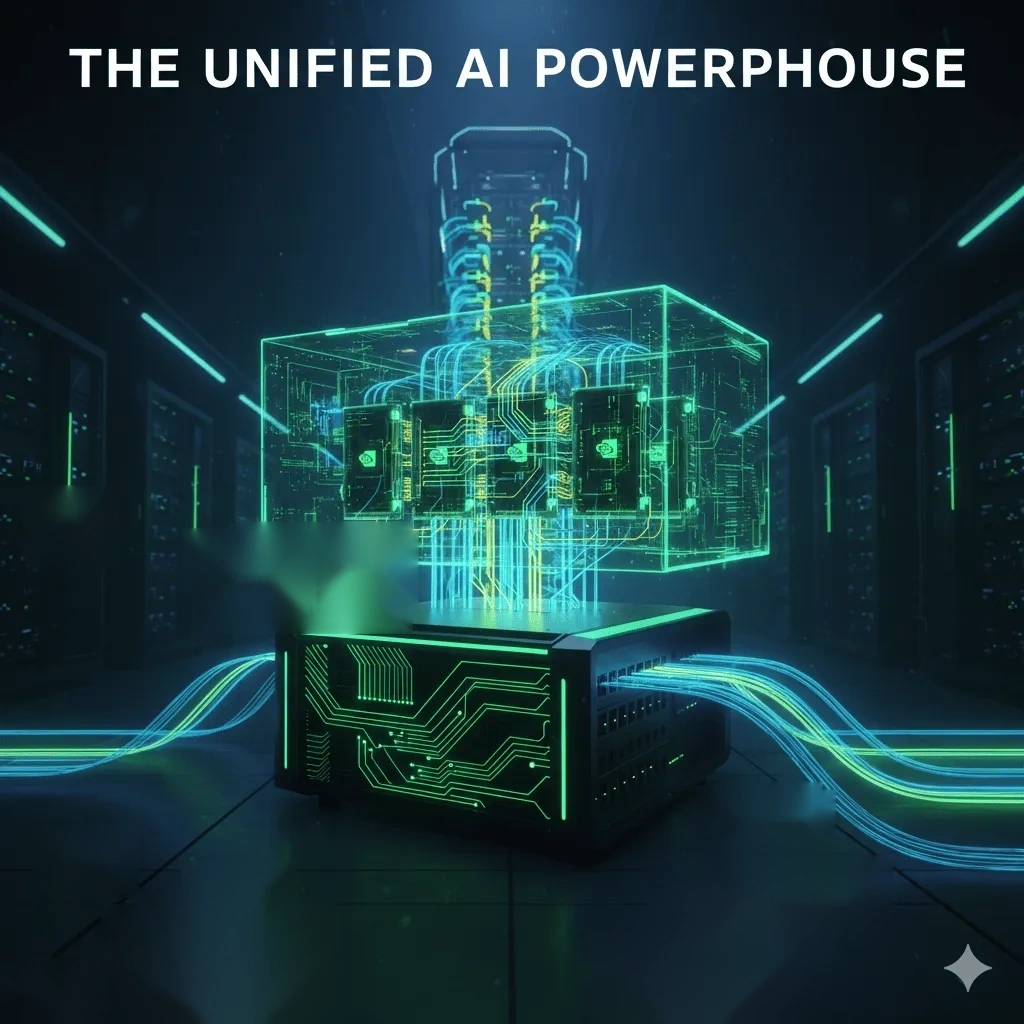
NVIDIA's Blackwell B300 raises the ceiling for what a single accelerator can deliver — but raw GPU throughput is only half the story. At frontier scale, the network that binds thousands of GPUs into one logical machine decides whether that compute is actually usable. This overview walks through the B300's memory and interconnect design and the data-center fabric required to keep it fed.
Key Takeaways
- B300 compute is only as useful as the fabric feeding it.
- Larger HBM lets fewer GPUs host bigger models, cutting communication overhead.
- Plan scale-up (NVLink) and scale-out (InfiniBand/RoCE) as one system, not two.
- Non-blocking, low-latency topology is what protects training throughput.
01Memory and bandwidth: feeding the beast
The B300 generation pairs a large pool of high-bandwidth HBM3e memory with substantially higher memory bandwidth than its predecessors, which matters most for inference on very large language models where the entire model and its KV cache must stay resident. More on-package memory means fewer GPUs are needed to host a given model, reducing both cross-GPU communication and total cost per token.
02NVLink inside the node, fabric between nodes
Within a server, GPUs communicate over NVLink and an NVLink Switch fabric that provides all-to-all bandwidth far beyond what PCIe can offer. Between nodes, the cluster relies on a high-radix InfiniBand or RoCE Ethernet fabric. The defining principle is the same at both levels: keep latency low and bandwidth uniform so collective operations such as all-reduce do not stall the slowest link.
- Scale-up — NVLink domains connect GPUs inside and across a few chassis as one memory space.
- Scale-out — InfiniBand/RoCE spines connect those domains into clusters of thousands.
- Congestion control — adaptive routing and telemetry keep tail latency predictable under load.
03Designing for the workload
Training and inference stress the network differently. Training is bandwidth-hungry and bursty around gradient synchronization; inference is latency-sensitive and steady. A well-designed B300 deployment provisions a non-blocking fabric for training pods while tuning queueing and routing for predictable inference response. Getting the topology, cabling, and congestion strategy right at design time is far cheaper than retrofitting it later.
For organizations standing up Blackwell-class infrastructure, the takeaway is simple: treat the network as a first-class design problem alongside the GPUs themselves. Semifly architects both layers together so the compute you buy is the compute you can actually use.
← Back to Insights