
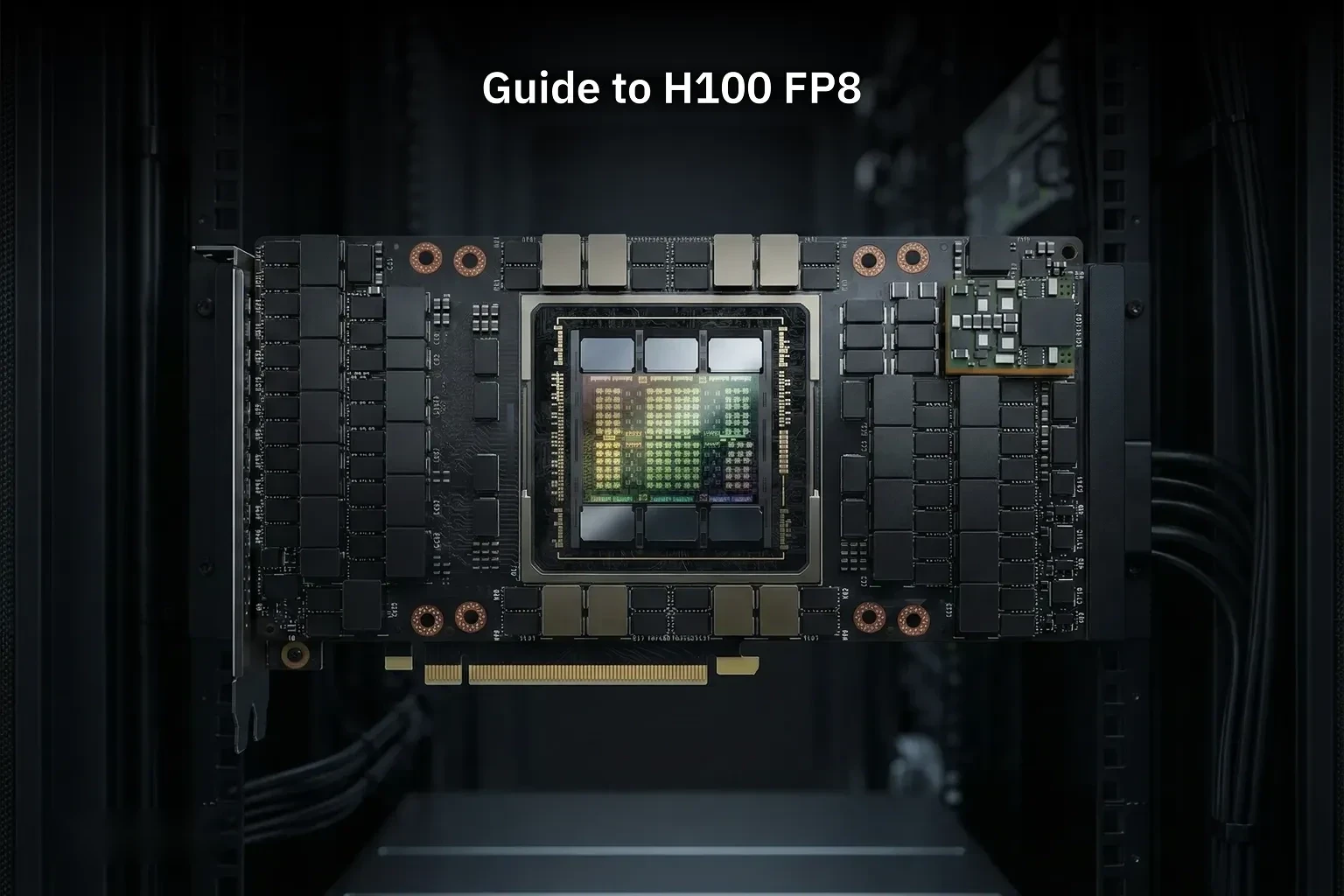
The rapid evolution of artificial intelligence (AI) has brought about exceptional computational demands. From training large language models (LLMs) to real-time inference in critical applications, the need for faster, more efficient hardware has never been greater. At the forefront of this revolution is NVIDIA’s H100 GPU, powered by FP8 precision, a groundbreaking innovation that is transforming the AI landscape. In this comprehensive guide, we’ll explore how H100 FP8 is reshaping AI training and inference, its technical underpinnings, real-world applications, and best practices for implementation.
Here are some statistics that highlight FP8’s Impact:
- FP8 training can reduce memory usage by up to 75% compared to FP16/FP32 mixed precision while maintaining model accuracy.
- The H100’s Transformer Engine combined with FP8 Tensor Cores delivers up to 9x faster AI training and 30x faster AI inference speedups on large language models compared to the A100.
- NVIDIA currently holds an 88% market share in AI chips used for training, with H100 GPU demand exceeding supply by 2-3x in early 2024.
- The H100 with FP8 precision can process up to 31,712 tokens/second for LLM inference compared to 21,806 tokens/second on the A100.
01Understanding Numerical Precision in AI
02A Brief History of Floating-Point Formats
Floating-point formats like FP32 (32-bit precision) have been the standard for AI training for years. However, as models grew larger and more complex, the industry shifted to FP16 (16-bit precision) to reduce memory usage and improve computational efficiency. FP8 (8-bit precision) is the next step in this evolution, offering even greater efficiency while maintaining accuracy.
03Why Precision Matters in Deep Learning
Precision directly impacts the accuracy and stability of AI models. Higher precision formats like FP32 provide more accurate calculations but require significantly more memory and computational power. Reduced precision formats like FP8 strike a balance by enabling faster computations and lower memory usage, making them ideal for large-scale AI workloads.
04The Trade-Off Between Precision and Efficiency
While reduced precision formats like FP8 offer significant performance benefits, they require careful implementation to avoid numerical instability. Techniques like dynamic scaling and precision switching are essential to ensure model accuracy.
05Deep Dive into FP8
FP8 is a reduced-precision floating-point format with two key variants: E4M3 and E5M2. Each variant is designed for specific use cases in AI training and inference.
- E4M3: Features a 4-bit exponent and 3-bit mantissa. It is ideal for weights and activations, offering high precision for most computations.
- E5M2: Features a 5-bit exponent and 2-bit mantissa. It provides a larger dynamic range, making it suitable for gradients and other operations that require higher numerical stability.
06FP8 vs. Other Precision Formats
- FP8 vs. FP16: FP8 offers up to 2x memory savings compared to FP16, with minimal impact on model accuracy.
- FP8 vs. INT8: While INT8 is highly efficient for inference, it lacks the flexibility and precision required for training complex models. FP8 bridges this gap by offering both efficiency and precision.
07H100’s Implementation of FP8
The NVIDIA H100 GPU is a groundbreaking innovation in AI hardware, designed to maximize the benefits of FP8 precision. Its architecture is purpose-built to handle the computational demands of modern AI workloads, particularly large language models (LLMs) and other transformer-based architectures. The H100 achieves this through its Transformer Engine, dynamic precision switching, memory management improvements, and hardware-level optimizations.
08Transformer Engine Architecture
The Transformer Engine is a core component of the H100 GPU, specifically designed to accelerate transformer-based models like GPT-3, BERT, and Llama. The Transformer Engine in the H100 introduces FP8 Tensor Cores, which enable the GPU to perform matrix multiplications and other tensor operations at FP8 precision. This is a significant improvement over the A100, which primarily relied on FP16 and FP32 precision. The Transformer Engine dynamically adjusts precision levels (FP8, FP16, or FP32) based on the specific operation, ensuring a balance between performance and accuracy.
09Dynamic Precision Switching
One of the most innovative features of the H100 is its ability to dynamically switch between precision formats (FP8, FP16, and FP32) during training and inference. This feature ensures that the GPU can adapt to the specific requirements of each computation, maximizing efficiency without sacrificing accuracy.
Tim Dettmers (@Tim_Dettmers), a leading expert in AI hardware, highlights the real-world benefits of FP8 training on the H100: FP8 training works well and has large benefits. It has steep networking requirements to achieve good utilization but there are solutions to that too. At 60% Model FLOPS (FP8) Utilization on H100, original GPT3 configuration can be trained in 3 days on 1024 H100s.
10Memory Management Improvements
Memory management is a critical factor in AI training and inference, especially as models grow larger and datasets become more complex. The H100 introduces several memory management improvements that leverage FP8 precision to optimize resource utilization.
- FP8 precision reduces the memory required for storing weights, activations, and gradients by up to 75% compared to FP16/FP32 mixed precision. This allows the H100 to handle larger models and datasets without running into memory bottlenecks.
- By reducing memory usage, the H100 enables organizations to train models with billions of parameters on a single GPU or a smaller cluster of GPUs. This is particularly beneficial for training large language models like GPT-4 or Llama.
11Hardware-Level Optimizations
The H100 GPU includes several hardware-level optimizations that are specifically designed to maximize the benefits of FP8 precision. These optimizations ensure that the GPU can deliver industry-leading performance for AI training and inference.
- The H100 includes support for NVIDIA NVLink 4.0, which provides high-speed interconnects between GPUs. This is essential for scaling FP8 workloads across multiple GPUs, enabling efficient communication and synchronization.
- The H100 includes hardware-level support for dynamic load balancing, ensuring that all Tensor Cores are utilized efficiently during FP8 operations. This minimizes idle time and maximizes throughput.
12Real-World Examples and Performance Benefits
131. Large Language Model Training & Inference
Large language models (LLMs) like GPT-3, GPT-4, and Llama require immense computational resources for both training and inference. NVIDIA’s H100 GPU, with its FP8 precision and Transformer Engine, has become the go-to solution for organizations scaling their LLM operations.
Meta’s deployment of a 100,000+ H100 GPU supercluster for Llama training demonstrates the power of FP8:
- 2x faster inference speeds compared to previous generations
- 45% reduction in training time for large models
142. Financial Services Industry
The financial services industry relies heavily on real-time data processing and analysis to make split-second decisions. High-frequency trading operations have seen remarkable improvements with H100 FP8:
- Microsecond-level latency for real-time trading decisions
- 35% reduction in processing latency
- 99.9% accuracy in risk assessment models
153. Healthcare and Biomedical Research
The healthcare and biomedical sectors are leveraging the H100 GPU to accelerate research, improve diagnostics, and enable real-time medical applications. FP8 precision has proven to be a game-changer in areas like medical imaging and genomics.
- 65% reduction in 3D medical visualization processing time, enabling real-time diagnostic assistance with 99% accuracy.
- Processing 1 million DNA sequences per hour and achieving 3x faster protein folding simulations.
164. Silicon Valley Tech Companies
Silicon Valley’s tech giants and AI research labs are at the forefront of innovation, and the H100 GPU is playing a pivotal role in their success. From reducing training times to enabling more complex models, the H100 is driving advancements in AI research and development.
- 50% reduction in AI model training time
- Significant energy savings through better efficiency
- Enhanced support for larger and more complex AI models
175. Cloud Service Providers
Cloud service providers are leveraging the H100 GPU to enhance their AI infrastructure, offering customers faster, more scalable solutions for training and deploying AI models.
- 43% increase in throughput
- 25% more efficient resource utilization
- Enhanced scalability for cloud-based AI services
18The Dangers of Mismanaging Floating-Point Precision in AI
Floating-point precision is a critical factor in AI model training and inference. Mismanaging it can lead to significant risks, including:
- Numerical Instability: Using inappropriate precision formats (e.g., FP8 for highly sensitive calculations) can cause gradient underflow or overflow, leading to unstable training and poor convergence.
- Loss of Model Accuracy: Small numerical errors in floating-point precision can compound over millions of iterations during AI model training, leading to significant deviations in model accuracy. For example, using lower precision formats like FP16 without proper scaling can result in up to a 5% drop in accuracy for certain tasks.
- Increased Debugging Complexity: Errors caused by precision mismatches are often subtle and difficult to trace, leading to longer development cycles and higher costs.
- Hardware Underutilization: Failing to optimize floating-point precision for specific hardware, like the H100’s FP8 Tensor Cores, can result in suboptimal performance, wasting computational resources.
- Inconsistent Results Across Deployments: Precision mismatches can cause models to behave differently during training and inference, leading to unpredictable outcomes in production environments.
19Future Implications
The adoption of FP8 precision is expected to accelerate in the coming years, with Gartner predicting that 85% of AI training workloads will utilize reduced precision formats by 2025. As models continue to grow in size and complexity, FP8 will play a critical role in enabling efficient, scalable AI training and inference.
20Conclusion
NVIDIA’s H100 GPU, powered by FP8 precision, represents a significant leap forward in AI computing. By reducing memory usage, accelerating training and inference, and enabling larger models, H100 FP8 is transforming the way organizations approach AI. Whether you’re training large language models, analyzing massive datasets, or deploying real-time AI applications, the H100 with FP8 precision is the key to unlocking new levels of performance and efficiency.
Ready to take your AI initiatives to the next level? Contact semifly to learn more about implementing H100 FP8 in your organization.
← Back to Insights