

The relentless growth of artificial intelligence (AI) and high-performance computing (HPC) demands hardware capable of tackling trillion-parameter models, simulations, and data-intensive tasks. NVIDIA’s H100 GPU, built on its revolutionary Hopper architecture, rises to this challenge with unprecedented computational power, efficiency, and scalability. Central to this capability is TFLOPS (teraflops)—a measure of a processor’s trillion floating-point operations per second. While TFLOPS highlights raw performance for matrix-driven workloads like AI training, real-world impact hinges on synergies with memory bandwidth, specialized cores, and software optimization. The H100’s 67 TFLOPS (FP64) marks a theoretical peak, but its true value emerges in how it accelerates breakthroughs across industries. This blog unpacks the H100’s power—where TFLOPS matters, where it falls short, and why holistic design defines modern computing.
01Understanding TFLOPS: Theory vs. Reality
021.1 Calculating TFLOPS
TFLOPS (teraflops) quantifies a processor’s theoretical peak performance by measuring how many trillion floating-point operations it can execute per second. The formula for calculating TFLOPS is:
TFLOPS=Cores×Clock Speed (GHz)×FLOPS per Cycle/1,000,000,000
For the NVIDIA H100, this translates to:
- Cores: 18,432 CUDA cores (streaming multiprocessors designed for parallel tasks).
- Clock Speed: ~1.8 GHz (base clock).
- FLOPS per Cycle: Depends on precision. For FP64 (double precision), each CUDA core handles 2 FLOPS per cycle.
Plugging in the numbers:
TFLOPS (FP64) =18,432×1.8×21,000≈67TFLOPS (FP64) =1,00018,432×1.8×2 ≈67
This gives the H100 a peak theoretical performance of ~67 TFLOPS for FP64 operations. However, this is a best-case scenario under ideal conditions, assuming no bottlenecks and perfect utilization.
031.2 Real-World Performance Factors
While TFLOPS offers a snapshot of raw compute potential, actual performance hinges on several critical factors:
- Memory Bandwidth Bottlenecks: Even with massive TFLOPS, a GPU can’t perform faster than it can access data. The H100’s 3 TB/s memory bandwidth (via HBM3) is groundbreaking, but demanding workloads like AI training or fluid dynamics simulations often require shuffling terabytes of data. If the compute cores outpace the memory subsystem’s ability to feed them data, performance plateaus. For example, large matrix multiplications in deep learning may hit memory walls if not optimized.
- Thermal and Power Constraints: The H100’s 700W TDP (thermal design power) generates significant heat. Sustained high performance requires robust cooling solutions. In real-world setups, thermal throttling can reduce clock speeds to prevent overheating, lowering effective TFLOPS. Data centers must balance power efficiency with performance, especially at scale.
- Software Optimization: Hardware is only as good as the software driving it. NVIDIA’s CUDA toolkit, libraries like cuBLAS (for linear algebra) and cuDNN (for deep learning), and frameworks like PyTorch or TensorFlow determine how efficiently the H100’s TFLOPS are harnessed. For instance:
-
- Tensor Core Utilization: The H100’s Tensor Cores accelerate mixed-precision workloads (e.g., FP8/FP16 for AI), bypassing FP64 limitations.
- Kernel Optimization: Poorly written code might use only a fraction of available cores, while optimized kernels leverage parallelism.
- Sparsity Support: The H100 can skip redundant calculations (zero values in data), effectively boosting usable TFLOPS.
- Workload-Specific Limitations: Not all operations are purely floating-point. Tasks involving integer math, data movement, or control logic (e.g., conditional branches) don’t benefit equally from TFLOPS. For example, training a transformer model might hit ~80% of peak TFLOPS with perfect optimization, but inference workloads with smaller batches may see lower utilization.In short, TFLOPS is a vital benchmark—but it’s the ecosystem around the GPU (memory, cooling, software, and workload design) that unlocks its true potential.
Applications Leveraging H100’s TFLOPS042.1 Accelerating AI Workloads
The NVIDIA H100’s raw compute power, measured in TFLOPS, is a game-changer for AI development. Its ability to process trillions of operations per second makes it ideal for:
- Training Massive Language Models: Models like GPT-4 or Meta’s Llama 2 require months of training on thousands of GPUs. The H100 slashes this time with features like FP8 Tensor Cores and the Transformer Engine, which dynamically adjusts precision to maximize throughput. For example, NVIDIA claims the H100 trains large language models 9x faster than its predecessor, the A100.
- Diffusion Models: Generative AI tools (e.g., Stable Diffusion, DALL-E) rely on iterative sampling processes. The H100 accelerates these steps by optimizing memory bandwidth and parallelism, reducing training times from weeks to days.
- Inference Optimization: Post-training deployment benefits from sparsity (skipping zero-value computations) and quantization (using lower-precision math like INT8). The H100’s 4th-Gen Tensor Cores natively support these techniques, enabling faster, energy-efficient inference for real-time applications like chatbots or image generators.
052.2 Scientific and Industrial Use Cases
Beyond AI, the H100’s TFLOPS empower breakthroughs in science and industry:
- Climate Modeling: Simulating Earth’s climate systems involves solving petabytes of data for variables like ocean currents or CO2 dispersion. The H100’s 3 TB/s memory bandwidth and FP64 performance allow researchers to run higher-resolution models in less time, improving prediction accuracy for extreme weather or carbon capture strategies.
- Drug Discovery: Pharmaceutical companies use molecular dynamics simulations to study protein interactions. The H100 accelerates these simulations by 10–20x compared to CPUs, enabling rapid virtual screening of millions of compounds. For instance, NVIDIA’s Clara Discovery platform leverages H100 GPUs to shorten drug development cycles.
- Autonomous Systems: Self-driving cars and drones depend on real-time sensor fusion (LiDAR, cameras, radar). The H100 processes these inputs at ultra-low latency, enabling split-second decisions for navigation and collision avoidance. Companies like Tesla and Waymo use GPU clusters to train and validate autonomous algorithms at scale.
06H100 TFLOPS vs. the Competition
073.1 Benchmark Comparisons
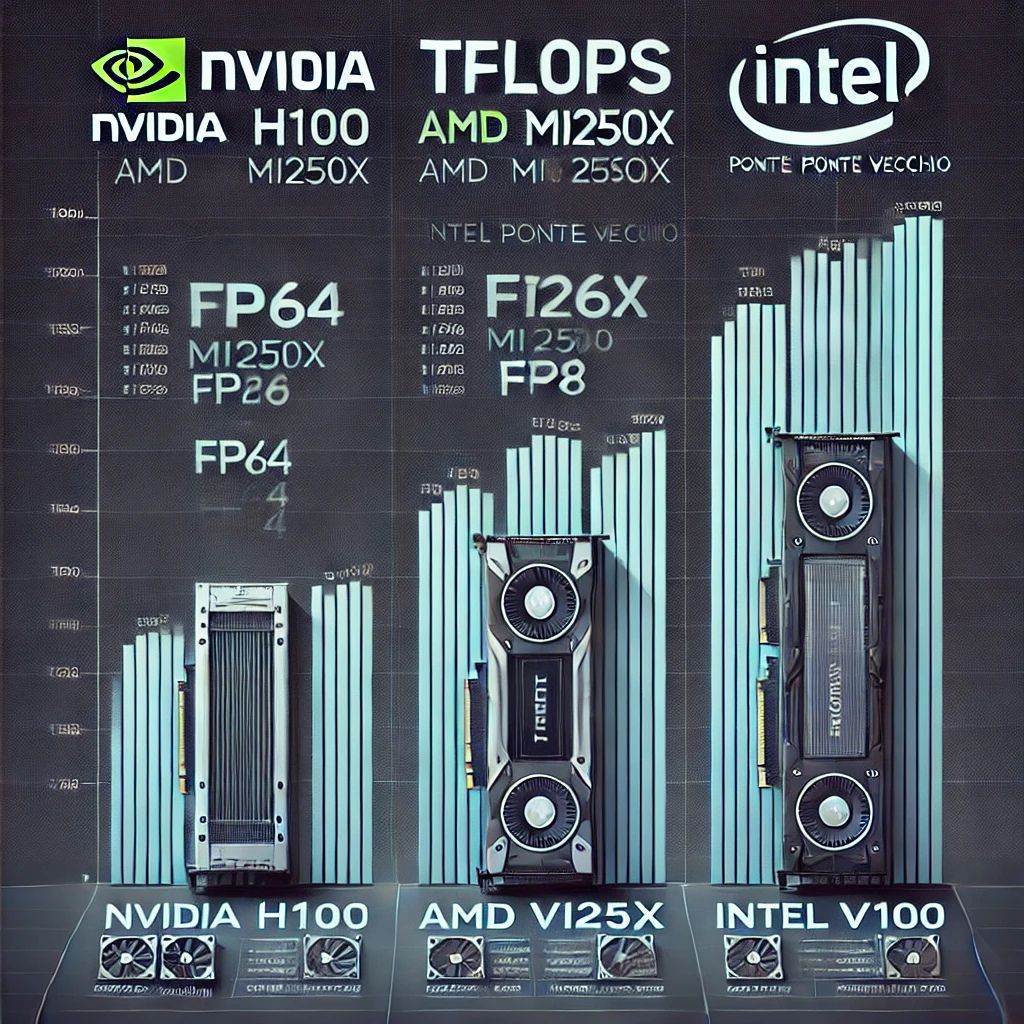
The NVIDIA H100 dominates the GPU market in raw compute power, but how does it stack up against rivals like AMD’s MI250X, Intel’s Ponte Vecchio, and its own predecessors?
08NVIDIA H100 vs. AMD MI250X
- TFLOPS:
-
- H100: ~67 TFLOPS (FP64), ~1,979 TFLOPS (FP16 with sparsity).
- MI250X: ~95 TFLOPS (FP64), ~383 TFLOPS (FP16).
Insight: AMD’s MI250X leads in FP64 performance (critical for traditional HPC), but the H100 crushes it in AI workloads with FP16/Tensor Core optimizations.
- Memory Bandwidth:
-
- H100: 3 TB/s (HBM3).
- MI250X: 3.2 TB/s (HBM2e).
Insight: AMD’s slight edge here benefits memory-bound tasks, but H100’s HBM3 offers better latency and efficiency.
- Power Efficiency:
-
- H100: ~2.8 TFLOPS/W (FP64).
- MI250X: ~1.3 TFLOPS/W (FP64).
Insight: The H100’s 4nm process and architectural refinements make it 2x more power efficient.
09NVIDIA H100 vs. Intel Ponte Vecchio
- TFLOPS:
-
- Ponte Vecchio: ~52 TFLOPS (FP64), ~209 TFLOPS (FP16).
Insight: Intel’s first-gen data center GPU lags in peak performance but excels in heterogeneous computing (CPU+GPU integration).
- Memory Bandwidth:
-
- Ponte Vecchio: 1.6 TB/s (HBM2e).
Insight: The H100’s 3 TB/s bandwidth gives it a decisive advantage in data-heavy workloads.
- Software Ecosystem:
-
- Intel relies on one API for cross-architecture compatibility, but NVIDIA’s CUDA remains the gold standard for AI/ML frameworks.
10H100 vs. Prior NVIDIA GPUs (A100, V100)
- TFLOPS Growth:
-
- H100 FP64: ~67 TFLOPS (vs. A100’s 19.5 TFLOPS, V100’s 7.8 TFLOPS).
- Tensor Core TFLOPS (FP16): H100 is 6x faster than A100.
- Memory Bandwidth:
-
- H100: 3 TB/s (vs. A100’s 2 TB/s).
- Power Efficiency:
-
- H100 delivers 4x better performance per watt than A100.
113.2 Beyond TFLOPS: Other Performance Metrics
While TFLOPS is a headline-grabbing figure, real-world performance hinges on three often-overlooked factors:
121. Memory Hierarchy
- H100: Boasts 50 MB of L2 cache (vs. A100’s 40 MB) and HBM3, reducing latency for iterative tasks like AI inference.
- Competitors: AMD’s MI250X uses a chiplet design with Infinity Cache, while Intel’s Ponte Vecchio employs EMIB (Embedded Multi-Die Interconnect Bridge) for dense packaging.
Why It Matters: Larger caches and advanced interconnects minimize data fetches, keeping compute cores fed and maximizing TFLOPS utilization.
132. Software Ecosystems
- NVIDIA: Dominates with CUDA, cuDNN, and TensorRT—tools optimized for AI/HPC. Over 4 million developers rely on this ecosystem.
- AMD: ROCm is maturing but still lacks framework support (e.g., PyTorch/TensorFlow integrations are less polished).
- Intel: oneAPI is versatile but struggles with adoption due to fragmented tooling.
Why It Matters: The H100’s software stack ensures researchers spend less time coding workarounds and more time innovating.
143. Scalability
- NVIDIA NVLink 4.0: Enables 900 GB/s GPU-to-GPU bandwidth, scaling to 32 GPUs in a single node (vs. AMD’s Infinity Fabric at 200 GB/s).
- Multi-Instance GPU (MIG): H100 can be partitioned into 7 isolated instances, allowing cloud providers to rent fractional GPU power efficiently.
Why It Matters: Scalability determines whether a GPU can handle hyperscale workloads (e.g., training GPT-5 across 10,000 GPUs).
The H100 isn’t just winning the TFLOPS race—it’s redefining how GPUs are evaluated. While AMD’s MI250X excels in legacy HPC (FP64) and Intel bets on hybrid architectures, NVIDIA’s full-stack advantage (silicon + software + scalability) makes the H100 the undisputed choice for AI and modern HPC. However, for organizations locked into AMD/Intel ecosystems or focused purely on FP64 workloads, competitors offer viable alternatives. In the end, TFLOPS is a starting point—not the finish line—for choosing the right GPU.
15The Future of TFLOPS and GPU Evolution
164.0 Beyond H100: What’s Next?
The NVIDIA H100 represents the pinnacle of today’s GPU technology, but the race for higher TFLOPS and efficiency is far from over. Here’s a glimpse into the future:
17NVIDIA’s Roadmap: Blackwell and Beyond
NVIDIA’s next-generation Blackwell architecture (expected post-2024) is rumored to push boundaries further:
- 3nm Process Node: Smaller transistors mean more cores per chip, boosting TFLOPS while reducing power consumption.
- Advanced Packaging: Technologies like CoWoS-L (Chip-on-Wafer-on-Substrate) could integrate CPU, GPU, and HBM memory into a single package, slashing latency and boosting bandwidth.
- Specialized Cores: Future GPUs may include dedicated units for tasks like real-time ray tracing, quantum simulation, or photonic computing, moving beyond generic TFLOPS metrics.
- AI-Driven Design: NVIDIA is already using AI to optimize GPU architectures. Blackwell might be the first GPU partially designed by neural networks, accelerating R&D cycles.
18Quantum Computing and Neuromorphic Chips
While GPUs dominate today, emerging technologies could reshape the compute landscape
- Quantum Computing: For specific tasks (e.g., cryptography, molecular modeling), quantum processors like IBM’s Osprey or Google’s Sycamore promise exponential speedups. However, they won’t replace GPUs outright—hybrid systems (quantum + GPU) may handle complex simulations.
- Neuromorphic Hardware: Chips like Intel’s Loihi 2 mimic the human brain’s architecture, offering ultra-efficient AI inference. While not TFLOPS-focused, they could complement GPUs in edge devices or low-power applications.
The future of TFLOPS isn’t just about bigger numbers—it’s about smarter, greener, and more equitable computing. NVIDIA’s Blackwell and quantum-neuromorphic hybrids may redefine performance benchmarks, but without addressing environmental and ethical challenges, raw compute power risks becoming a liability. The next era of GPUs must balance three pillars:
- Performance: Higher TFLOPS for AI, scientific discovery, and immersive tech.
- Sustainability: Net-zero data centers, recyclable hardware, and energy-efficient architectures.
- Access: Affordable access to avoid concentrating power in the hands of a few corporations.
In the end, the evolution of TFLOPS will mirror humanity’s priorities: Will we build tools that uplift society, or ones that deepen existing divides? The answer lies in the choices engineers, policymakers, and users make today.
Conclusion
← Back to Insights
The NVIDIA H100 GPU stands as a titan in the TFLOPS race, revolutionizing AI training, scientific research, and data center efficiency with its staggering compute power. Yet, TFLOPS alone don’t dictate success—its real-world impact hinges on memory bandwidth, software ecosystems, and energy efficiency. For organizations pushing AI frontiers or running massive simulations, TFLOPS is critical; for others, factors like scalability or cost-per-watt may matter more. As GPU technology evolves, the key lies in aligning hardware choices with your mission’s unique demands. Before diving into the TFLOPS arms race, ask: What problems are we solving? The answer will guide you to the right balance of power, practicality, and purpose.
- Ponte Vecchio: 1.6 TB/s (HBM2e).
- Ponte Vecchio: ~52 TFLOPS (FP64), ~209 TFLOPS (FP16).