FEATURED STORY OF THE WEEK
H200 Memory Breakthrough-Transform AI Training on Hugging Face

H200 Memory Breakthrough: Transform AI Training on Hugging Face
Modern AI models are growing more complex every day. Large language models and advanced vision systems require enormous computing power. Training these models now demands revolutionary hardware solutions. This surge in complexity creates new challenges for researchers and developers.
NVIDIA’s H200 GPU combined with Hugging Face’s platform creates a powerful solution. Hugging Face is a popular service for sharing and using AI models. The H200 brings cutting-edge memory technology to this ecosystem. Together, they form a game-changing combination for AI development.
The H200’s memory advancements transform three key areas of AI model training. First, they simplify development by reducing technical workarounds. Second, they improve training efficiency, saving time and resources. Third, they enhance experimentation with larger models. These changes make advanced AI development more accessible.
For Hugging Face users working on AI model training, the H200 changes what’s possible. Its massive 141GB memory capacity handles models with billions of parameters. Parameters are the basic building blocks that AI learns during training. This eliminates constant data shuffling between components. The H200’s ultra-fast memory chips move information 1.8 times quicker than previous versions. This revolution in memory management directly benefits AI training workflows.
1. What is Hugging Face, and Why Does Hardware Matter?
Hugging Face has become essential for modern AI development. Think of it as a GitHub for artificial intelligence. It hosts thousands of pre-trained models (like ChatGPT alternatives), curated datasets, and easy-to-use libraries. Tools like its Transformers Hub and Accelerate library help developers build AI systems faster. This ecosystem supports everything from chatbots to image generators.
However, training advanced models faces major hardware hurdles. Large language models with billions of parameters – the internal settings AI learns – demand colossal memory. When GPUs run out of memory, training slows or crashes. Developers must use complex tricks like offloading data to slower CPU memory. These bottlenecks waste time and limit innovation.
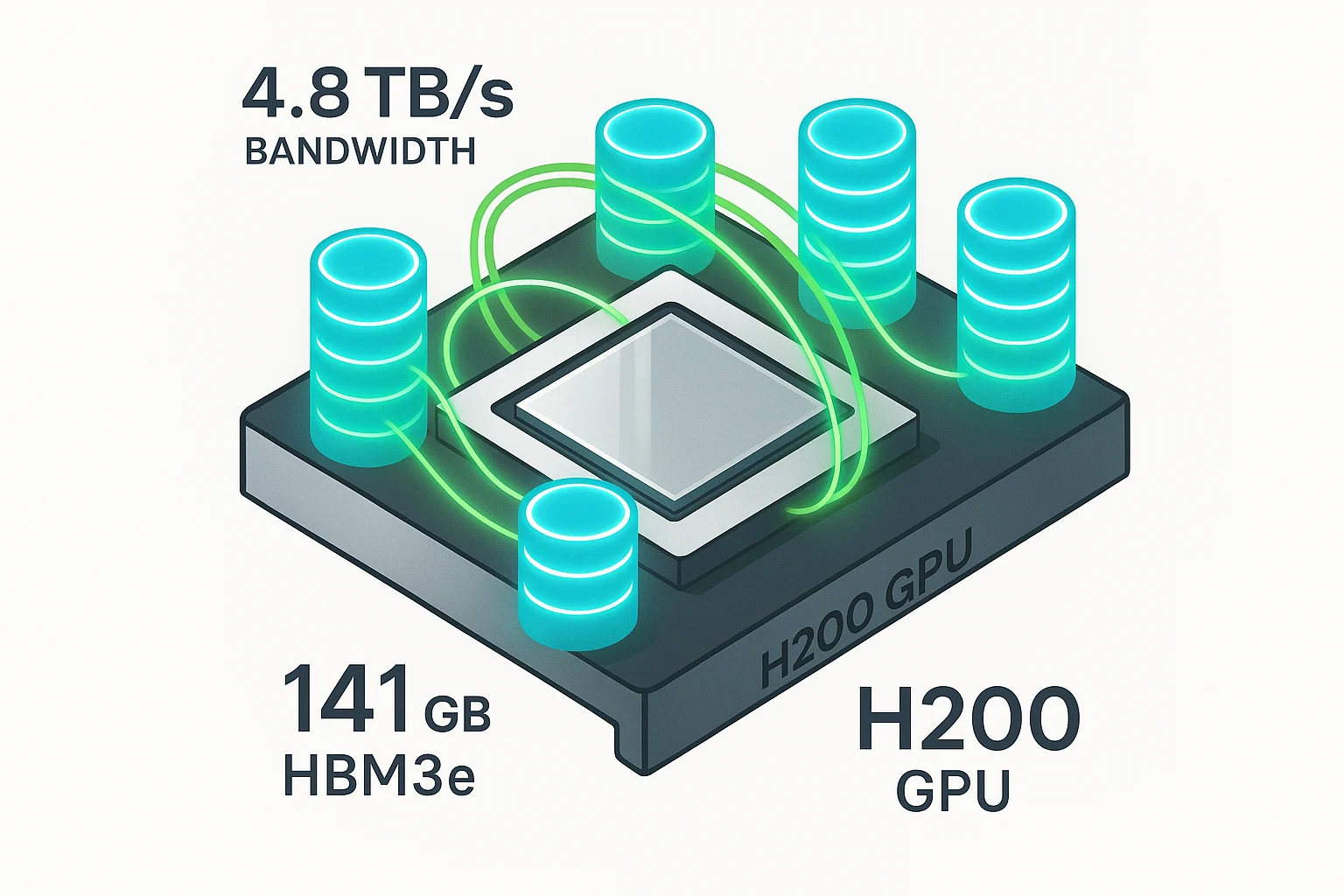
This is where NVIDIA’s H200 GPU changes the game. With 141 GB of cutting-edge HBM3e memory – a type of ultra-fast storage – and 4.8 TB/s bandwidth (data transfer speed), it smashes previous limits. Compared to the H100 GPU, the H200 offers nearly double the memory capacity and 43% more bandwidth. This enables next-gen AI model training with the H200.
Hugging Face tools harness the H200’s power seamlessly. The Accelerate library automatically uses the GPU’s massive memory for larger batch sizes – groups of data processed together. This eliminates manual offloading for models up to 70B parameters. Suddenly, training complex models becomes simpler and faster on Hugging Face’s platform.
2. How Does H200 Memory Management Revolutionize Training?
The NVIDIA H200 GPU introduces breakthroughs that fundamentally change large-scale model training. Its hardware innovations solve critical bottlenecks that previously slowed progress. This revolution stems from two key technologies working together.
HBM3e Memory: Speed Meets Scale
HBM3e is a new type of ultra-fast memory integrated directly into the GPU. With 4.8 terabytes per second (TB/s) bandwidth – 1.8x faster than the H100 – it moves data like never before. Bandwidth measures how quickly the GPU accesses its memory. This speed allows training models with billions of parameters without slowdowns. Massive models like Llama 3-70B fit comfortably within its 141 GB capacity.
FP8 Precision: Smarter Math, Faster Results
FP8 (8-bit floating point) is a new number format for calculations. It performs matrix operations – the core math behind AI – twice as fast as older 16-bit formats. Crucially, it maintains accuracy through smart scaling techniques. Hugging Face’s libraries automatically apply FP8, accelerating training without compromising model quality. This allows cost-effective AI model training with the H200.
Impact: Fewer Compromises, More Power
The H200 eliminates painful memory workarounds for models up to 70B parameters. Developers no longer need constant checkpointing (saving/reloading model states) or offloading (shunting data to slow CPU memory). Training runs continuously at full speed. This also enables near-linear scaling in multi-GPU clusters. Adding more GPUs now delivers proportional speed gains, making massive projects feasible.
Impact: Scaling Made Simple
Multi-GPU training often suffers from communication delays between cards. The H200’s massive bandwidth minimizes this bottleneck. When eight H200 GPUs work together, they achieve nearly 8x the performance of a single GPU for large models. This linear scaling makes training 100B+ parameter models practical and efficient for Hugging Face users.
3. How Does H200 Simplify Development on Hugging Face?
The NVIDIA H200 fundamentally streamlines AI model training for Hugging Face developers. By eliminating memory constraints, it removes complex technical hurdles that once dominated the AI model training process. This lets engineers focus on innovation rather than optimization.
Larger Batches, Fewer Hacks
Developers can now use significantly larger batch sizes – groups of training examples processed together – without techniques like gradient_checkpointing that saved memory by recalculating data during training instead of storing it. Similarly, offload_state_dict (moving model parts to slower CPU memory) becomes unnecessary. The H200’s 141 GB on-device memory handles this natively.
Minimal Memory Tweaking
Complex code adjustments to prevent “out-of-memory” crashes are largely obsolete. Hugging Face’s Accelerate library automatically leverages the H200’s capabilities. Developers specify their model and dataset and Accelerate optimizes memory use with minimal configuration. This cuts setup time and reduces debugging.
Single-Node Power for Big Models
Previously, training models like a 30B-parameter LLM required complex parallelism across multiple GPUs or even servers (nodes). This demanded specialized distributed computing skills. With the H200, these models now train efficiently on a single server equipped with just one or two GPUs. This simplifies infrastructure and accessibility.
Development Simplifications with H200 and Hugging Face
| Traditional Challenge | H200 + Hugging Face Solution |
|---|---|
| Manual gradient checkpointing needed | Unnecessary for models ≤70B parameters |
| Slow CPU offloading required | Eliminated by 141 GB ultra-fast GPU memory |
| Multi-node/GPU orchestration complex | Single-node training for most common models |
| Forced low-precision compromises | Native FP8 support maintains accuracy |
4. In What Ways Does H200 Boost Training Efficiency?
The NVIDIA H200 delivers dramatic efficiency gains for Hugging Face workflows. By solving memory bottlenecks, it accelerates training and reduces operational costs. These improvements make large-scale AI model training with the H200 more practical and sustainable.
Faster Model Training
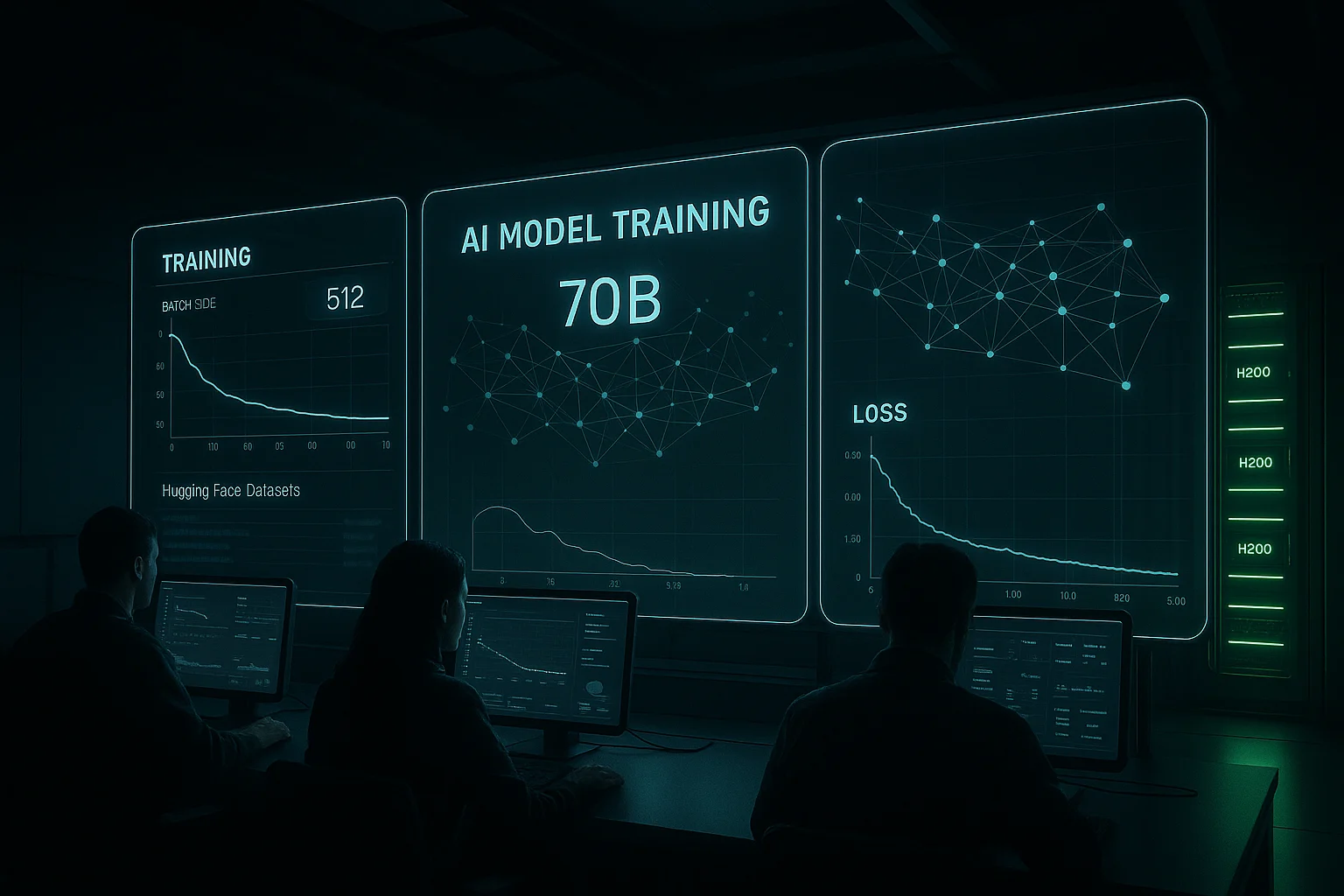
The H200 cuts training time significantly versus previous GPUs. For example, training a 70B-parameter Llama model runs 1.6x faster than on the H100. This speedup comes from reduced idle time – delays caused by shuffling data between components. With much less waiting, GPUs work continuously at full capacity.
Substantial Cost Savings
Shorter training directly lowers expenses. Fewer GPU hours mean smaller cloud bills on services like AWS P5e or Azure ND H200 instances. Training a model like Bloom 176B now costs much less due to the H200’s efficiency. These savings free budgets for more experiments or larger datasets.
Energy Efficiency Gains
The H200 achieves more work per watt of electricity. Its improved architecture delivers 1.7x better energy efficiency than the H100. This reduces both carbon footprint and cooling costs – critical for sustainable AI development.
Efficiency Comparison (H100 vs. H200)
| Metric | H100 | H200 | Improvement |
|---|---|---|---|
| Memory Bandwidth | 3.35 TB/s | 4.8 TB/s | 43% |
| FP8 Throughput | 67 TFLOPS | 197 TFLOPS | 2.9x |
| Max Batch Size (30B model) | 8 samples | 24 samples | 3x |
| Energy Efficiency | Baseline (1x) | 1.7x | 70% |
5. How Does Enhanced Memory Enable Better Experimentation?
The H200’s massive 141 GB memory unlocks unprecedented creative freedom for Hugging Face users. By eliminating memory constraints, it transforms how researchers prototype and refine models. This accelerates innovation in AI model training with the H200.
Rapid Architecture Testing
Researchers can now test advanced designs like MoEs (Mixture of Experts) or 100B+ parameter models without constant memory adjustments. MoEs use specialized sub-networks for different tasks, demanding extra memory. Previously, each experiment required days of optimization. Now, these models run out-of-the-box on the H200, enabling faster iteration.
Efficient Hyperparameter Tuning
Larger batch sizes – enabled by the H200’s memory – stabilize training convergence (the process where a model learns patterns). This reduces failed experiments. For example, tuning learning rates or optimizer settings requires fewer trial runs since larger batches provide more reliable feedback per training step.
Seamless Tool Integration
Hugging Face’s ecosystem leverages the H200 natively:
- AutoTrain: Automatically tests hundreds of model configurations
- trl library: Simplifies RLHF (Reinforcement Learning from Human Feedback) for chatbots
- Custom Pipelines: Run complex workflows without memory crashes
These tools use the full 141 GB of memory, enabling experiments previously limited to tech giants.
Democratizing Advanced Research
With memory barriers gone, startups and academics can explore cutting-edge techniques like speculative decoding or 3D parallelism. This levels the playing field – a university lab can now iterate on 70B-parameter models as efficiently as large corporations using Hugging Face’s accessible tools.

6. How to Implement the H200 on Hugging Face
Getting started with AI model training with the H200 on Hugging Face is straightforward. Follow these steps to leverage its revolutionary memory capabilities in your workflow.
1. Access H200 Instances
Major cloud providers offer H200 access:
- AWS: Launch p5e.48xlarge instances (8x H200 GPUs)
- Azure: Use ND H200 v5 virtual machines
These platforms provide pre-configured environments for Hugging Face. Simply select “H200” as your accelerator type when provisioning resources.
2. Install Key Libraries
Ensure your environment uses updated Hugging Face tools:
bash
pip install transformers accelerate torch==2.3+cu121 -U
The Accelerate library automatically detects H200 capabilities, while torch.compile optimizes FP8 operations.
3. Configure Your Training Script
This sample code trains a 70B-parameter model using H200’s full potential:
python
from transformers import AutoModelForCausalLM, TrainingArguments
from accelerate import Accelerator
# Enable FP8 mixed precision
accelerator = Accelerator(mixed_precision=”fp8″)
# Load model directly into H200 memory
model = AutoModelForCausalLM.from_pretrained(“meta-llama/Llama-3-70B”)
# Training settings (automatically uses H200 features)
args = TrainingArguments(
output_dir=”./results”,
per_device_train_batch_size=24, # 3x larger batches vs H100
optim=”adamw_torch_fused”, # Uses FP8 acceleration
)
Pro Tip: Monitor Memory Usage
Add this to your script to track H200 memory in real-time:
python
stats = accelerator.get_memory_stats(accelerator.device)
print(f”H200 Memory Used: {stats[‘used’]/1e9:.1f}GB / 141GB”)
Conclusion
The NVIDIA H200 GPU fundamentally transforms AI model training on Hugging Face. Its revolutionary 141GB memory eliminates historic bottlenecks like manual data offloading and batch size limitations. This breakthrough enables truly frictionless development for models with billions of parameters. Training complex AI systems now requires fewer technical workarounds and less specialized expertise.
Looking ahead, this technology democratizes cutting-edge AI experimentation. Researchers at universities, startups, and independent labs can now explore huge models and novel architectures like MoEs (Mixture of Experts) without massive infrastructure. What was once exclusive to tech giants becomes accessible to all Hugging Face users, accelerating global AI innovation.
The efficiency gains are equally transformative. With 1.6x faster training speeds and 70% better energy efficiency than previous GPUs, projects consume fewer resources and lower costs. This makes sustainable, large-scale AI development achievable for more organizations.
Start leveraging these advantages today. Major cloud platforms offer immediate access to the H200 hardware. Combine this with Hugging Face’s libraries – no complex setup required. Experiment with larger models, try new techniques, and push boundaries without memory constraints. The future of accessible AI starts now.

More Similar Insights and Thought leadership
No Similar Insights Found
Subscribe today to receive more valuable knowledge directly into your inbox
We are writing frequenly. Don’t miss that.
Subscribe to get updates

Unregistered User
It seems you are not registered on this platform. Sign up in order to submit a comment.
Sign up now