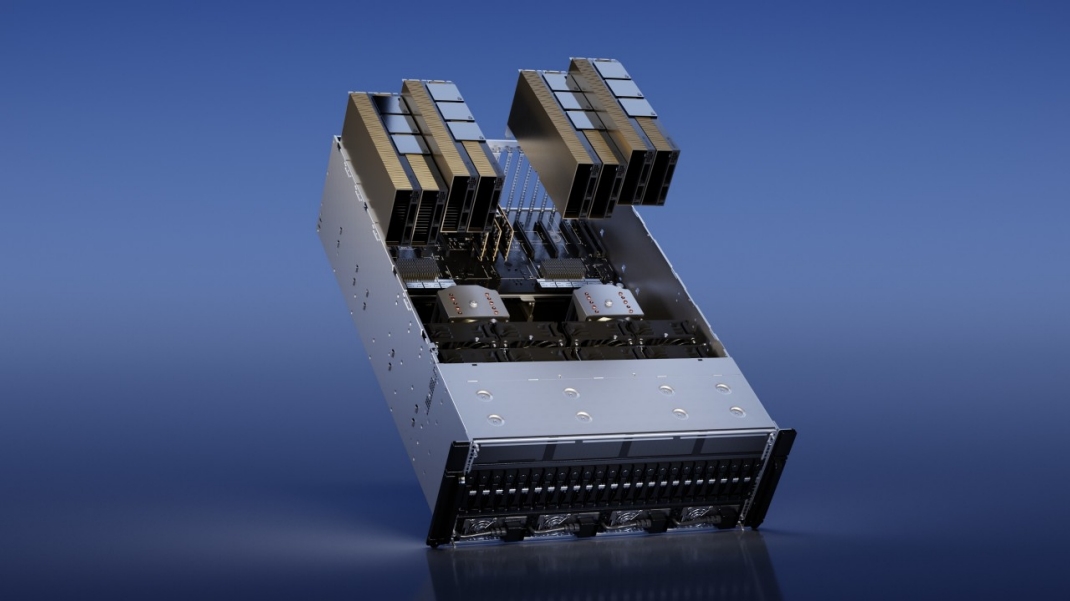
Not all H100s are the same product. The PCIe card slots into ordinary servers and behaves like a very fast accelerator; the SXM5 module bolts onto a baseboard, draws up to 700W, and joins its seven siblings over NVLink at 900GB/s each. The spec-sheet difference looks incremental. The operational difference is categorical—and extracting the value you paid for is a strategy, not a default.
Key Takeaways
- SXM5 vs PCIe is the H100 decision that matters: NVLink-coupled scaling and full power envelope versus deployment convenience.
- Utilization is the entire ROI story—an idle SXM5 fleet is the most expensive paperweight in the building.
- MIG partitioning, smart scheduling, and workload routing turn peak hardware into consistent throughput.
- Operations—thermals, firmware discipline, health baselines—protect the investment over its working life.
01What SXM5 buys you
Three things, concretely. The full 700W power envelope keeps clocks high under sustained load where PCIe variants shed performance. NVLink coupling makes eight GPUs behave like one large accelerator for tensor- and pipeline-parallel jobs—the difference between scaling that works and scaling that stalls on interconnect. And the platform inherits the engineered ecosystem around it: baseboards, fabrics, and reference architectures tuned for exactly this configuration.
02The utilization playbook
- Measure first: per-GPU utilization, memory occupancy, and NVLink traffic on dashboards someone reviews weekly. Most fleets discover embarrassing idle patterns within the first month of honest telemetry.
- Partition the leftovers: MIG slices turn an underused GPU into several right-sized inference or dev instances—recovered capacity at zero hardware cost.
- Schedule for the fabric: place multi-GPU jobs NVLink-locally before spilling across nodes; queue policies that respect topology routinely lift effective throughput double digits.
- Tier the workloads: SXM5 time goes to jobs that need its scaling; single-GPU experimentation belongs on cheaper silicon.
03Operating for the long run
Sustained 700W per module makes thermals a first-class metric—trend them per GPU and treat drift as a maintenance signal. Hold firmware and driver versions as a tested, fleet-wide baseline rather than a rolling experiment. Archive burn-in benchmarks per device and re-run them at maintenance windows; performance degradation you can measure is performance you can warranty. And keep a documented second life planned—today's training fleet is next cycle's inference tier, and an orderly handoff preserves more value than an improvised one.
04The strategic frame
SXM5 capacity is the scarce, premium tier of an AI estate. The organizations that harness it share one habit: they treat utilization as a managed business metric with an owner, a dashboard, and a quarterly target. The hardware delivers what the spec sheet promises—to exactly the degree the operation around it insists.
Ready to put this into practice?
Talk to the Semifly team about your infrastructure, security, and compliance roadmap.
Contact Us