FEATURED STORY OF THE WEEK
How 5G Will Revolutionize Manufacturing in 2022 and Beyond

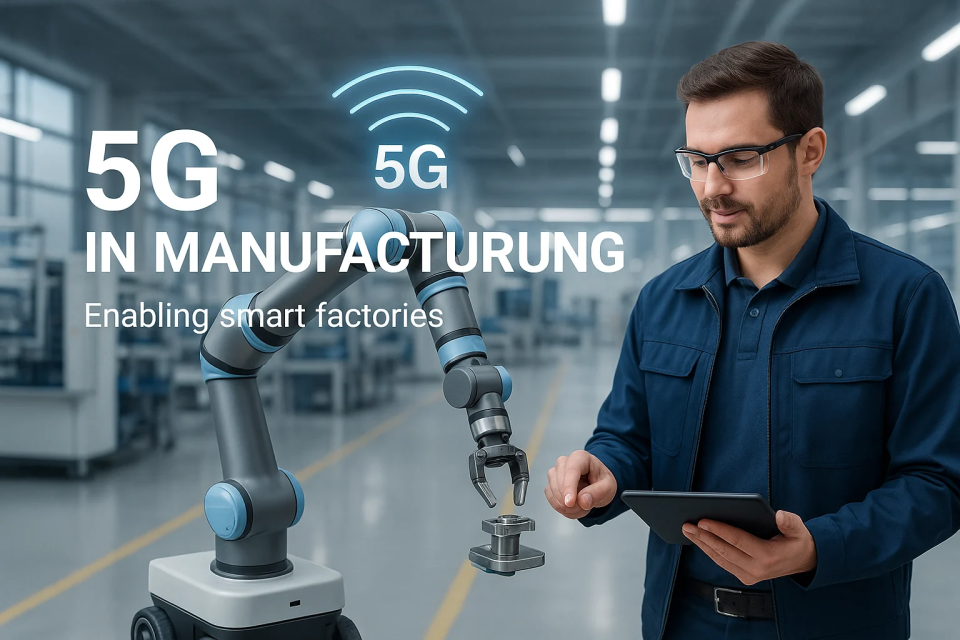
Manufacturing has made impressive progress in the sophistication of its technologies and processes. Even so, optimizing communication—between both humans and machines—has been slow going compared to those other innovations.
5G mobile technology, combined with the revolutionary Industry 4.0 technology in place today, stands to change that. The sophisticated connectivity of 5G could be the key to the industry’s next leap forward in digitization. That’s because 5G can improve multiple dimensions of modern manufacturing simultaneously: automation, labor augmentation, and logistics, among others.
Over then next 15 years, “application of 5G will create 309,000 manufacturing jobs in the United States” alone, Forbes reported in 2020. According to McKinsey, “the manufacturing sector could generate an additional $400 billion to $650 billion of global GDP impact” as well. But just as 5G adoption in consumer markets has been slow, successful use cases for 5G in manufacturing setting have only begun to emerge.
There is enormous potential for 5G in manufacturing—if technology leaders can identify the applications that are simplest to implement, with the greatest possible value produced as a result. This article is designed to help manufacturing CIOs and other leaders identify the 5G applications that are right for their organizations,
Beginning the Journey Towards 5G Maturity
“5G represents the next generation of broadband cellular technology,” Forbes reports in April 2021. “However, the 5G protocol is slowly evolving to add more features for industrial applications.” That’s because wireless connectivity does not have the strong foundation in manufacturing it has found in consumer markets. Manufacturing environments require unwavering speed, accuracy, and reliability that 4G infrastructure can’t always deliver.
5G changes this by eliminating those risks and executive leaders’ misgivings about mobile connectivity. Now, the new technology has the potential to boost the manufacturing sector in ways even more transformative than other industries.
This is due to the sheer variety of applications and use cases available among manufacturers today. “5G in the industrial manufacturing context offers opportunities beyond factory automation,” as Forrester describes, including “process automation, human-machine interfaces, logistics, warehousing, monitoring, and maintenance.”
Indeed, 5G will widen manufacturers’ abilities to automate equipment and processes; but more often it will enhance the work of human beings, freeing them from tedious and undesirable tasks so they can add value in more strategic, analytical, or creative capacities instead. They will have new resources available to them in those efforts as well, as 5G improves their means of collecting and processing data.
5 Ways 5G Will Transform Manufacturing Over the Next Decade
The real-world benefits of 5G applications in manufacturing have been only marginal to date. However, 5G will inevitably enhance multiple core functions of manufacturing processes in place today. Here is a closer look at how 5G will transform five key areas of modern manufacturing.
1. Streamlining Automation
Automation is already a critical part of modern manufacturing, but its connectivity depends mostly on wired connections. Automated transport vehicles move across pre-determined fixed paths when detached form wired connections, with limited opportunities for optimization or adjustment as well. 5G has the potential to free machines from tedious and expensive cabling, allowing for greater flexibility within the factory. Combined with artificial intelligence (AI) and machine learning, 5G may introduce new layers of real-time flexibility and automated optimization to factory operations.
2. Augmenting Human Labor
Just as AI has done more to augment human workers than it has to replace them, 5G will enhance the work of human factory workers, field operators, and optimization specialists as well. “5G and AI could also collaborate to provide personnel with immersive experiences to ease their work,” said Forbes in its 2020 article. “Superimposing simulated objects in a real environment, for instance, could improve training, enhance product design, and guide operators through factory procedures that still require manual intervention.” In another vision, human workers can collaborate more closely with human-support robots—also called “cobots”—which will become untethered from its wired connections as it traverses the factory floor with its human counterparts as well. “5G-enabled cobots will leverage low latency to monitor sensor outputs in real time and optimize collaborative behavior,” says Forbes.
3. Improving Tracking and Traceability
Traceability remains an essential function in manufacturing, and a consistent area for improvement. 5G may finally solve for all traceability challenges by adding near-real-time traceability to all parts, products, and equipment. Massive machine-type communication (mMTC), which supports connectivity with vast quantities of sensors, can leverage 5G to track all physical objects within a factory setting. With the help of robots, factory personnel can find virtually any object within the factory, quickly and easily; they can improve inspections, process control, and minimize the potential for failures with these new capabilities.
4. Enabling Remote Control
The COVID-19 pandemic challenged all industries to consider shifting employees to remote work. This proved difficult for a number of industries, but especially manufacturing where much of the labor is manual—even in terms of the physical upkeep of machines. Even so, 5G could facilitate the digitization and remote control of programmable logic controllers (PLCs) traditionally restricted to physical factory environments. Remote workers could visualize processes and performance within the factory in near-real-time, no matter where they happen to sit.
5. Transforming Logistics and Facility Management
As 5G improves data collection and processing through its support of myriad remote sensors, it allows manufacturers to improve analytics processes. Manufacturers can leverage these new insights to optimize logistics and facility management, which may include new applications for 5G technologies. For example, transport vehicles can communicate the details of their cargo to stock control functions before they arrive to those locations. Manufacturers may be able to better manage their energy usage, optimize production based on market demand, or reduce their carbon footprint in strategic ways as well.
5. Transforming Logistics and Facility Management
As 5G becomes more widely adopted, the manufacturing industry is making headway on its use of 5G technologies. However, manufacturers who want to take advantage of its capabilities must be prepared to make additional changes—to their equipment, digital tools, and processes, among others.
Semifly supports manufacturers all over the world as they begin their 5G transformations—supporting them during their transition and helping them optimize their ongoing technology investments. Contact one of our manufacturing experts today to learn more about our capabilities
More Similar Insights and Thought leadership
No Similar Insights Found
Subscribe today to receive more valuable knowledge directly into your inbox
We are writing frequenly. Don’t miss that.
Subscribe to get updates

Unregistered User
It seems you are not registered on this platform. Sign up in order to submit a comment.
Sign up now