FEATURED STORY OF THE WEEK
NVIDIA B300 and Generative AI

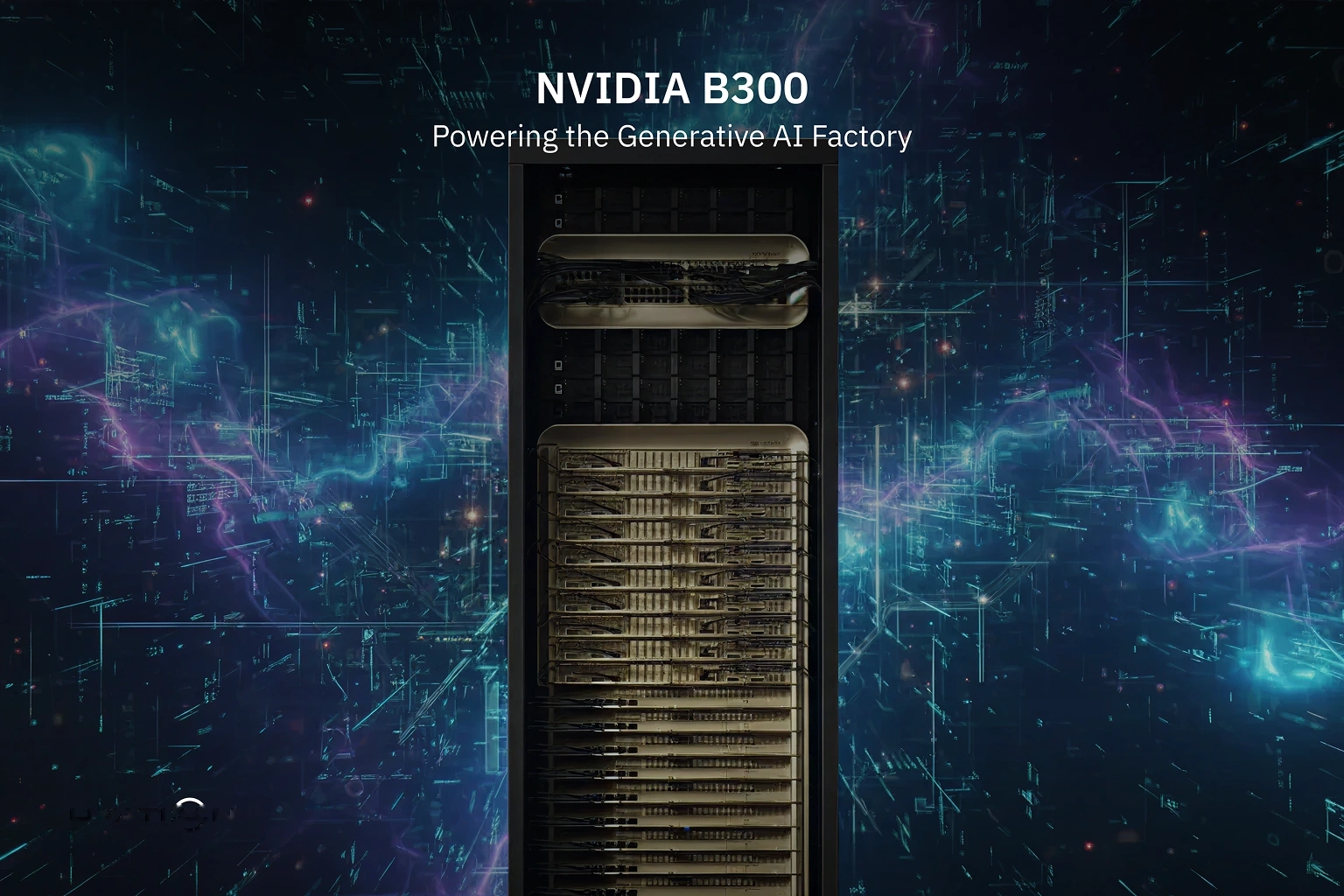
Over the past year, many enterprises reached a quiet realization: building generative AI models is no longer the hardest part. Running them continuously, reliably, and at scale has become the real challenge. Large language models are now expected to reason, retain long conversational context, coordinate tools, and operate as autonomous agents in production environments.
In this phase, the majority of compute is no longer consumed during training, but during inference, where models generate vast numbers of tokens in real time. This shift has exposed limitations in traditional GPU infrastructure, particularly around memory capacity, attention throughput, power efficiency, and cost predictability.
In response, the industry is moving toward what NVIDIA describes as the AI Factory model: purpose-built infrastructure designed to support the full lifecycle of generative AI, from training and fine-tuning to high-volume, test-time scaling in production. This model treats inference not as an afterthought, but as the primary workload. The NVIDIA B300, based on the Blackwell Ultra architecture, is a direct answer to this transition.
It is engineered specifically for generative AI reasoning and inference, where efficiency, memory scale, and throughput determine real-world viability. In this blog, we examine how the NVIDIA B300 enables the AI Factory era, starting with its architectural foundations, moving into its breakthroughs in memory and FP4 inference, and finally exploring how it scales across enterprise and hyperscale AI systems to support modern generative AI workloads.
Blackwell Ultra Architecture: Built for Generative AI at Scale
The NVIDIA B300 is built on the Blackwell Ultra GPU architecture, designed specifically around the realities of modern generative AI workloads. Unlike earlier architectures that primarily optimized for training throughput, Blackwell Ultra is shaped by how large models actually behave in production where memory access patterns, interconnect speed, and sustained inference performance define success. At this scale, generative models are no longer constrained by compute alone.
They are constrained by how efficiently data moves across the system, how coherently memory is accessed, and how well the architecture sustains performance under continuous, high-concurrency workloads. Blackwell Ultra addresses these requirements at the architectural level.
Architectural Foundations
Blackwell Ultra represents one of the most complex processors ever engineered:
- It integrates 208 billion transistors, enabling unprecedented parallelism and specialization.
- The GPU is manufactured using a custom TSMC 4NP process, optimized for high performance and energy efficiency at scale.
- Instead of relying on a single monolithic die, Blackwell Ultra adopts a dual-die design, where two reticle-limited dies operate as a single, unified GPU.
- These dies are connected through a 10 TB/s NV-HBI chip-to-chip interconnect, allowing them to function with shared memory semantics and minimal latency.
This architectural approach allows Blackwell Ultra to scale beyond the physical limits of traditional GPU designs while preserving the unified execution model required by large transformer-based architectures.
For generative AI workloads where attention layers, large parameter sets, and long context windows demand fast, coherent access to data, this design is essential for maintaining predictable performance at scale.
Memory as the Primary Bottleneck: Solving the Trillion-Parameter Problem
As generative AI models continue to scale, memory has emerged as the defining constraint, often more limiting than raw compute. Large language models now routinely operate with hundreds of billions of parameters, and Mixture-of-Experts (MoE) architectures push these requirements even further by activating multiple expert networks per request. In production inference, insufficient memory capacity or bandwidth quickly becomes a bottleneck, increasing latency and limiting concurrency.
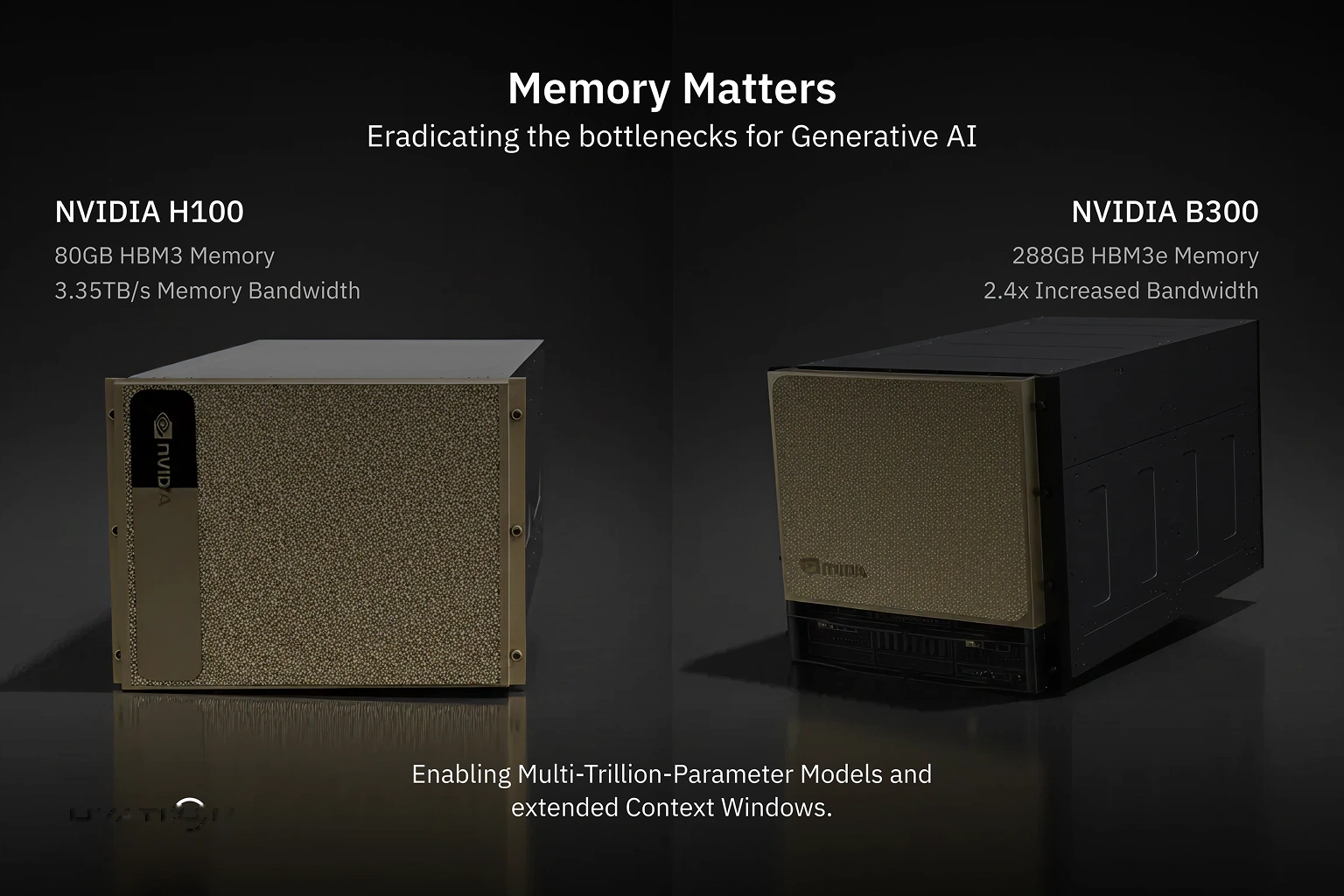
The NVIDIA B300 addresses this challenge directly by treating memory not as a secondary resource, but as a first-order architectural priority.
Massive HBM3e Capacity
Each Blackwell Ultra GPU in the B300 platform integrates 288 GB of HBM3e memory, representing a 3. 6× increase over the 80 GB capacity available in the H100 generation. This expansion fundamentally changes what is feasible in generative AI deployments. With this level of on-package memory, enterprises can host multi-trillion-parameter models, support larger MoE configurations, and enable extended context windows required by reasoning agents, all without excessive model partitioning or off-chip memory access. For inference workloads, this directly translates into lower latency and higher throughput.
Bandwidth to Match Model Scale
Capacity alone is not sufficient at this scale. Generative models place sustained pressure on memory bandwidth, particularly during attention computation and token generation. The B300 delivers up to 8 TB/s of HBM bandwidth per GPU, a 2. 4× increase over the H100’s 3. 35 TB/s. This bandwidth ensures that compute units remain consistently fed with data, preventing stalls that degrade real-world inference performance. At the system level, HGX B300 platforms provide more than three times the total memory capacity of H100-based systems and over twice that of H200-based platforms. This removes one of the most persistent blockers to large-scale generative AI inference, enabling higher model density, greater concurrency, and more predictable performance in production environments.
Generative AI Acceleration: FP4 Changes the Economics of Inference
As generative AI moves from experimentation to production, the economics of inference have become as important as raw performance. Serving large models at scale requires sustained throughput, predictable latency, and tight control over power consumption. This is where the NVIDIA B300 introduces its most consequential generative AI innovation: native FP4 inference. Rather than treating low-precision computation as a compromise, Blackwell Ultra is designed to make ultra-low precision a practical and reliable foundation for large-scale inference.
NVFP4: Ultra-Low Precision, High Accuracy
Blackwell Ultra introduces NVFP4, a 4-bit floating-point format implemented directly in hardware. This format is specifically tuned for transformer-based generative models, where inference accuracy must be preserved while maximizing efficiency.
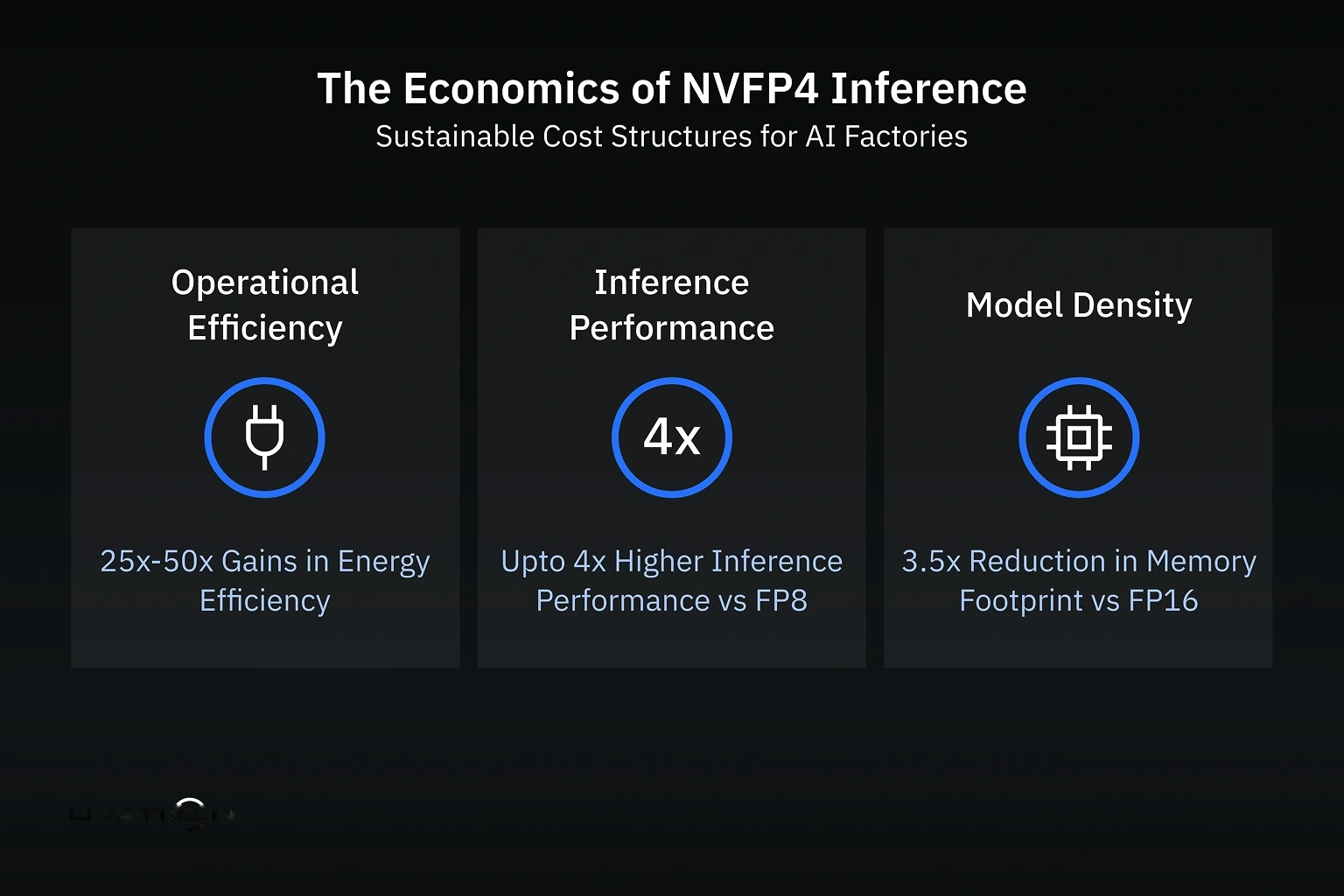
To understand why FP4 matters, it helps to understand quantization in simple terms. AI models work with numbers. During training, these numbers are stored very precisely. This makes training accurate, but it also makes computation expensive. During inference, this level of precision is often not required. Quantization reduces how precisely numbers are stored by using fewer bits. This lowers memory usage, reduces power consumption, and allows models to run faster. The challenge is that lower precision can remove too much detail. When numbers are simplified, small differences can be lost. This loss is called quantization error. If the error becomes too large, the model’s responses can become less accurate, especially for long prompts, reasoning tasks, or attention-heavy workloads. With NVFP4, the B300 delivers:
- Up to 4× higher inference performance compared to FP8
- 25–50× gains in energy efficiency, significantly reducing operational costs
- A 3. 5× reduction in memory footprint compared to FP16
These improvements fundamentally change the feasibility of deploying very large models in production. Models such as Llama 3. 1 405B can be served with dramatically fewer GPUs, lower power draw, and reduced memory overhead without sacrificing response quality. To maintain accuracy at 4-bit precision, B300 incorporates a dual-level scaling mechanism that minimizes quantization error. Instead of treating all numbers the same, the hardware adjusts how values are represented at different levels.
This helps preserve important details and keeps errors small. As a result, quantization error is reduced by 88% compared to simpler methods. Because of this, FP4 on the B300 is not just faster. It is accurate enough for real-world generative AI use. Each B300 GPU can deliver up to 15 petaFLOPS of dense NVFP4 performance, making FP4 a reliable foundation for large-scale inference.
Transformer and Attention Optimization for AI Reasoning
As generative AI models evolve beyond simple text generation, their performance characteristics are increasingly shaped by attention layers. Long-context reasoning, agentic workflows, and tool-using models place sustained pressure on attention computation, making it one of the most performance-critical components of modern inference. The NVIDIA B300 addresses this directly by combining architectural specialization with software-level optimization, ensuring that attention-heavy workloads scale efficiently and predictably.
Second-Generation Transformer Engine
At the core of this optimization is the second-generation Transformer Engine, designed specifically for transformer-based generative models. This engine integrates:
- Custom Blackwell Tensor Cores, optimized for low-precision and mixed-precision computation
- Tight integration with NVIDIA’s generative AI software stack, including TensorRT-LLM and NeMo
- Native support for dense, sparse, and Mixture-of-Experts (MoE) transformer architectures
This combination allows models to dynamically leverage the most efficient execution paths during inference, maintaining high throughput while adapting to varying model structures and workloads.
Attention-Layer Acceleration
Blackwell Ultra places particular emphasis on accelerating attention operations, which are often the dominant contributor to latency in long-context and reasoning tasks. Compared to earlier Blackwell GPUs, the B300 delivers:
- 2× faster attention-layer performance
- Measurable improvements in token-generation throughput and end-to-end reasoning latency
In practical deployments, these architectural and software optimizations translate into 11–15× higher LLM throughput per GPU compared to the Hopper generation. This makes the B300 especially well suited for production inference scenarios where responsiveness, concurrency, and cost efficiency must be balanced at scale.
Final Thoughts
Generative AI has shifted the infrastructure conversation from model training to production inference at scale. As models grow larger and more reasoning-driven, efficiency, memory capacity, and attention performance have become the true constraints. The NVIDIA B300, built on the Blackwell Ultra architecture, is designed specifically for this reality. With high-capacity HBM3e memory, native FP4 inference, and transformer-focused acceleration, it establishes a new baseline for running large generative models efficiently in production. By prioritizing inference economics over peak theoretical performance, B300 enables AI factories to deploy reasoning models and agentic systems at scale: reliably, predictably, and with sustainable cost structures.
Accessing NVIDIA B300 Through the Semifly Marketplace
As enterprises move from evaluating generative AI to deploying it at scale, access to the right infrastructure becomes as critical as the architecture itself. Selecting and procuring platforms like the NVIDIA B300 requires not only availability, but also alignment with workload requirements, deployment models, and long-term scaling plans.
The Semifly Marketplace provides a streamlined path for organizations looking to adopt NVIDIA B300–based platforms as part of their AI factory strategy. Rather than treating procurement as a standalone step, the marketplace is positioned to support informed infrastructure decisions. Through the Semifly Marketplace, enterprises can:
- Access NVIDIA B300–based systems designed for generative AI training and inference workloads
- Evaluate configurations aligned to memory-intensive, FP4-optimized inference use cases
- Compare deployment options across enterprise, data center, and AI factory environments
- Simplify procurement through a single platform for discovery and acquisition
- Engage with infrastructure experts to ensure right-sized systems for current and future workloads
Schedule a free consultation with Semifly’s AI infrastructure experts to discuss your generative AI workloads, evaluate B300-based configurations, and plan a scalable AI factory deployment.

More Similar Insights and Thought leadership
No Similar Insights Found
Subscribe today to receive more valuable knowledge directly into your inbox
We are writing frequenly. Don’t miss that.
Subscribe to get updates

Unregistered User
It seems you are not registered on this platform. Sign up in order to submit a comment.
Sign up now