
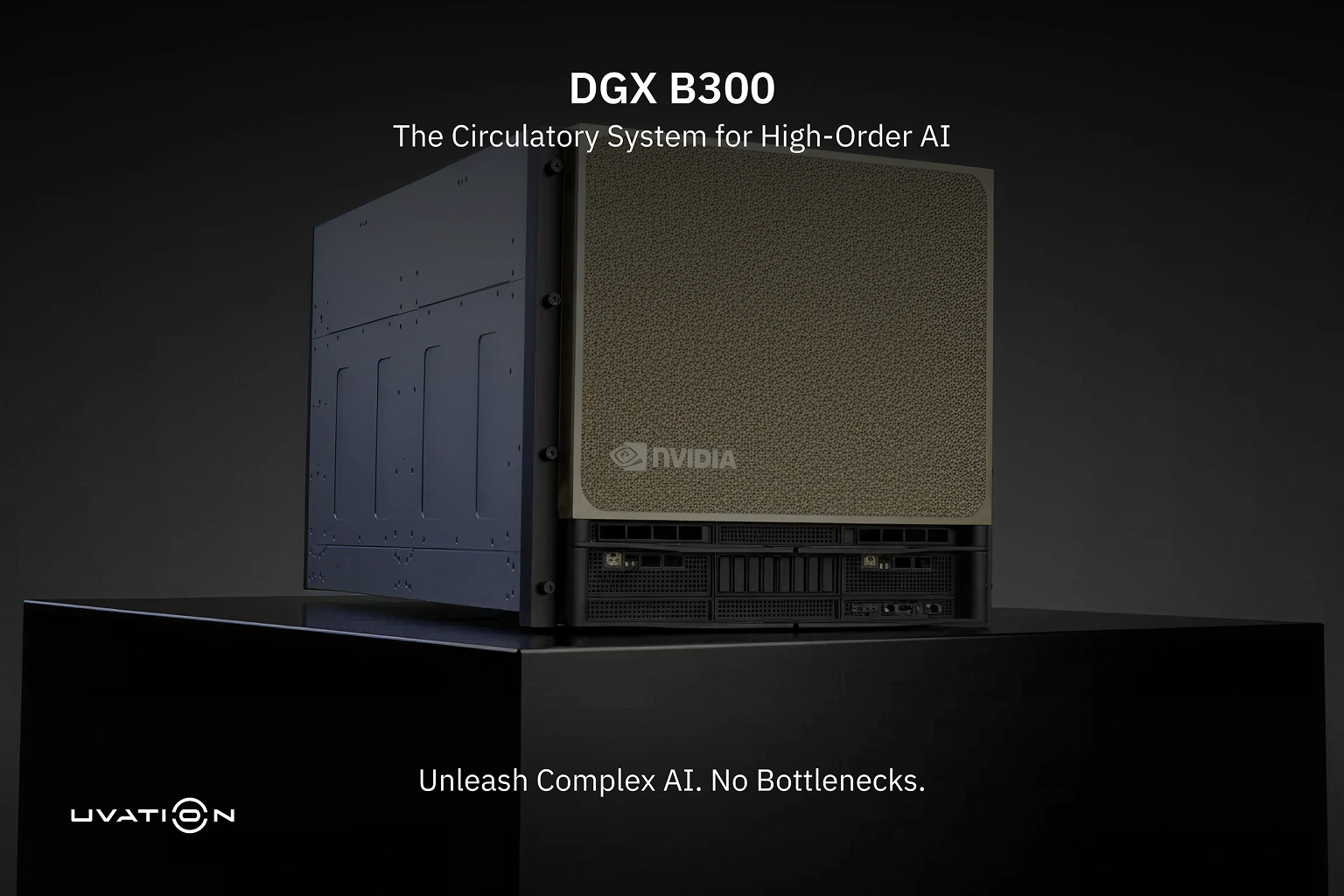
In March 2025, NVIDIA launched the DGX B300, built on its new Blackwell Ultra architecture, marking a significant step forward in AI infrastructure. Unlike older systems designed primarily for training, the B300 is built to handle complex reasoning, real-time inference, and generative AI workloads all on a single platform. For enterprises working on large language models, agentic AI, or multi-step reasoning tasks, this system promises the performance and flexibility needed to run end-to-end AI operations without splitting workloads across multiple machines. In this blog, we’ll break down how the B300 delivers on this promise, from compute and memory to data movement, software orchestration, and deployment, showing how it transforms raw hardware into a production-ready AI platform.
01Engineered for High-Order AI: How the B300 Processes Complex Models
When you’re running advanced AI workloads today, it’s no longer enough to just throw raw compute at the problem. Modern models: large language models, reasoning agents, and multi-step inference pipelines require both precision and scale, moving vast amounts of data while maintaining context across long sequences. DGX B300 is designed to train models faster, keep them thinking, reasoning, and responding without bottlenecks, all on a single system. From handling deep attention chains to feeding models massive context windows, and supporting the full AI lifecycle under one roof. Let’s break down exactly how it does this.
02Handling Deep-Chain Attention
Models that reason, plan, or act step-by-step need to connect hundreds of thousands of tokens seamlessly. The B300’s architecture accelerates attention layers roughly 2× and boosts overall AI compute, allowing these deep chains to run faster without breaking stride. For agents, planners, and multi-step inference, this means your models can handle more complexity in less time, keeping reasoning accurate and responsive.
03Memory Designed Around Context, Not Just Size
Each GPU packs 288 GB of HBM3e, totaling 2.3 TB across the system. But the important part is how this memory feeds models with extremely long context windows without bottlenecks. Whether your LLM is processing 100K or even a million tokens, the B300 keeps the data flowing, ensuring high throughput for reasoning-heavy workloads.
04One Box for the Entire Model Lifecycle
Training, fine-tuning, and inference usually happen on different machines, slowing workflows and fragmenting data. The B300 handles all stages of the AI lifecycle on a single platform, keeping everything in one place. This continuity reduces delays, simplifies pipelines, and lets your AI models move smoothly from experimentation to production. The B300 is a purpose-built platform that lets your AI think deeper, remember more, and run smoother across every stage of its lifecycle.
05The Data Movement Layer: How the B300 Keeps Models Fed
You can have the fastest GPUs and the largest memory, but without high-speed data flow, even the best hardware can stall. The B300 solves this by building a data movement layer that keeps everything running seamlessly, from inside the system to multi-node clusters. It acts as circulatory system for your AI workloads, if data can’t move quickly, reasoning slows down, and throughput drops.
06Internal High-Speed Fabric
Inside the B300, the eight Ultra GPUs are interconnected through fifth-generation NVLink, creating a unified high-speed fabric. With 14.4 TB/s of aggregate bandwidth, this isn’t just a number, it’s the amount of data needed to keep multiple GPUs thinking as a single reasoning core. For models that rely on multi-GPU attention, long token chains, or cross-GPU memory sharing, this internal fabric ensures that no GPU waits idle, and complex computations proceed without interruption.
07External Connectivity That Doesn’t Bottleneck the Cluster
Running multi-node AI workloads demands more than internal speed. That’s why the B300 integrates ConnectX-8 SuperNICs, capable of up to 800 Gb/s, directly attached to GPUs via PCIe Gen6. This design allows multiple B300 systems to link into larger clusters without bottlenecks, enabling distributed reasoning workloads and large-scale inference graphs to operate as efficiently as if they were a single system. Whether your AI is generating responses in real time or handling massive multi-step training, the data pipeline keeps pace.
08Infrastructure Independence and Security
One thing every AI team eventually learns is that performance isn’t lost inside GPU kernels but the layers around them. Network overhead, storage contention, noisy neighbors, insecure firmware paths- these are the issues that quietly erode throughput long before a model hits scale. The B300 avoids this entirely by splitting AI compute and infrastructure control into two separate worlds. The GPUs focus purely on model execution, while a dedicated control plane takes over orchestration, security, and data-path policing. This separation is what keeps the system predictable even when multiple teams, workflows, and datasets hit it at once.
09BlueField-3 as the System’s Operational Brain
Every B300 carries a BlueField-3 DPU, and this is where the infrastructure work actually lives. Instead of letting storage, networking, or monitoring consume GPU cycles, the DPU performs these tasks in parallel, off to the side, on its own specialized silicon.
- Multi-tenant compute elasticity: Isolates workloads so teams can share a system without stepping on each other’s bandwidth.
- Accelerated data-path operations: Encryption, routing, and packet steering are handled on the DPU, not the host CPU or GPUs.
- Real-time security enforcement: BlueField inspects and enforces policy inline, creating a protected environment without slowing inference or training.
This is the component that ensures the Ultra GPUs never get dragged into infrastructure duties, keeping AI performance consistent even under mixed or bursty load.
10A Hardened Control Surface
Supporting this offload strategy is a fully isolated management layer built around a DC-SCM module. Instead of the typical scattered firmware and ad-hoc control paths, the B300 consolidates system control into a hardened surface.
- Better lifecycle management: Controlled updates, predictable resets, and centralized telemetry.
- Secure firmware boundary: The management plane is physically separated, preventing drift, tampering, or accidental impact on GPU execution.
Together, BlueField-3 and the DC-SCM create an operational bubble around the system- a clean, secure environment where GPUs can run at full efficiency without ever dealing with infrastructure noise.
11AI Factory Software: Turning the Hardware Into a Production System
The B300’s hardware gets most of the attention, but the reality inside any AI team is simple: models don’t move, scale, or stay stable unless the software stack behaves like an actual factory floor. That’s why NVIDIA positions the B300 not just as a compute system, but as something that arrives with its own operational backbone.Let’s see how the B300’s software layers coordinate scheduling, model execution, and inference scaling so teams can run real workloads without stitching together a dozen tools.
12Mission Control as the Factory Operating Layer
Mission Control is the layer that keeps the entire system coherent. Instead of treating jobs as isolated containers, it manages the B300 like a shared factory floor.
- Scheduling: Balancing interactive work, long training jobs, and recurring inference tasks.
- Infrastructure intelligence: Real-time awareness of utilization, bottlenecks, and system health.
- Run:ai–driven orchestration: Cloud-native GPU allocation and fair-sharing across teams.
It’s the part that makes the B300 feel predictable even when multiple groups are pushing the system hard.
13AI Enterprise as the Model Runtime Layer
If Mission Control organizes the factory, NVIDIA AI Enterprise is where the actual model execution takes place. It gives the B300 a stable, validated environment instead of a patchwork of containers and dependencies.
- Optimized foundation model execution: Kernels, libraries, and configs tuned for Blackwell Ultra.
- Secure, validated components: Everything versioned, hardened, and supported for production.
It’s the layer that eliminates the “works on one machine, breaks on another” problem.
14Dynamo as the Inference Acceleration Layer
Dynamo sits at the top of the stack, built for high-volume reasoning and large-context inference. It’s open-source, but deeply aligned with the B300’s architecture.
- Open-source, transparent and extensible.
- Built for scaled-up reasoning services, especially long-context models and agent-style inference loops.
- Real response-time and QPS gains achieved by better model residency and pipelined GPU execution, not tuning tricks.
Dynamo is what turns the B300 from “fast hardware” into a system that can actually serve AI products at scale.
15Accessing the B300 Through Semifly Marketplace
After exploring the hardware and software capabilities of the B300, the next step for teams is getting access to the system in a streamlined way. Semifly Marketplace offers a centralized platform where organizations can evaluate, purchase, and deploy NVIDIA B300 systems, simplifying procurement and ensuring the right configurations for production workloads.
- Centralized availability: Find B300 configurations tailored for different AI workloads without navigating multiple vendors.
- Deployment guidance: Recommended setups and configurations for enterprise-grade AI pipelines, ensuring your teams can start using the system efficiently.
- Ongoing support alignment: Access to professional services and guidance to integrate the B300 into existing infrastructure.
For teams considering adoption, Semifly also offers the opportunity to schedule a free consultation to help select the right system and plan deployment.
16Final Word
The NVIDIA DGX B300 is a complete AI platform. From deep-chain reasoning and massive context memory to high-speed data flow, secure infrastructure, and coordinated software orchestration, it’s built to handle the full lifecycle of advanced AI workloads. By combining these capabilities, teams can train, fine-tune, and deploy models at scale without fragmenting workflows or compromising performance. For organizations ready to explore how the B300 fits into their AI strategy, Semifly Marketplace provides streamlined access and expert guidance, including the option for a free consultation to plan the right deployment for your needs.
← Back to Insights