
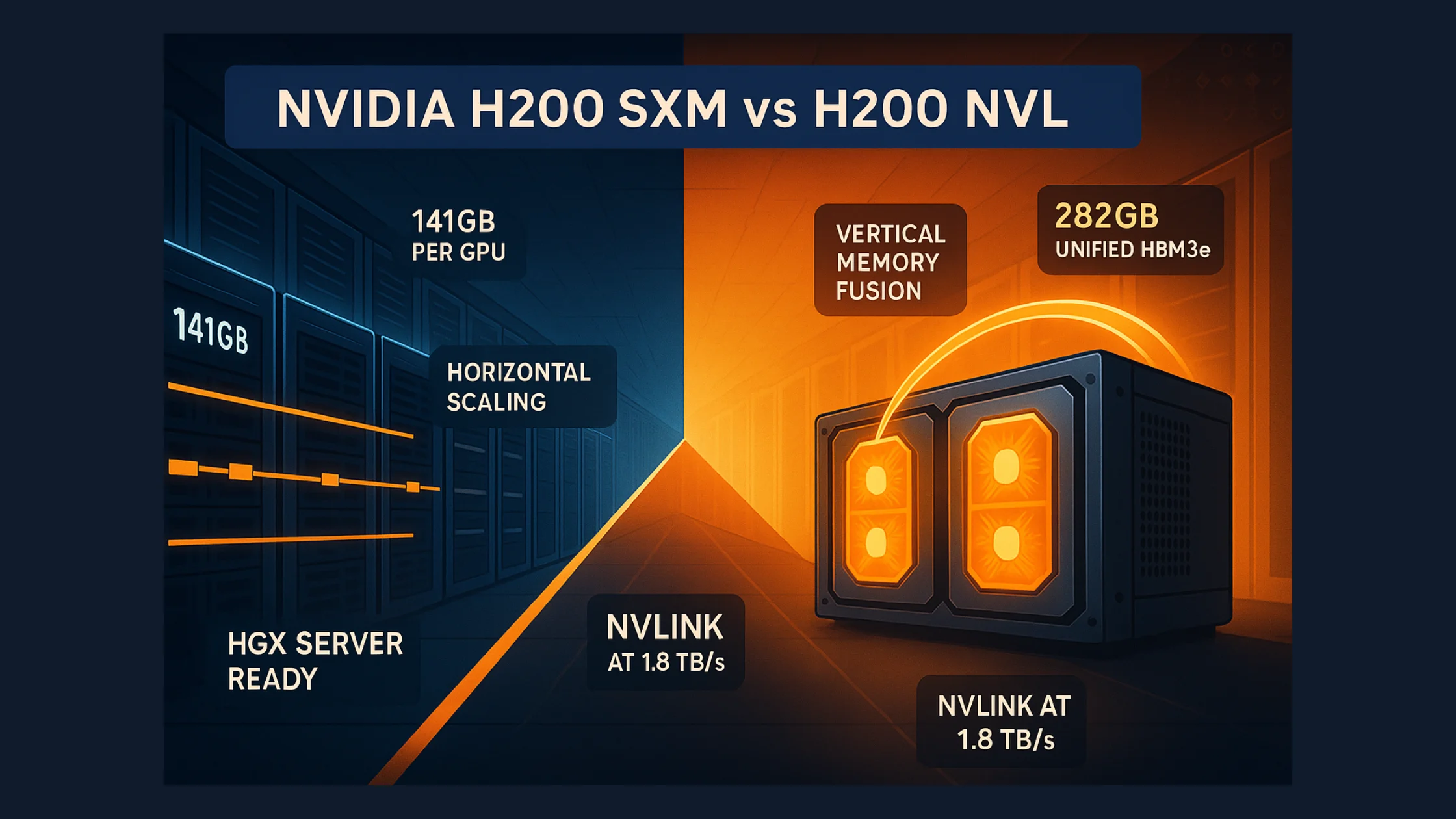
The NVIDIA H200 ships in two very different form factors, and choosing between them shapes the cost, density, and scalability of an entire deployment. The SXM module and the NVL PCIe variant share the same Hopper silicon and 141 GB of HBM3e, but they target different infrastructure realities.
Key Takeaways
- Pick SXM for large training clusters and bandwidth-bound inference at scale.
- Pick NVL to add AI capacity to standard servers without re-architecting the room.
- Match cooling and power up front — SXM density assumes the facility can support it.
- Consider future scale: NVLink domains grow more gracefully than PCIe islands.
01H200 SXM: maximum density and bandwidth
The SXM form factor plugs into NVIDIA's HGX baseboard, where eight GPUs share a high-bandwidth NVLink Switch fabric. This is the configuration of choice for large-scale training and the most demanding inference, because every GPU can exchange data with every other at full NVLink speed. It also carries higher power and cooling requirements, which is why SXM systems are typically liquid-cooled or deployed in purpose-built racks.
02H200 NVL: flexible integration
The NVL variant is a PCIe card, often paired in bridged sets, designed to drop into standard enterprise servers. It trades some peak inter-GPU bandwidth for far easier integration into existing data-center estates. For teams scaling AI inside conventional infrastructure — or running mixed workloads — NVL lowers the barrier to entry.
03The practical decision
Most organizations do not choose purely on specifications — they choose on what their facility, budget, and roadmap can support. A greenfield AI factory leans SXM; an enterprise modernizing existing racks often starts with NVL and grows. Semifly helps size the right mix against real workloads rather than headline numbers, so capacity matches both today's models and tomorrow's.
← Back to Insights