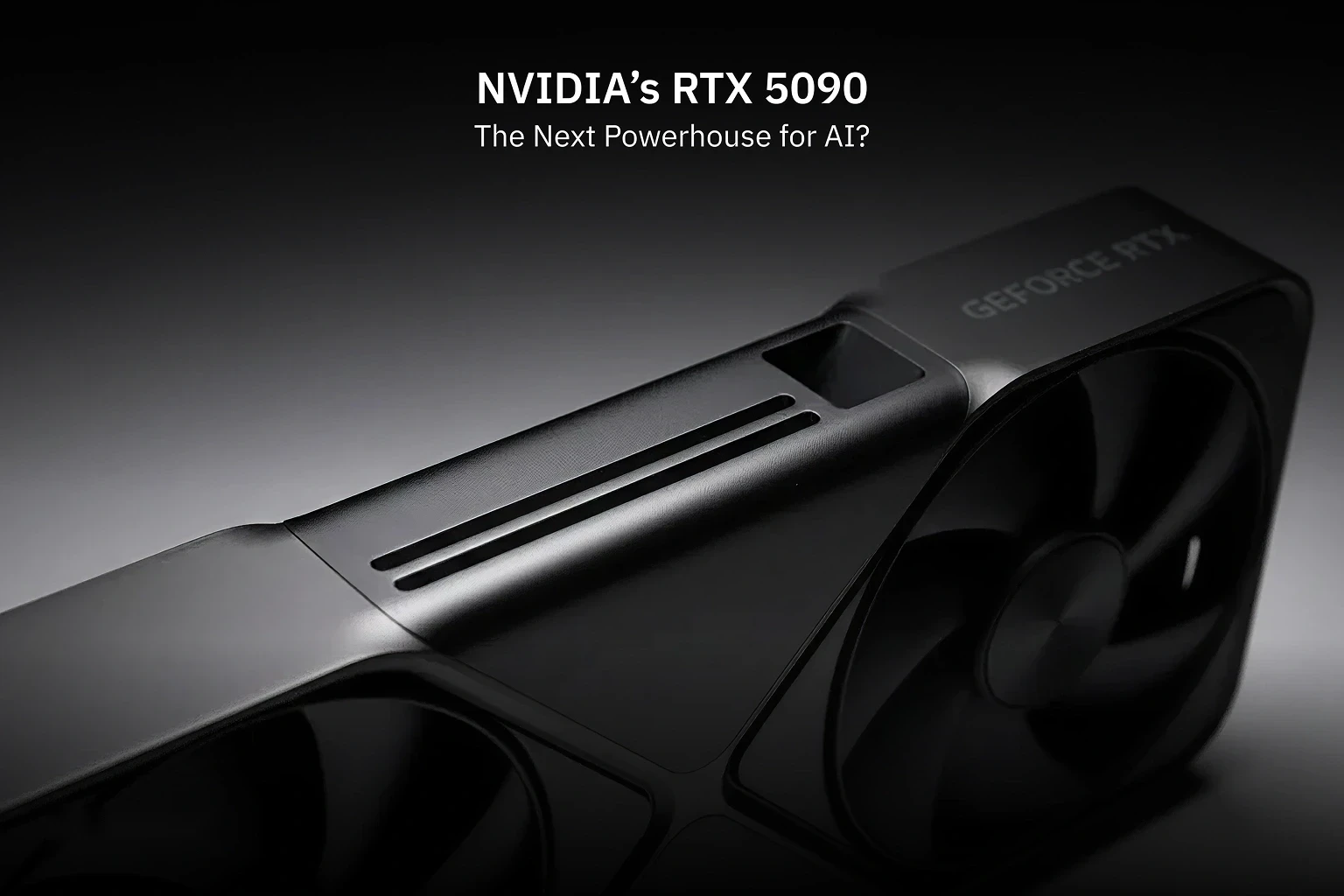
The RTX 5090 is NVIDIA's flagship Blackwell-generation desktop GPU—and the most common cause of a very specific enterprise argument. One camp sees a workstation card with data-center-class AI throughput at a fraction of data-center price. The other sees a gaming product wearing a lab coat. Both are partially right, and the disagreement dissolves once you place the card in the deployments it was actually built for.
Key Takeaways
- The 5090 delivers serious AI throughput and 32GB of fast GDDR7—exceptional per-dollar compute for individual workloads.
- What it lacks defines its ceiling: no NVLink, no ECC-class reliability story, consumer drivers and licensing, ~575W in a desktop envelope.
- Ideal roles: developer workstations, prototyping, fine-tuning small models, local inference on 30B-class quantized models, rendering and simulation.
- Wrong roles: dense multi-GPU servers, 24×7 production serving, anything your compliance team will audit.
01What you are actually buying
Blackwell-generation tensor cores, 32GB of GDDR7 with bandwidth in data-center territory, and a power budget around 575W. For a single developer's workload—tuning a LoRA, running a quantized 30B model locally, iterating on a diffusion pipeline—the experience is close to remarkable: work that recently required a shared cluster queue now happens under a desk.
02What the spec sheet leaves out
Enterprise GPUs earn their premium on the parts that do not benchmark. The 5090 has no NVLink—multi-GPU scaling rides PCIe, which caps serious distributed work. Its memory is not ECC-protected the way data-center parts are, which matters the moment silent corruption can reach a result someone acts on. Consumer driver branches and license terms are not designed for data-center deployment, and 575W of cooler exhaust per card is a real facilities constraint the third time someone proposes “just racking a few.”
03Deployment patterns that work
- The AI developer workstation: one card per researcher beats one queue per team for iteration speed—and frequently beats the cloud bill for sustained experimentation.
- The prototyping tier: validate ideas locally on the 5090, then graduate survivors to H200-class infrastructure for scale training and serving.
- Visualization and simulation: rendering, CAD, and digital-twin work where its graphics heritage is an asset rather than a compromise.
04The bottom line
Buy 5090s as productivity multipliers for the people building your AI, sized one per human. Buy your production capacity from the data-center line, sized by your serving math. Organizations that respect that boundary get the best of both price lists; organizations that blur it usually rediscover the boundary during an incident review.
Ready to put this into practice?
Talk to the Semifly team about your infrastructure, security, and compliance roadmap.
Contact Us