
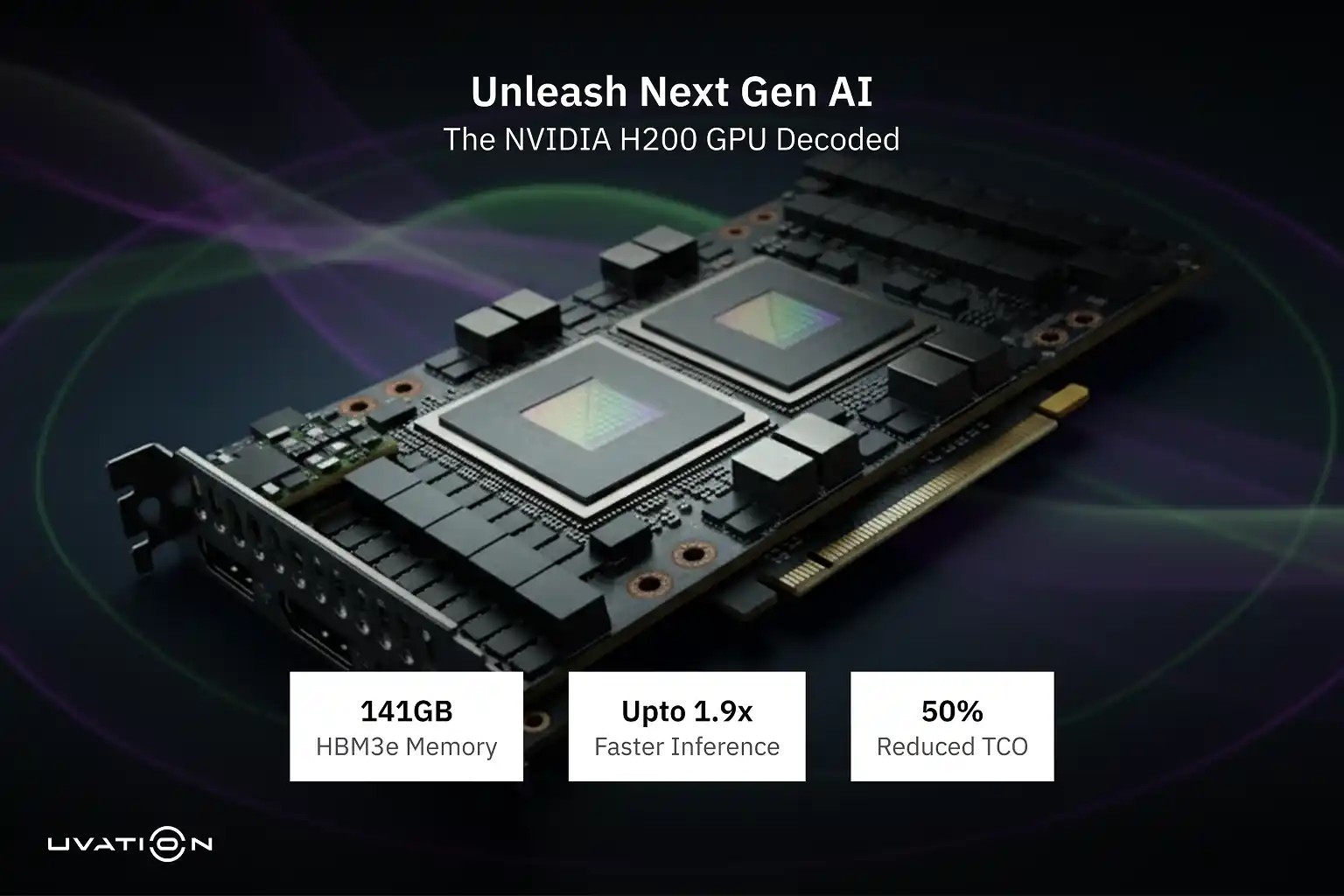
The global Artificial Intelligence (AI) boom has continuously pushed the limits of computational demand, necessitating accelerators capable of handling massive workloads, particularly for Large Language Models (LLMs). Standing at the forefront of this revolution is the NVIDIA H200 Tensor Core GPU, based on the Hopper architecture. This GPU is not just an incremental update; it is a specialized machine engineered to solve the most persistent bottlenecks in modern distributed AI training and inference: memory capacity and bandwidth.
The emergence of the H200 signals a critical shift in AI infrastructure philosophy, moving beyond raw compute power alone and emphasizing the necessity of intelligent hardware-software co-design to achieve true scalability and efficiency.
01Architectural Power: Memory, Precision, and Performance
The NVIDIA H200 Tensor Core GPU distinguishes itself from its predecessor, the H100, primarily through significant memory innovation, while retaining the same core compute profile.
The H200 is the first GPU to utilize HBM3e high-bandwidth memory. This translates to a massive upgrade in capacity, providing 141 GB of GPU memory—nearly double the capacity of the H100’s 80 GB. Crucially, the memory bandwidth has also been significantly boosted to 4.8 TB/s, representing a 1.4x increase over the H100’s 3.35 TB/s.
This architectural focus directly addresses memory-bound workloads inherent in large-scale AI:
- Large Models and Context Windows: The H200’s expanded memory allows models with 100+ billion parameters, such as DeepSeek R1 (685 billion parameters), to be served reliably, supporting longer input sequences and larger KV caches without requiring complex distributed memory management strategies across numerous nodes, as was necessary with H100s.
- Inference Acceleration: For LLM inference, the H200 has demonstrated substantial gains, achieving up to 1.9x faster performance compared to the H100 in workloads like Llama-2 70B. This speed and memory capacity enable higher throughput on latency-insensitive batch workloads.
- Mixed Precision Support: The H200 maintains powerful compute capability across multiple precisions, including FP8, FP16, BF16, and INT8, delivering 3,958 TFLOPS/TOPS for FP8/INT8 density. The use of FP8 mixed precision, accelerated by the Transformer Engine, allows for advanced training and inference acceleration while maintaining numerical stability, enabling up to 1.4x performance improvement for attention operations compared to standard FP16.
02Scaling the AI Factory: Network Fabric and Distributed Challenges
The transition to multi-GPU systems—whether scale-up (fewer, higher-capacity devices like 32xH200) or scale-out (more, lower-capacity devices like 64xH100)—exposes communication bottlenecks that profoundly influence efficiency.
03The Role of Interconnects
For complex distributed training and multi-GPU inference, high-speed interconnects are indispensable.
- NVLink and NVSwitch: The H200 leverages the Hopper architecture’s fourth-generation NVLink, enabling 900 GB/s GPU-to-GPU communication within the server. When paired with NVSwitch, this creates a non-blocking, all-to-all mesh connectivity, which is critical for tensor parallelism (TP) used in inference. In fact, using NVSwitch can provide up to 1.5x greater real-time inference throughput compared to a comparable GPU without NVSwitch, particularly as batch sizes increase and GPU-to-GPU traffic rises.
- Ethernet Fabric: Solutions like the Dell PowerEdge XE9680 H200 cluster utilize Ethernet (e.g., Broadcom Thor2 400GbE NICs and Tomahawk 5 switches) as the high-performance GPU interconnect. This Ethernet backbone provides robust, lossless fabric that maintained 97.3% network efficiency under peak AI workloads across 64 GPUs, offering advantages in cost, deployment speed, and operational continuity.
04The Bottleneck of Collective Communication
Distributed training of large models (especially Mixture-of-Experts or MoE models) relies heavily on the All-to-All (alltoallv) communication primitive. In MoE models, this operation can account for 30–56% of training time.
This communication faces major system challenges:
- Workload Skew and Dynamism: In MoE training, token routing leads to highly uneven traffic demands across GPU pairs, creating straggler effects where busy NICs delay the entire collective operation. This pattern changes dynamically, requiring schedules to be recomputed quickly (in milliseconds).
- Two-Tier Fabric Heterogeneity: GPUs are connected via fast intra-server (scale-up, e.g., NVLink, 900 GB/s) and much slower inter-server (scale-out, e.g., InfiniBand/Ethernet, 400 Gbps) links.
To address the severe performance degradation caused by skew and incast congestion in these fabrics, new schedulers like FAST exploit the faster scale-up links (NVLink) to rebalance traffic locally before sending it across the slower scale-out network. This strategy can improve end-to-end MoE training throughput by up to 4.48x over standard libraries like RCCL, demonstrating the critical link between communication-aware scheduling and achieving scalable performance.
05The Efficiency Imperative: Cooling, Power, and TCO
The sheer computational intensity of the H200 architecture places unprecedented stress on data centre infrastructure, making thermal management and power efficiency central concerns.
06Power and Thermal Constraints
The H200 GPU has a Thermal Design Power (TDP) up to 700W (configurable). A fully integrated DGX H200 system (with eight GPUs) can draw up to 10.2 kW of power, which is directly converted into heat. This density challenges traditional air cooling systems, demanding continuous, massive airflow.
Due to the extreme heat generation, liquid cooling—specifically Direct-to-Chip (D2C) cold plates—is strongly recommended for efficiently removing thermal output and preventing system failures.
Furthermore, internal system architecture can lead to thermal imbalance. In air-cooled systems, GPUs near the exhaust frequently reach higher temperatures, triggering clock throttling (frequency reduction) to prevent overheating. This throttling causes performance variability and can disrupt synchronization in distributed workloads, especially those using synchronization-heavy strategies like tensor and data parallelism. Addressing this requires sophisticated, cooling-aware strategies that leverage infrastructure monitoring.
07Maximizing Investment: TCO and Management
Despite the high initial cost (e.g., $31,000 to $32,000 for a single NVL H200 GPU card), the H200 architecture is engineered for superior efficiency measured in performance per watt.
The H200 promises up to 50% reduced energy use and total cost of ownership (TCO) compared to the H100 for key LLM inference workloads, primarily because its accelerated performance means the same task completes faster with less total energy consumed. Enterprises deploying solutions like the Dell PowerEdge XE9680 H200 platform reported achieving 19-23% total cost advantages over three-year cycles, alongside 20% superior power efficiency.
To manage these complex systems effectively, sophisticated software stacks are essential:
- Orchestration and Monitoring: Kubernetes provides the necessary orchestration layer for scaling and managing H200 workloads, seamlessly integrating with the NVIDIA GPU Operator for automated driver/software deployment and the Multi-Instance GPU (MIG) feature to partition a single H200 into up to seven independent instances.
- System Health: NVIDIA System Management (NVSM) is an “always-on” health monitoring engine for DGX systems, providing continuous health checks, system alerts, and the ability to generate detailed diagnostic logs. NVSM uses the NVIDIA Data Center GPU Manager (DCGM) to monitor GPU health, reporting critical issues like NVLink link degradation or power limit misconfiguration.
08Conclusion: Beyond Hardware—The Future of Co-Design
The NVIDIA H200 GPU solidifies its position as a transformative technology for AI and HPC, primarily driven by its massive HBM3e memory capacity and superior bandwidth. However, unlocking this potential relies entirely on successfully navigating the non-algorithmic complexities of modern infrastructure, such as intricate network topologies, highly dynamic workload imbalances, and persistent thermal constraints.
The shift demonstrated by the H200 era emphasizes the crucial need for full-stack optimization—where parallelism strategies, cooling systems, power budgets, and scheduling policies are co-designed and continuously tuned with awareness of real-world hardware variability to ensure robust, efficient, and scalable deployment of the largest AI models.
← Back to Insights