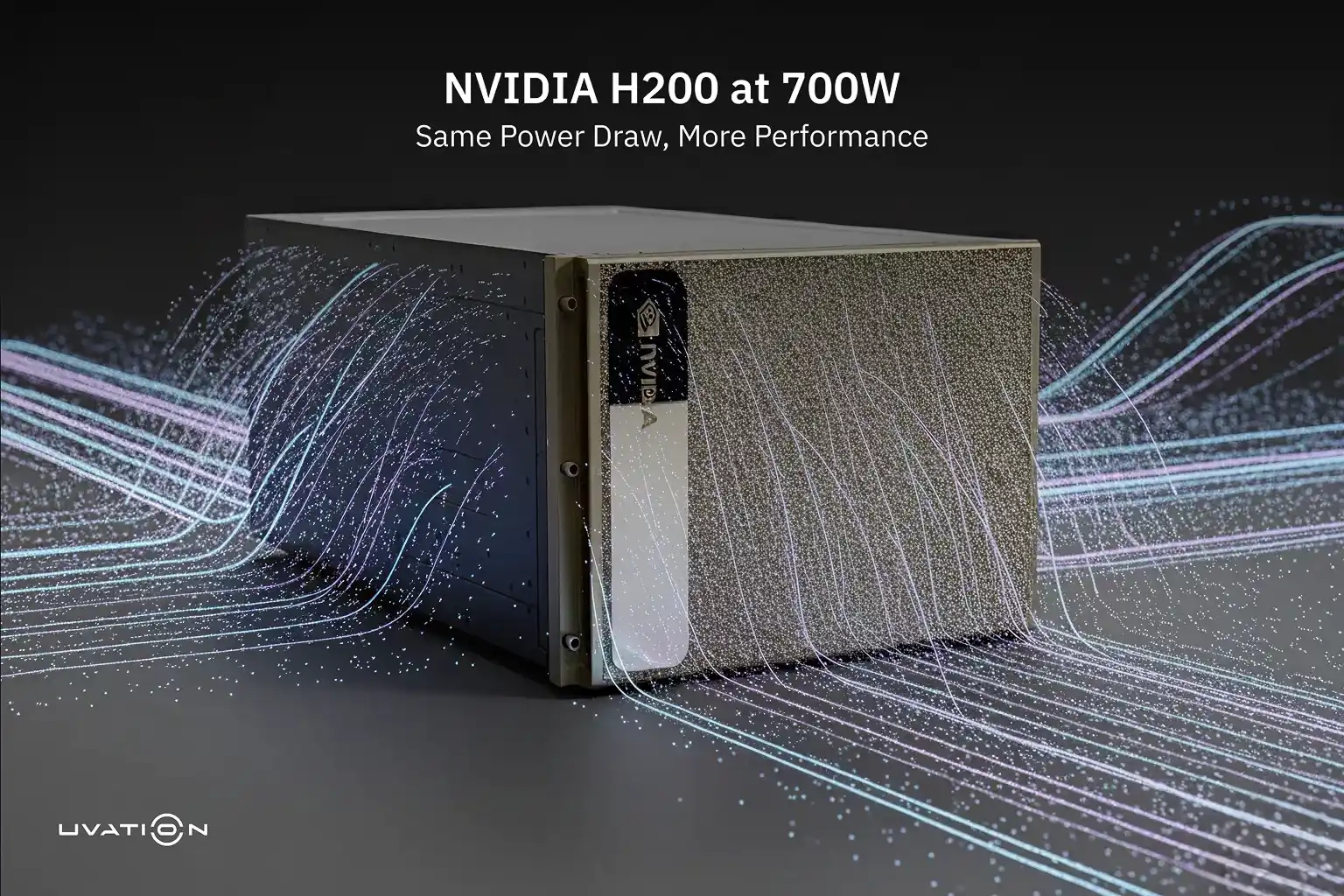
“What is the best GPU for AI?” is the wrong question, and it costs organizations real money every quarter. The right question is “best for which job”—because the AI GPU market now spans an order of magnitude in price and the expensive failure mode is buying the wrong class, not the wrong model within a class.
Key Takeaways
- Match the GPU class to the workload class: development, fine-tuning, production inference, and frontier training have different binding constraints.
- Memory—capacity and bandwidth—is the binding constraint for most modern LLM work, not raw compute.
- Interconnect (NVLink vs PCIe) decides whether multi-GPU scaling is real or aspirational.
- Price the system, not the card: power, cooling, networking, and software licensing routinely double the real cost.
01The four questions that pick your class
1. Does the model fit? Parameter count, precision, and context length set a hard memory floor. A model that does not fit in VRAM does not run slowly—it does not run. Quantization buys room at the cost of evaluation effort; count that effort.
2. Is the workload compute-bound or memory-bound? Training dense models saturates compute; serving LLMs with long contexts saturates memory bandwidth and capacity. The H200's value over the H100 is almost entirely a memory story—which tells you exactly which workloads justify it.
3. One GPU or many? The moment a job spans GPUs, interconnect becomes the spec that matters. NVLink-connected systems scale collectives the way the textbooks promise; PCIe-only configurations hit a wall that no amount of per-card brilliance fixes.
4. How many hours per week will it run? Utilization decides rent-versus-buy. Bursty experimentation favors cloud; sustained pipelines favor owned infrastructure, often by a wide margin over a three-year horizon.
02The classes, honestly described
- Workstation (RTX 5090 class): unbeatable per-dollar for development, prototyping, and local inference on quantized mid-size models. Not a production serving tier—no NVLink, no enterprise reliability story.
- Inference-optimized data center (L40S class): efficient, dense, right-sized for serving small-to-mid models and mixed visual/AI workloads at scale.
- Flagship training/serving (H100/H200 class): the default for serious LLM work. Choose H200 when memory is the constraint—long contexts, big KV caches, large embedding tables; H100 remains excellent for compute-bound training.
- Rack-scale (B300/GB-class systems): when the unit of purchase is a training cluster, you are buying a system architecture—fabric, cooling, facilities—not a GPU. Evaluate it as one.
03Total cost, total honesty
The card is one line on the invoice. A serious selection prices power and cooling at your facility's rates, the network fabric multi-GPU training demands, software licensing where production support requires it, and the engineering time each option consumes. Run that arithmetic per workload class and the “best GPU” question answers itself—usually with a short portfolio rather than a single SKU.
Ready to put this into practice?
Talk to the Semifly team about your infrastructure, security, and compliance roadmap.
Contact Us