AI server procurement punishes vagueness. A web server mis-sized by 30% costs a little latency; an AI server mis-sized by the same margin either cannot run the workload at all or strands six figures of idle silicon. The good news: the decision decomposes into a handful of questions whose answers are measurable before any purchase order exists.
Key Takeaways
- Profile before you procure: memory footprint, compute-vs-memory boundedness, and scaling behavior of your actual workloads.
- GPU class and count drive everything else—CPU, RAM, storage, and networking are sized around the accelerators, not vice versa.
- Interconnect honesty: single-node NVLink covers most enterprises; multi-node fabrics are a step-change in cost and complexity.
- Facilities and operations belong in the evaluation, not the postmortem.
01Start from the workload, not the catalog
Three measurements anchor the whole decision. First, the memory footprint of your largest model at its serving precision and context length—this sets the per-GPU VRAM floor and quickly separates 24GB-class from 80GB-class from 141GB-class requirements. Second, boundedness: profile whether your jobs saturate compute or stall on memory bandwidth, because that distinction decides between GPU generations more reliably than any benchmark chart. Third, scaling shape: does the workload live on one GPU, eight NVLink-coupled ones, or across nodes?
02Anatomy of a right-sized AI server
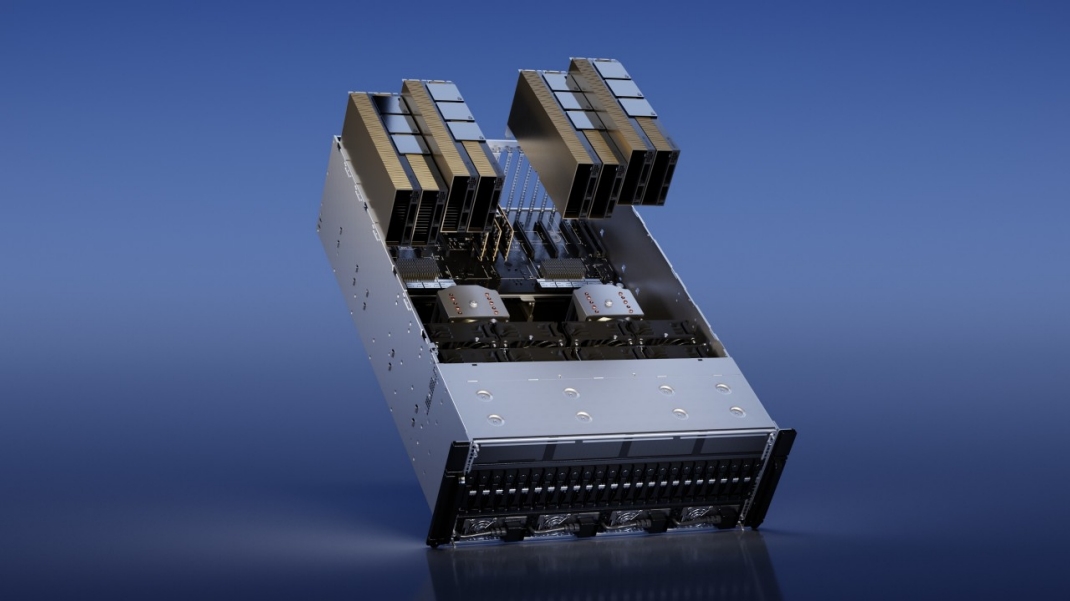
- GPUs: the class question from your profiling—workstation, inference-optimized, or flagship training silicon—then count per node based on parallelism strategy.
- CPU and system RAM: enough to feed the accelerators—data loading, preprocessing, and checkpoint handling stall expensive GPUs when starved. System RAM at 2× aggregate VRAM is a sane default.
- Storage: NVMe scratch fast enough for your dataset streaming rate; training jobs that read slower than they compute are paying GPU prices for disk waits.
- Networking: single-node deployments need ordinary connectivity; anything multi-node needs 200–400Gb-class fabric with RDMA—and the switch budget that implies.

03The questions that prevent regret
- Can the facility feed it? Modern multi-GPU nodes draw 5–10kW+. Rack power, cooling, and floor loading are purchase prerequisites.
- Who operates it? Firmware baselines, scheduler policy, health monitoring—name the owner or budget the managed service.
- What is the utilization plan? An AI server below 50% utilization is a rent-vs-buy decision that was answered wrong; sharing, MIG partitioning, and queueing policy belong in the plan.
- What is year-3? Define the second life—inference tier, dev cluster—before purchase, and the depreciation math gets honest.
04Buy the boring truth
The right AI server is rarely the most impressive one in the catalog; it is the one whose every component traces back to a measurement of your workload and whose operating plan has names attached. Organizations that procure this way get infrastructure that disappears into productivity—which is the entire point.
Ready to put this into practice?
Talk to the Semifly team about your infrastructure, security, and compliance roadmap.
Contact Us