FEATURED STORY OF THE WEEK
The Best DGX B200 AI Cluster for Enterprises

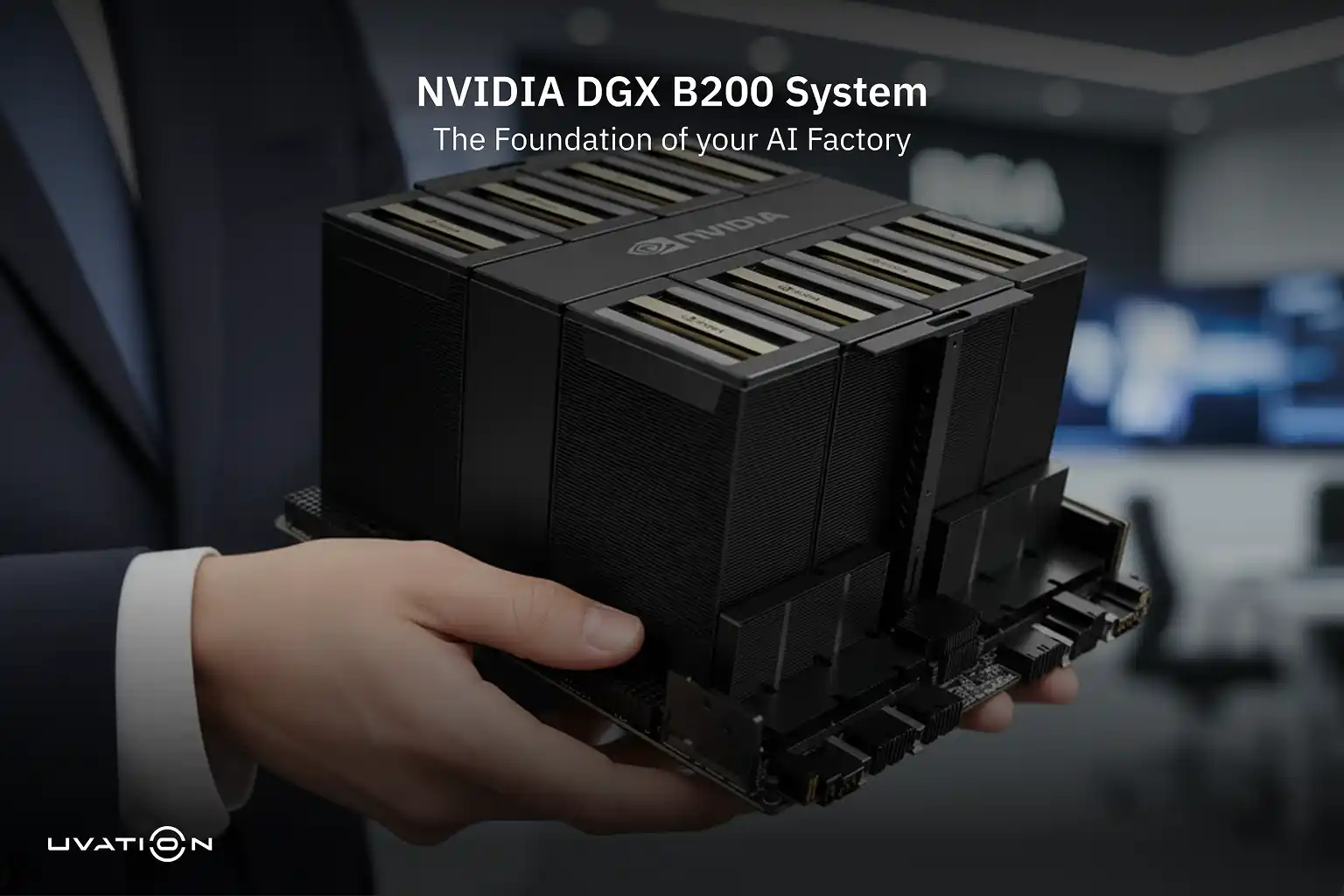
The emergence of generative AI (GenAI) and large language models (LLMs) has fundamentally reshaped enterprise computational demands, necessitating infrastructure that can deliver unprecedented speed, efficiency, and scale. The NVIDIA DGX™ B200 system is the universal platform purposefully built for all demanding AI infrastructure and workloads, positioning itself as the “foundation for your AI factory”. By leveraging the cutting-edge Blackwell architecture, the DGX B200 is the modular building block for creating highly scalable AI clusters, notably through the NVIDIA DGX SuperPOD™ reference architecture.
How Blackwell Refines NVIDIA’s Compute DNA
The Blackwell architecture is the successor to the 2022-era Hopper generation. Blackwell integrates several cutting-edge technologies designed explicitly for massive-scale AI:
- Dual-Die Architecture and Transistor Count: Each B200 GPU utilizes a unique dual-die design, essentially fusing two GPU chips into a single package via a high-bandwidth interconnect that supports speeds of 10 TB/s. A single Blackwell GPU boasts 208 billion transistors, a substantial leap from the 80 billion transistors found in the preceding H100 and H200 GPUs.
- Fifth-Generation NVLink: The architecture features the fifth-generation NVIDIA NVLink®, providing 1.8 TB/s of GPU-to-GPU bandwidth. This dramatically increased speed is crucial for allowing thousands of GPUs to operate as one single giant GPU.
- Advanced Precision: Blackwell features the second-generation Transformer Engine and introduces the NVFP4 low-precision format for enhanced efficiency without compromising accuracy. This innovation is a primary driver for the generational leap in inference performance.
What the DGX B200 Brings to Your Enterprise
The NVIDIA DGX B200 is an integrated, rack-mount supercomputer delivered in a 10U form factor. It is equipped with an optimized hardware stack to maximize AI throughput:
| Specification | Details and Figures |
|---|---|
| GPUs | 8x NVIDIA Blackwell GPUs |
| Training Performance | 72 petaFLOPS (FP8 precision) |
| Inference Performance | 144 petaFLOPS (FP4 precision) |
| GPU Memory (Total) | 1,440 GB (≈180 GB HBM3e per GPU) |
| Interconnect | 14.4 TB/s aggregate all-to-all GPU bandwidth (5th Gen NVLink) |
| CPU | 2× Intel® Xeon® Platinum 8570 (112 cores total, up to 4 GHz) |
| System Memory | 2 TB, configurable up to 4 TB DDR5 RAM |
| Networking | 4× OSFP ports (8× ConnectX-7 VPI cards) + 2× BlueField-3 DPUs; up to 400Gb/s InfiniBand/Ethernet |
| Storage (Internal) | OS: 2× 1.92TB NVMe M.2 (RAID 1) Data Cache: 8× 3.84TB NVMe U.2 SED (RAID 0) |
| Power Consumption | ~14.3 kW max |
The DGX B200 is tightly integrated with the complete NVIDIA AI software stack, including NVIDIA Base Command™ for orchestration and scheduling, and NVIDIA AI Enterprise for optimized frameworks and microservices.
Enterprise Challenges the DGX B200 Solves Today
The DGX B200 platform is engineered to tackle the most demanding challenges faced by enterprises seeking to operationalize cutting-edge AI:
- Accelerating AI Model Performance: The system delivers up to 3X faster training performance and 15X faster inference performance compared to the preceding DGX H100 platform. This acceleration significantly shortens the AI development lifecycle, increasing the pace of iteration and time-to-results.
- Handling Trillion-Parameter Models: The architecture is designed to handle model sizes up to 10 trillion parameters. Its substantial 1,440 GB of integrated GPU memory addresses memory capacity limitations that frequently result in Out-of-Memory (OOM) errors when dealing with large models.
- Real-Time Generative AI: For deployment-focused organizations, the B200 offers revolutionary inference speeds. It has demonstrated the ability to achieve over 1,000 tokens per second (TPS) per user on the 400-billion-parameter Llama 4 Maverick model, hitting server peaks of 72,000 TPS/server. This performance allows for real-time interactions required for advanced conversational AI and agentic applications.
- Cost and Energy Efficiency: In power-constrained facilities, the Blackwell architecture improves energy efficiency, potentially enabling an overall throughput increase of up to 13% compared to default settings. The DGX B200’s energy efficiency improvements translate into significantly lower operational expenses, with Blackwell lowering the cost per million tokens by 15X compared to the previous generation.
- Simplified Scaling and Operations: The system forms the architectural foundation for NVIDIA DGX SuperPOD. This modular design uses Scalable Units (SUs) of 32 DGX B200 systems, allowing for predictable scaling up to and beyond 127 nodes. The deployment is unified and managed by NVIDIA Mission Control (which includes NVIDIA Base Command Manager and NVIDIA Run:ai functionality), streamlining cluster orchestration, provisioning, and resource allocation.
Getting DGX B200 Into Your Data Center: Plan and Expectations
Deploying a DGX B200 cluster requires careful planning across facility infrastructure, power delivery, cooling, and networking.
Data Center and Power Infrastructure: The DGX B200 operates at a significant power draw of approximately 14.3 kW max.
- Density: The typical deployment model supports only two DGX B200 systems per 42U/48U rack to manage power and cooling demands effectively, equating to a peak server demand of 28.6 kW per circuit. Deploying four systems per rack requires specialized data centers engineered for extreme density air-cooled deployments.
- Power Redundancy: The DGX B200 employs six 3.3 kW power supply units (PSUs) configured for 5+1 redundancy. Critically, the system requires at least five of the six PSUs to be energized for operation. Traditional dual-source power provisioning models (N) may fail during an upstream event if more than one PSU loses power. The optimal configuration for maximum availability is to provision six discrete UPS sources (“6 to make 5”), ensuring that the failure of any single PDU or UPS source will not impact the systems.
- Cooling: The system relies on air cooling, requiring an airflow of 1,550 CFM and generating 48,794 BTU/hr of heat output. Effective thermal management requires maintaining an operating temperature range of 5°C to 30°C (41°F to 86°F).
Network and Storage Planning: The overall cluster architecture demands careful planning of the physical arrangement of nodes, cable, and port structure.
- Fabrics: A DGX SuperPOD installation uses segregated networks: a high-performance Compute Fabric (InfiniBand/NVLink) for GPU-to-GPU communication, a dedicated Storage Fabric for high-speed data access, and separate In-Band and Out-of-Band networks for management.
- High-Speed Storage: To maximize performance, the storage must support RDMA over InfiniBand or Converged Ethernet (RoCE). The system supports GPUDirect Storage (GDS), utilizing the nvidia-fs kernel module. GDS enables a direct DMA path between GPU memory and storage, bypassing the CPU bounce buffer to increase bandwidth and minimize CPU overhead.
- Storage Benchmarks: The required read bandwidth per node for enhanced workloads is 125 GBps per SU (500 GBps aggregate for a 4 SU cluster), and the write requirement is 62 GBps per SU (250 GBps aggregate for a 4 SU cluster).

Comparing DGX B200 to Other DGX Models and AI Infrastructure
The DGX B200 sits at the frontier of commercial AI computing, but it must be compared against its predecessor, specialized rack-scale systems, and competitors:
| Feature | NVIDIA DGX B200 | NVIDIA DGX H100 | NVIDIA GB200 NVL72 | Cerebras CS-3 |
|---|---|---|---|---|
| Architecture | Blackwell | Hopper | Grace Blackwell | Wafer Scale Engine |
| Form Factor | 10 RU (8 GPUs) | 10 RU (8 GPUs) | Full Rack (72 GPUs) | 15U Server (1 WSE) |
| FP8 Training | 72 petaFLOPS | 32 petaFLOPS | N/A (Rack-scale) | 125 petaFLOPS (FP16) |
| FP4 Inference | 144 petaFLOPS | N/A | Optimized for 30× boost vs H100 | N/A |
| Total GPU Memory | 1,440 GB HBM3e | 640 GB HBM3 | 384 GB HBM3e per GB200 Superchip | 12 TB – 1.2 PB external memory |
| Interconnect Bandwidth | 14.4 TB/s (NVLink 5th Gen) | 900 GB/s (NVLink 4th Gen) | 130 TB/s aggregate (NVLink 5th Gen) | 27 PB/s on-wafer fabric |
| Max Power (System) | ~14.3 kW | 10.2 kW | 120 kW | 23 kW |
| Comparative Speed | 3× training, 15× inference vs H100 | Baseline | 30× faster inference than HGX H100 | Up to 21× faster inference vs B200 GPU |
The B200’s performance jump over the H100 is substantial across almost every metric. However, dedicated competitors like the Cerebras CS-3 challenge the B200 in raw performance (125 petaflops for CS-3 vs. 36 petaflops for the DGX B200 in FP16 contexts) and memory capacity (up to 1.2 PB external memory on CS-3). While the CS-3 claims superior interconnect bandwidth and performance per watt, NVIDIA holds a dominant position due to its extensive CUDA ecosystem maturity, which has underpinned AI development for years.
Is DGX B200 Right for Your Enterprise?
The decision to adopt the DGX B200 hinges on balancing current needs, budget, and future ambition. The B200 is positioned for organizations committed to future-proofing and tackling next-generation models (200B+ parameters) where performance cannot be compromised.
When DGX B200 is the ideal choice:
- Frontier AI Workloads: Your roadmap includes extreme model sizes or highly complex reasoning/agentic AI applications demanding sub-50ms latency.
- Infrastructure Modernization: You are undertaking a full infrastructure upgrade, as the DGX B200’s power and cooling demands exceed what older data centers can typically support for density deployments.
- Unified Platform Strategy: You require a unified hardware and software solution that integrates tightly with the full NVIDIA AI Enterprise and Mission Control stack for simplified management and orchestration.

Cost and Acquisition: The DGX B200 is an enterprise-grade investment; complete 8x B200 server systems can exceed $500,000 in outright purchase cost. Individual DGX B200 GPUs are estimated around $45,000–$50,000 for the 192GB SXM model. For smaller or intermittent consumption, cloud rental options are available, with hourly rates starting around $5.87 to $8.64 depending on the provider and bundling.
How Semifly Marketplace Supports Your DGX B200 Journey
The provided sources do not contain any information regarding “Semifly Marketplace” or how it specifically supports the deployment or procurement of the NVIDIA DGX B200 system.
Final Word
The NVIDIA DGX B200, powered by the Blackwell architecture, sets the new standard for AI compute density, scale, and efficiency. Its groundbreaking performance figures—up to 144 petaFLOPS of FP4 inference and 1,440 GB of unified GPU memory—are essential for handling the explosion in large model complexity and the stringent latency demands of real-time AI agents. Supported by a three-year Enterprise Business-Standard Support package and NVIDIA’s comprehensive software ecosystem, the DGX B200 provides a production-ready solution that delivers agility and resilience for AI data centers scaling into the exascale era.
More Similar Insights and Thought leadership
No Similar Insights Found
Subscribe today to receive more valuable knowledge directly into your inbox
We are writing frequenly. Don’t miss that.
Subscribe to get updates

Unregistered User
It seems you are not registered on this platform. Sign up in order to submit a comment.
Sign up now