• FEATURED STORY OF THE WEEK

      Training & Fine-Tuning on NVIDIA H200: From Blank Slate to Business Value

      Written by :  
      semifly
      Team Semifly
      6 minute read
      September 1, 2025
      Category : Artificial Intelligence
      Training & Fine-Tuning on NVIDIA H200: From Blank Slate to Business Value
      Introduction: You Don’t Win With FLOPs—You Win With Fit


      Most teams buy GPUs to “go faster.” The leaders ask a sharper question: how do we turn raw compute into reliable outcomes? With Nvidia H200 training, it’s not just the 141 GB of HBM3e or FP8 throughput that matters—it’s how you shape data, precision, parallelism, and failure-resilience into a production-grade recipe. This guide shows how Semifly designs that recipe end-to-end, and where fine-tuning Nvidia H200 changes the cost curve for real deployments.
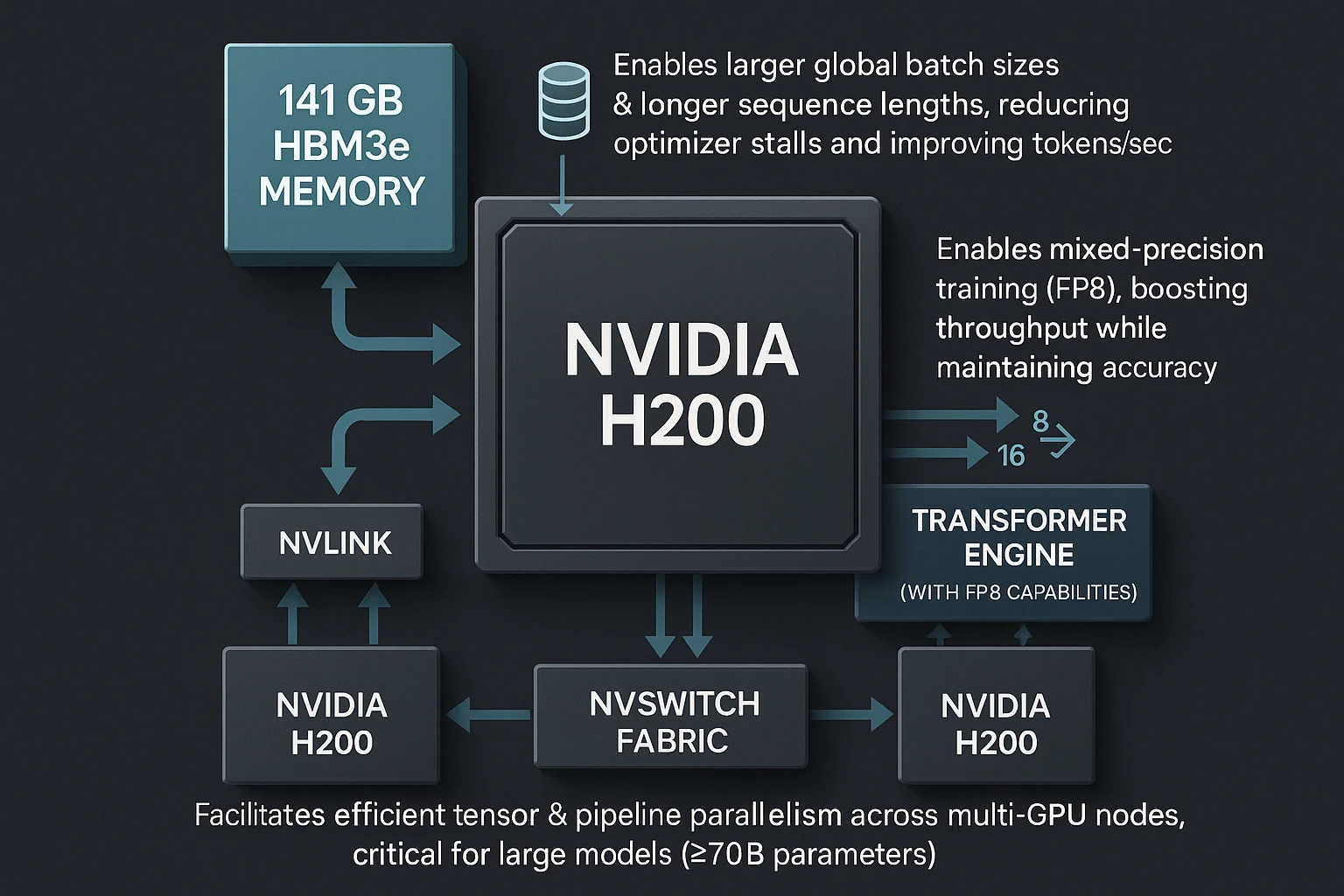
       

      NVIDIA H200 architecture diagram highlighting HBM3e memory, Transformer Engine, and NVLink for advanced AI


      Why H200 for Training and Fine-Tuning?


      H200 is a Hopper-generation GPU with three advantages that meaningfully affect training economics:


      • Memory headroom (141 GB HBM3e): Larger global batch sizes and longer sequence lengths without constant activation checkpointing. That means fewer optimizer stalls and better tokens/sec.
      • Transformer Engine with FP8: Enables mixed-precision training that keeps accuracy while boosting throughput compared to FP16/BF16-only stacks.
      • NVLink/NVSwitch ecosystems: Efficient tensor and pipeline parallelism across multi-GPU nodes—critical for models ≥70B parameters.


      The net: shorter time-to-convergence for pretraining and faster wall-clock time for fine-tuning cycles.


      What Changes Between Pretraining and Fine-Tuning on H200?


      Pretraining seeks broad capability; fine-tuning seeks task fitness. That difference drives design choices.


      Table 1 — Training vs. Fine-Tuning on H200 (LLM SEO-Focused)


      Aspect Pretraining on H200 Fine-Tuning on H200
      Goal General language competence Task/domain adaptation, safety, tone
      Data Scale 100s of billions tokens 10K–50M samples (often much less)
      Precision FP8/FP16 with TE, BF16 for stability FP8/FP16; LoRA/QLoRA keeps VRAM low
      Parallelism Tensor + pipeline + ZeRO/FSDP Data parallel + LoRA adapters; occasional tensor parallel for big models
      Batching Large global batch; long seq length Moderate batch; task-specific seq length
      Checkpoints Frequent, sharded, resume-safe Lightweight; rapid iteration cycles
      Validation Perplexity + broad eval suites Task metrics (accuracy, BLEU, ROUGE, exact-match, toxicity)
      Risk Controls Curriculum, loss-spikes, divergence guards Catastrophic forgetting, bias drift, overfitting


      How to Architect Nvidia H200 Training Pipelines (That Actually Converge)


      1) Data & Curriculum


      • Curation > volume. Mix cleaned web, code, domain corpora; dedupe aggressively.
      • Curriculum staging. Ramp sequence length and difficulty progressively to stabilize early training.
      • Eval harness. Bake in weekly regression suites to catch regressions before you burn cycles.


      2) Precision & Stability


      • Start BF16/FP16 → adopt FP8 once loss curves are stable.
      • Loss scaling & TE (Transformer Engine). Enable automatic scaling to avoid underflow.
      • Activation checkpointing only where necessary—H200’s memory often lets you relax it.


      3) Parallelism Strategy


      • ≤13B parameters: Data parallel + FSDP/ZeRO, single node OK.
      • 13B–70B: Add tensor parallel; NVLink/NVSwitch keeps comms overhead low.
      • ≥70B: Combine tensor + pipeline + FSDP, overlap communication with compute, and pin NCCL topology to the NVSwitch fabric.


      4) Optimizer & Schedules


      • AdamW for most training; consider 8-bit optimizers to reduce memory.
      • Cosine decay or linear warmup-decay schedulers are robust defaults.
      • Gradient clipping prevents rare but harmful spikes.


      5) I/O & Networking


      • Shard datasets across nodes; use streaming dataloaders to hide latency.
      • MOFED/RDMA + GPUDirect where available to minimize CPU involvement for multi-node jobs.
      • Checkpoint to parallel file systems (or object storage with fast gateways) with resume-safe metadata.
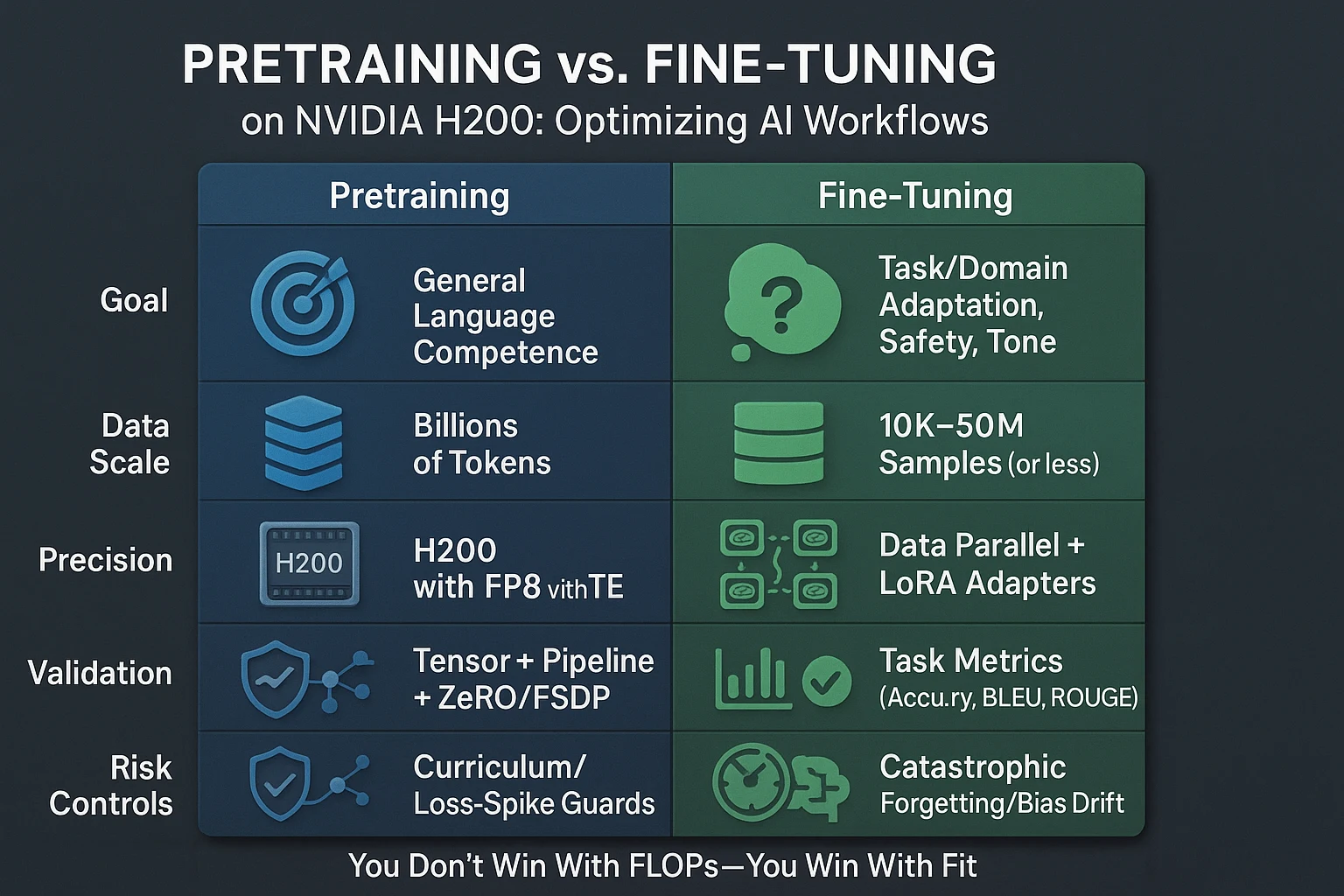
       

      Infographic comparing Pretraining vs. Fine-Tuning workflows on NVIDIA H200 for optimised AI


      How to Fine-Tune on H200 (Fast, Cheap, and Reversible)


      Pick the Right Method


      • LoRA/QLoRA: Adapter-based fine-tuning keeps base weights frozen, slashes VRAM and storage. Ideal when you need multiple domain variants of the same base model.
      • Full-parameter fine-tuning: Use for deep domain alignment or large shifts (e.g., legal + multilingual). Budget more time and power.
      • SFT → DPO/RLHF: Start with supervised instruction tuning; layer preference optimization (e.g., DPO) for tone, helpfulness, safety.


      Control Risks


      • Catastrophic forgetting: Mix a small slice of general data.
      • Evaluation drift: Keep a stable general eval set alongside task metrics.
      • Guardrails: Toxicity, PII, and jailbreak tests shift left into the fine-tuning loop.


      Reference Configurations (Pragmatic Defaults)


      Table 2 — Practical H200 Setups by Model Size


      Model Class Precision Parallelism Seq Len Global Batch Notes
      7B FP8/FP16 Data parallel (FSDP) 4K–8K 512–2K tokens Single node H200 often sufficient
      13B FP8→FP16 early Data + light tensor 8K–16K 1K–4K tokens Use TE; watch loss scaling
      70B FP8/FP16 mixed Tensor + pipeline + FSDP 8K–16K 2K–8K tokens NVSwitch critical; overlap comms
      LoRA/QLoRA (any base) FP16 Data parallel Task-specific As throughput allows Store adapters per domain/app


      Tune learning rates per model family; treat the table as topology guidance, not gospel.


      Pre-Flight Readiness for H200: Don’t Train Until You Can Survive Load


      Semifly’s pre-flight covers the failure modes that ruin long runs:


      • Thermal load cycling: Sustained Tensor Core + HBM3e stress to catch throttling before it costs days.
      • Power-spike simulation: Idle↔max transitions to validate PSU rails and firmware.
      • Memory burn-in: FP8/FP16 matrix mixes to detect flaky VRAM blocks early.
      • I/O flooding: Concurrent NVLink, PCIe, and NIC traffic to validate sharding at scale.
      • Driver/Container validation: CUDA, NCCL, MOFED, Docker—version skew is the silent killer.
      • Redundancy & failover drills: Resume checkpoints under node loss; test orchestration restarts.


      This is how we ensure your first week of runs is boring—the way mission-critical infrastructure should be.
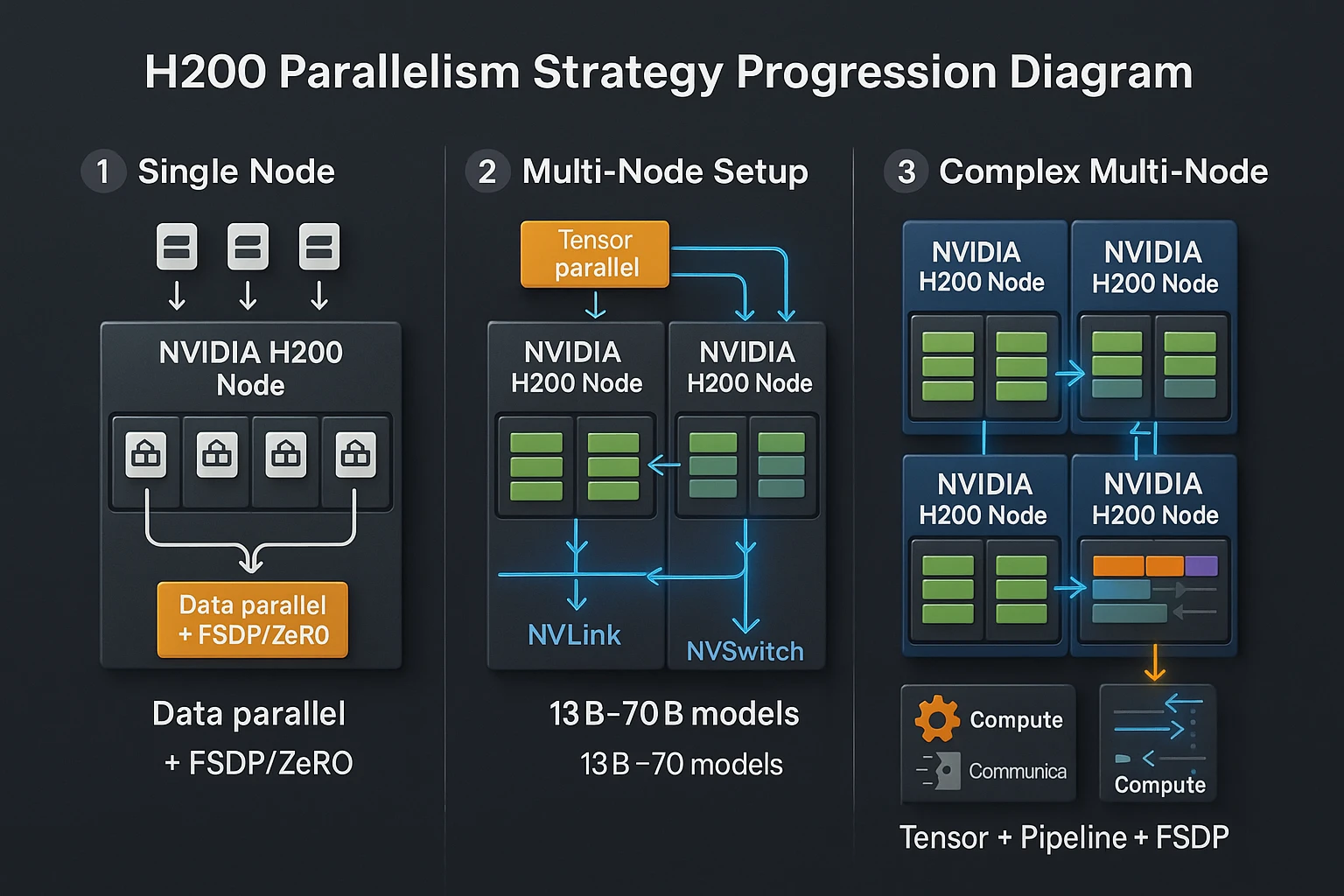
      H200 parallelism strategy progression diagram, showing scaling for AI models from single to multi-node


      What Semifly Delivers (So You Don’t Burn Sprints on Plumbing)


      • Architecture-first H200 clusters (DGX/MGX/PCIe) sized to your models and SLAs.
      • Data, precision, and parallelism playbooks customized to your stack.
      • MOFED/RDMA-ready networking and storage pathways tuned for checkpoint I/O.
      • Benchmark-to-baseline reports: tokens/sec, utilization, comms overhead, cost per 1K tokens.
      • Adapter strategy (LoRA/QLoRA) at scale: versioned, reversible, multi-tenant friendly.


      Final Take: Train for Capability, Fine-Tune for Fit


      Nvidia H200 training gets you to capability faster; fine-tuning Nvidia H200 turns that capability into product-market fit. The winners won’t be those with the biggest cluster—but those with the cleanest pipeline, the safest guardrails, and the most reliable runbooks.


      When you’re ready to turn H200 into outcomes, start with a pre-flight, then scale with confidence. Semifly can take you from blank slate to business value—without rewriting your world.
       

      Bookmark me
      Share on
      Comments
      Add your Comment

      Writing About AI

      Semifly

      is an engineer and a technologist with a diverse background spanning software, hardware, aerospace, defense, and cybersecurity. As CTO at Semifly, he leverages his extensive experience to lead the company’s technological innovation and development.

      Explore Nvidia’s GPUs

      Find a perfect GPU for your company etc etc
      Go to Shop

      FAQs

      • The NVIDIA H200 offers three significant advantages that directly impact the economics and efficiency of AI model training. Firstly, it boasts 141 GB of HBM3e memory, providing ample headroom for larger global batch sizes and longer sequence lengths. This reduces the need for constant activation checkpointing, leading to fewer optimizer stalls and better tokens-per-second throughput. Secondly, its Transformer Engine with FP8 enables mixed-precision training, which maintains accuracy while substantially boosting throughput compared to solely using FP16/BF16. Lastly, the H200 benefits from the NVLink/NVSwitch ecosystems, which facilitate efficient tensor and pipeline parallelism across multiple GPU nodes. This is particularly crucial for training larger models, especially those with 70 billion parameters or more. Collectively, these features lead to a shorter time-to-convergence for pre-training and faster wall-clock times for fine-tuning cycles.

      • Pre-training and fine-tuning on the H200 serve distinct goals, leading to different design choices. Pre-training aims for broad general language competence, typically utilising vast datasets (hundreds of billions of tokens) and requiring frequent, sharded, and resume-safe checkpoints. It often employs a combination of tensor, pipeline, and ZeRO/FSDP parallelism strategies with large global batch sizes and long sequence lengths. Risk controls during pre-training focus on managing curriculum, loss spikes, and divergence.


        In contrast, fine-tuning seeks task or domain adaptation, safety, or tone, often using much smaller datasets (10K–50M samples). It prioritises lightweight, rapid iteration cycles for checkpoints and typically uses data parallelism, sometimes with LoRA adapters to keep VRAM low. Precision often remains FP8/FP16, and batching is moderate with task-specific sequence lengths. The primary risk controls in fine-tuning are preventing catastrophic forgetting, addressing bias drift, and avoiding overfitting.

      • Architecting NVIDIA H200 training pipelines for convergence involves several critical aspects:


        • Data & Curriculum: Prioritise high-quality, aggressively deduplicated data over sheer volume. Implement curriculum staging to progressively ramp up sequence length and difficulty, stabilising early training. Integrate weekly regression suites into an evaluation harness to catch issues early.
        • Precision & Stability: Begin with BF16/FP16, adopting FP8 once loss curves stabilise. Enable automatic loss scaling and the Transformer Engine to prevent underflow. Utilise activation checkpointing only when strictly necessary, as the H200’s ample memory often allows for more relaxed application.
        • Parallelism Strategy: For models ≤13B parameters, data parallelism with FSDP/ZeRO on a single node is usually sufficient. For 13B–70B models, add tensor parallelism, leveraging NVLink/NVSwitch to minimise communication overhead. For models ≥70B, combine tensor, pipeline, and FSDP, ensuring communication overlaps with computation and pinning NCCL topology to the NVSwitch fabric.
        • Optimizer & Schedules: AdamW is a robust default; consider 8-bit optimizers to conserve memory. Cosine decay or linear warmup-decay schedulers are reliable. Gradient clipping is crucial to prevent harmful spikes.
        • I/O & Networking: Shard datasets across nodes and use streaming dataloaders to hide latency. Leverage MOFED/RDMA + GPUDirect where available for multi-node jobs to minimise CPU involvement. Checkpoint to parallel file systems (or object storage with fast gateways) with resume-safe metadata.
      • To achieve fast, cheap, and reversible fine-tuning on the H200, specific methods and risk controls are employed:


        • Picking the Right Method:LoRA/QLoRA: Adapter-based fine-tuning is highly recommended. It keeps base model weights frozen, significantly reducing VRAM and storage requirements. This method is ideal for creating multiple domain-specific variants from a single base model.
        • Full-parameter fine-tuning: Reserved for deep domain alignment or significant shifts (e.g., legal + multilingual), requiring more time and power.
        • SFT → DPO/RLHF: Start with supervised instruction tuning (SFT) and then layer preference optimisation (like DPO or RLHF) to refine tone, helpfulness, and safety.
        • Controlling Risks:Catastrophic forgetting: Mitigate this by including a small slice of general data in the fine-tuning dataset.
        • Evaluation drift: Maintain a stable general evaluation set alongside task-specific metrics to monitor overall model performance.
        • Guardrails: Integrate toxicity, PII, and jailbreak tests directly into the fine-tuning loop to ensure safety and ethical behaviour.


        These strategies enable efficient iteration and deployment of fine-tuned models while minimising resource consumption and allowing for easy reversion or adaptation

      • Before embarking on long training runs with the H200, Semifly emphasises rigorous pre-flight readiness checks to prevent failure modes that can waste significant time and resources:


        • Thermal Load Cycling: Sustained stress on Tensor Cores and HBM3e is conducted to identify and mitigate potential throttling issues before they impact multi-day runs.
        • Power-spike Simulation: Transitions between idle and maximum power draw are simulated to validate the stability of Power Supply Unit (PSU) rails and firmware.
        • Memory Burn-in: Intensive FP8/FP16 matrix mixes are performed to detect any flaky VRAM blocks early, ensuring memory reliability.
        • I/O Flooding: Concurrent traffic across NVLink, PCIe, and NIC is generated to validate the efficiency and reliability of data sharding at scale.
        • Driver/Container Validation: All critical software components, including CUDA, NCCL, MOFED, and Docker, are thoroughly checked for version compatibility, as version skew can be a silent killer of stable operations.
        • Redundancy & Failover Drills: Resume capabilities from checkpoints under simulated node loss are tested, along with orchestration restarts, to ensure robust fault tolerance.


        These comprehensive checks are designed to make the initial weeks of training runs “boring” – a hallmark of mission-critical infrastructure.

      • Practical H200 setups vary depending on the model’s class and size, with general guidance on precision, parallelism, sequence length, and global batch size:


        • 7 Billion Parameter Models: Typically use FP8/FP16 precision, primarily data parallel (FSDP) on a single H200 node. Sequence lengths range from 4K–8K tokens, with global batch sizes of 512–2K tokens.
        • 13 Billion Parameter Models: Start with FP8, transitioning to FP16 early if needed. They combine data parallelism with light tensor parallelism. Sequence lengths are usually 8K–16K tokens, and global batch sizes are 1K–4K tokens, utilising the Transformer Engine and monitoring loss scaling.
        • 70 Billion Parameter Models: Require mixed FP8/FP16 precision, and a combination of tensor, pipeline, and FSDP parallelism. Sequence lengths are typically 8K–16K tokens, with global batch sizes of 2K–8K tokens. NVSwitch is critical for these large models, and communication should be overlapped with computation.
        • LoRA/QLoRA (any base model): These adapter-based methods generally use FP16 precision with data parallelism. Sequence lengths are task-specific, and global batch sizes are adjusted based on throughput requirements, with the key being storing adapters per domain or application.


        It’s important to tune learning rates per model family and consider these configurations as topology guidance rather than strict rules.

      • The introduction highlights that “You Don’t Win With FLOPs—You Win With Fit.” While the NVIDIA H200 offers impressive raw computational power (FLOPs), such as 141 GB of HBM3e and high FP8 throughput, simply having powerful hardware is not enough. The true value lies in how this raw compute is effectively transformed into reliable, production-grade outcomes. This involves expertly shaping data, managing precision, implementing efficient parallelism, and building in failure resilience. The H200 enables capabilities, but it’s the strategic application and fine-tuning that ensures the model “fits” the specific task, domain, and business requirements. This ‘fit’ ultimately determines whether an AI deployment delivers tangible business value and a return on investment, rather than just impressive benchmark numbers.

      • Semifly offers a comprehensive suite of services designed to help organisations maximise the value of the NVIDIA H200 without requiring them to “burn sprints on plumbing.” These services include:


        • Architecture-first H200 clusters: Designing and deploying DGX, MGX, or PCIe clusters tailored to specific model requirements and Service Level Agreements (SLAs).
        • Customised Playbooks: Providing data, precision, and parallelism strategies customised to an organisation’s existing technology stack.
        • Optimised Networking and Storage: Configuring MOFED/RDMA-ready networking and storage pathways, specifically tuned for efficient checkpoint I/O.
        • Performance Benchmarking: Delivering benchmark-to-baseline reports that detail key performance metrics such as tokens-per-second, GPU utilisation, communication overhead, and cost-per-1K tokens.
        • Scalable Adapter Strategy: Implementing a robust strategy for LoRA/QLoRA at scale, ensuring adapter versioning, reversibility, and multi-tenant friendliness.


        Through these offerings, Semifly aims to streamline the process from initial setup to achieving business value, allowing clients to focus on their core AI development rather than infrastructure complexities.

      More Similar Insights and Thought leadership

      No Similar Insights Found

      semifly
      About Us