
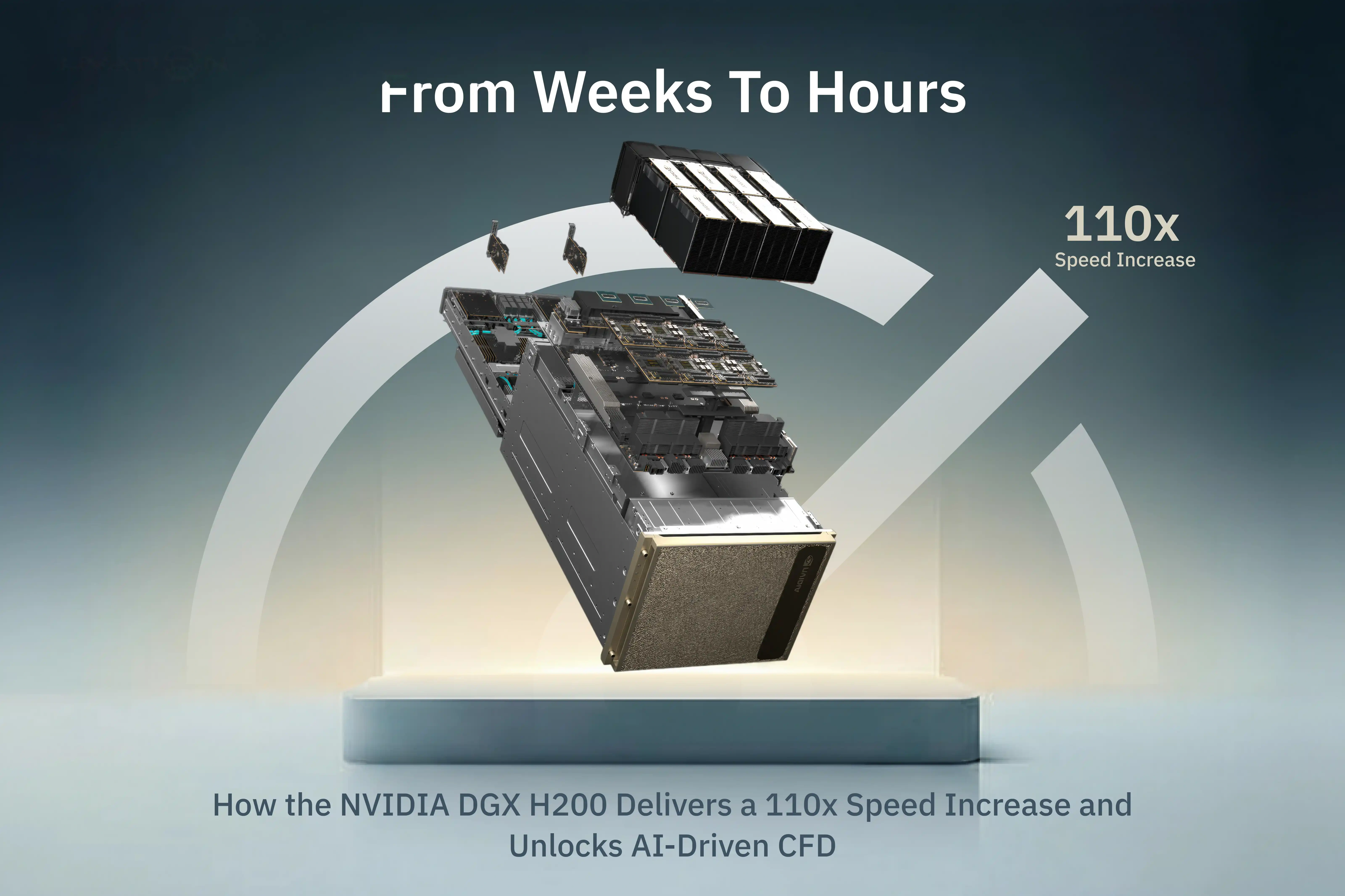
Computational Fluid Dynamics (CFD) has moved from being a specialist’s tool to becoming a hallmark of modern engineering and research. From fine-tuning the aerodynamics of a Formula 1 car to simulating complex blood flow patterns in healthcare, engineers now rely on CFD for insights that are both fast and precise. But delivering this level of fidelity comes at a steep computational cost, one that traditional CPU clusters and earlier GPUs often struggle to handle.The NVIDIA DGX H200 meets this demand head-on, bringing together next-generation GPU performance and AI integration to accelerate large-scale CFD workloads, improve accuracy, and make scaling more seamless than ever before.
01Why Traditional CFD Approaches Fall Short
Modern CFD is anything but simple. Today’s simulations deal with massive models, fine-grained meshes, and multiple interacting physics, pushing traditional infrastructure to its limits. CPU clusters and older GPUs often can’t keep pace, slowing design cycles and capping the complexity engineers can realistically explore.
- Memory limitations: High-resolution grids and boundary data can easily exceed system memory, forcing constant transfers between storage and compute that stall progress.
- Bandwidth-dependent: CFD solvers revisit grid points millions of times. Without fast data movement, performance grinds down, stretching simulation times far beyond what projects can tolerate.
- Compute-intensive: Advanced turbulence models or multiphysics simulations require enormous computational throughput to converge quickly, something legacy systems weren’t built to deliver.
When these constraints pile up, the result is clear: slower iterations, fewer design explorations, and limited use of AI-assisted workflows. The NVIDIA DGX H200 is designed to break through these limits, giving teams the ability to handle larger, more detailed simulations with speed, accuracy, and efficiency.
02DGX H200: Purpose-Built for CFD at Scale
Unlike generic compute platforms, the DGX H200 is engineered specifically for the dual demands of AI and high-performance computing. That makes it a natural fit for CFD workloads, where scale, precision, and speed all matter. With the H200, engineers can tackle larger meshes, capture more complex physics, and even weave AI-driven methods into their workflows—all within a single, unified system.
031. HBM3e Memory at 141 GB per GPU
In CFD, memory is often the ceiling you hit first. High-fidelity turbulence models and dense meshes quickly expand into datasets too large for conventional GPU memory, forcing constant shuffling across PCIe that drags down performance. The H200 changes that with 141 GB of ultra-fast HBM3e per GPU, enough to keep entire meshes resident in memory. That means less time wasted on transfers, lower latency, and far more headroom for complex simulations.
042. 4.8 TB/s of Memory Bandwidth
In CFD, raw memory isn’t enough, speed matters just as much as capacity. Solvers like OpenFOAM, Fluent, and CONVERGE CFD move massive amounts of data every iteration, and any slowdown in memory transfers creates stalls that drag out simulation times. The H200 delivers 4.8 TB/s of memory bandwidth, keeping data flowing continuously. The result? Simulations that once took 10 hours can now finish in 2, enabling faster design cycles and more exploration within the same time frame.
053. NVLink 4 and NVSwitch Fabric
Scaling CFD efficiently means GPUs need to talk to each other quickly. When simulations are split across multiple GPUs, frequent data exchanges—like halo updates—can become a bottleneck. NVLink 4 and NVSwitch provide ultra-fast GPU-to-GPU connectivity, minimizing latency in these exchanges and ensuring solvers converge faster. With this high-speed communication, multi-GPU simulations run smoother, more predictable, and closer to their theoretical performance limits.
064. Multi-Node Support via Quantum-2 InfiniBand
Some CFD simulations demand more than what a single DGX H200 can handle. When workloads span multiple nodes, data movement between systems becomes critical. Quantum-2 InfiniBand delivers high-throughput, low-latency interconnects, ensuring that distributed simulations communicate efficiently and scale seamlessly. The result is large, multi-node runs that maintain performance, reduce iteration times, and handle massive datasets without compromise.
07AI-Driven CFD: Merging Simulation with ML
CFD is no longer limited to raw numerical solving, AI is now enhancing simulations to make them faster, smarter, and more flexible. With the NVIDIA DGX H200, hybrid workflows combine traditional solvers with machine learning models, unlocking capabilities that were previously out of reach.
For instance:
- Predicting flow patterns – Instead of computing every step from scratch, AI models can estimate common flow behaviors in familiar geometries, saving time.
- Design optimization – Reinforcement learning can explore multiple design options automatically, helping teams find the best solution faster.
- Parallel uncertainty analysis – Generative models can run multiple scenarios at once, giving engineers a clearer picture of possible outcomes without waiting for long serial simulations.
By running AI and CFD on the same platform, teams can accelerate simulations, experiment more freely, and make data-driven design decisions in real time, all without switching between separate systems.
08Key Benefits of NVIDIA DGX H200 for CFD
The following benefits highlight the practical advantages teams gain when leveraging this platform CFD workflows:
- Faster Simulations: Large and complex models no longer have to compromise on detail. With the H200, simulations run significantly faster, allowing more design iterations in less time.
- Higher Accuracy: Detailed grids and advanced physics can be fully supported, improving the fidelity of results and enabling more confident engineering decisions.
- AI Integration: Traditional solvers can now work alongside machine learning models, providing predictive insights and accelerating exploration of design variables.
- Scalable & Flexible: Whether it’s a single-node deployment or a multi-node cluster, the H200 scales efficiently, adapting to the workload without bottlenecks.
- Energy Efficient: By delivering more performance per watt than traditional CPU clusters, the H200 reduces operational costs while supporting sustainable HPC practices.
Real-World CFD Workloads Benefiting from H200
Each industry faces unique CFD challenges. The DGX H200 deloivers efficiency gains across diverse applications:
These are not just incremental improvements, they represent transformational time savings that can reshape R&D cycles.
09Deployment Considerations: What Decision-Makers Must Know
Adopting DGX H200 into your CFD workflow involves making sure the system can deliver its full potential. Here are the key points to consider:
- Solver Readiness: Make sure your CFD applications, like Fluent, OpenFOAM, or StarCCM+, have GPU-optimized versions ready. This ensures simulations run efficiently without unexpected bottlenecks.
- Data Pipelines: CFD simulations can produce terabytes of data per run. Fast storage, optimized I/O, and smooth data movement are just as important as raw compute power to avoid delays.
- Ecosystem Tools: Tools like NVIDIA Modulus for AI-driven physics, Omniverse for visualization, and CUDA-X libraries can enhance workflows and enable new capabilities beyond traditional CFD.
- Scalability: Consider whether a standalone DGX H200 is enough or if a multi-node DGX SuperPOD is needed for large-scale, industrial simulations. Proper planning ensures performance scales with your workloads.
These factors often determine whether performance gains are incremental or exponential.
10The Business Case: TCO, ROI, and Sustainability
For leaders weighing investment, the DGX H200 offers value beyond raw performance:
- Reduced Time-to-Market: Faster design cycles mean earlier product launches.
- Lower Simulation Costs: A single DGX H200 can replace racks of CPU servers, reducing footprint and energy use.
- Sustainability Gains: Efficient computing means fewer resources per simulation, critical for organizations tracking carbon impact.
When evaluated holistically, the DGX H200 often delivers a higher ROI than traditional clusters, particularly for enterprises running constant CFD workloads.
11Future-Proofing CFD Workloads with DGX H200
With sustainability, speed, and real-time feedback becoming central to industries, the bar for CFD simulation continues to rise. Whether you’re designing the next-generation hyperloop, optimizing combustion in jet engines, or building virtual wind tunnels, Computational Fluid Dynamics (CFD) and H200 are now inseparable. The DGX H200 is not just a GPU-powered server, it’s a strategic investment in simulation precision, reduced time-to-market, and long-term R&D agility.
12Making the Most of DGX H200 for CFD with Semifly
To truly ensure faster, more accurate, and scalable CFD simulations, deployment and workflow optimization are key. At Semifly Marketplace, we help organizations get the most out of their DGX H200 systems with tailored configurations, tuned solvers, and streamlined pipelines.
Here’s how we do it:
- Solver Tuning: We pre-configure Ansys Fluent, OpenFOAM, and StarCCM+ with hardware-level optimizations for the H200 architecture.
- Storage and Ingestion Pipelines: CFD data can reach terabytes per simulation; our stack ensures fast I/O and efficient pre/post-processing workflows.
- Containerized Environments: Ready-to-deploy Docker and Singularity containers for CFD solvers ensure fast boot-up and repeatability.
- AI Integration: We help clients build and deploy ML models trained on simulation results, reducing future run times by 10–100x in some cases.
Ready to accelerate your CFD simulations? Book a free consultation with Semifly today and see how we can help you get the most out of your DGX H200.