Seeing the price tag for cutting-edge AI hardware like the NVIDIA H200 server can be a shock. It’s a big upfront investment. Many businesses naturally focus heavily on this initial purchase cost, known as Capital Expenditure (CapEx). They see a large sticker price and hesitate.
But this narrow focus overlooks a critical reality: the true expense of AI infrastructure extends far beyond the purchase. Massive, ongoing operational costs (OpEx) often remain hidden—soaring power bills, intensive cooling demands, data center space, staff management time, and losses from downtime. Over the equipment’s lifespan, these recurring costs can dwarf the initial purchase price.
This is why Total Cost of Ownership (TCO) is the true measure of value. TCO calculates everything: the initial CapEx plus all operating expenses (OpEx) accumulated over the server’s entire lifecycle. It reveals what the technology genuinely costs your business from deployment to retirement.
Here’s the pivotal insight: Despite their higher upfront price, NVIDIA H200 servers deliver revolutionary performance and efficiency. This dramatically slashes major OpEx burdens. The result? Over time, the H200 achieves a surprisingly lower total cost of ownership.
In this blog, we will discuss exactly how the H200 reduces TCO. We’ll explore its key savings areas: drastic power and cooling reductions, fewer servers required for equivalent output, accelerated results that free staff time, enhanced reliability, and extended viability before replacement. Looking beyond the sticker price reveals the real value.
011. The TCO Breakdown: Where Costs Really Hide
Judging an AI server’s investment solely by its purchase price is like buying a car based only on the showroom sticker. One can miss the bigger financial picture. The true cost of owning and operating AI infrastructure unfolds over 3-5 years. Total Cost of Ownership (TCO) forces you to look at every expense involved.
Let’s break down the major cost components hiding behind that initial price tag:
Acquisition Cost (CapEx): This is the upfront price you pay to buy the NVIDIA H200 server hardware. A single H200 GPU costs $30,000–$40,000, with a full 8-GPU server reaching $300,000+. While significant, it’s just the starting point. Focusing only here ignores the potentially much larger operational expenses that accrue daily, monthly, and yearly throughout the server’s life.
Power and Cooling (OpEx): Running powerful GPUs consumes massive amounts of electricity. Each H200 GPU consumes ~700W under load. For an 8-GPU server running 24/7:
- Annual Power Cost: 5.6 kW × $0.15/kWh × 8,760 hrs = $7,350
- Cooling (PUE 1.5): Adds 50% more ($11,025/year)
Over 5 years, this totals $90,000+ per server. This consumes 40–50% of operational budgets.
Compute Density & Space (OpEx/CapEx): The NVIDIA H200 servers deliver 1.6–1.9x higher performance than the H100 in LLM workloads. This means:
- 40% fewer servers are needed for the same output.
- Space Savings: Reducing a 10-rack cluster to 6 racks saves $1,500–$2,500/month per rack.
Annual Impact: Around $72,000–$120,000 saved in real estate/cooling.
Performance & Utilization (OpEx): NVIDIA H200 servers slash training times by 30–50%. For a team running daily AI jobs, this efficiency leads to:
- Staff Productivity: 5 engineers saving 5 hrs/week × $75/hour = $97,500/year.
- Hardware Utilization: 30% higher throughput = $100,000+ yearly savings by delaying new purchases.
Maintenance & Downtime (OpEx)
Enterprise H200 GPUs have <1% annual failure rates. This helps save:
- Downtime Cost: $10,000+/hour for AI services.
- Incident Reduction: Fewer failures cut IT labor/support costs by ~$50,000/year.
Longevity & Upgrade Cycles (CapEx/OpEx)
H200’s 141 GB/s HBM3e memory and FP8 support extend its relevance for next-gen AI models. This enables:
- 5-year viable lifespan (vs. 3–4 years for older GPUs).
- Deferred CapEx: Pushes back a $300,000+ server refresh by 1–2 years. This saves $60,000–$100,000 annually in upgrade costs.
02Why NVIDIA H200 Servers Win on TCO
032. H200’s TCO Slashing Superpowers
The NVIDIA H200 servers aren’t just faster—they are engineered to demolish hidden operational costs. Below, we break down how the H200’s technical leaps translate into tangible long-term savings.
a. Power & Cooling: The Efficiency Multiplier
The H200 delivers 2.1x more performance per watt than the H100. Key specs like Transformer Engine optimizations and ultra-efficient HBM3e memory slash power use. Each H200 GPU draws 700W versus older GPUs at 900W+. For an 8-GPU server running 24/7:
- Annual Power Savings: 1.6 kW × $0.15/kWh × 8,760 hrs = $2,100
- Cooling Savings (PUE 1.5): Adds $3,150/year.
TCO Win: Over 5 years, this cuts $26,250 per server, targeting the key OpEx cost.
b. Unmatched Compute Density: Doing More with Less Space
With 1.9x higher LLM throughput than H100, the H200 consolidates workloads. For example, it is possible to replace 10x older GPUs with 5x H200s for equal performance. This 50% server reduction means:
- Rack Space Saved: 5 servers free up 10U (half a rack).
- Cost Impact: At $2,000/month/rack, this saves $12,000/year.
TCO Win: A smaller footprint translates to lower rent, cooling, and power distribution costs.
c. Accelerating Time-to-Value & Staff Productivity
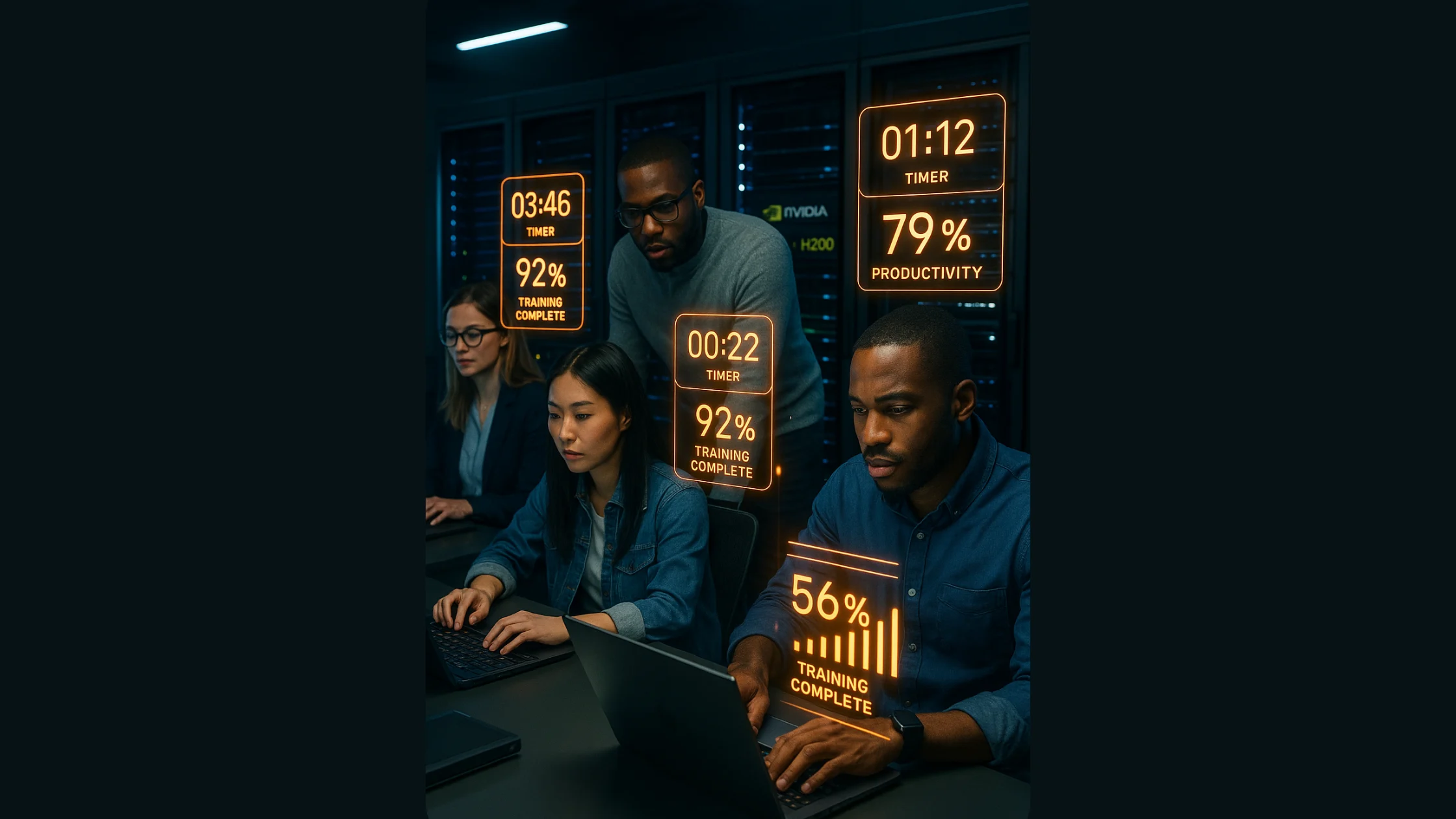
H200 trains models 45% faster and handles 2x more inferences/second vs. H100. For a team training 10 models monthly:
- Time Saved: 14 days → 7 days per model.
- Productivity Gain: 5 engineers reclaim 350 hours/year ($26,250 value at $75/hr).
TCO Win: Faster deployments accelerate revenue. This leads to $130,000+ staff savings over 5 years.
d. Enhanced Reliability & Reduced Downtime Costs
NVIDIA H200 servers achieve more than 99.9% uptime with robust drivers and CUDA libraries. This reduces:
- Failures: <1% annual hardware failure rate.
- Downtime: Avoids $10,000+/hour losses during outages.
TCO Win: Saves $50,000+/year in support staff and lost revenue.
e. Future-Proofing: Extending the Viable Lifespan
H200’s 141 GB/s HBM3e memory and FP8 precision support next-gen 100B+ parameter models. This extends its usefulness to 5 years (vs. 3–4 for older GPUs). Delaying upgrades by 1–2 years:
- Defers CapEx: Avoids $300,000+ per 8-GPU server refresh.
- Cuts Deployment Costs: Saves $20,000+ in IT labor per upgrade cycle.
TCO Win: Longer lifespan = better ROI and $100,000+ deferred costs.
04Why This Matters:
*All figures are based on 8-GPU server operations over 5 years.*
053. The TCO Math: Putting it All Together
Let’s cut through the noise with real numbers. We’ll compare a 100-GPU cluster using NVIDIA H100 versus its H200 equivalent for the same AI workload over 5 years. Assumptions:
Workload: Training large language models (LLMs) 24/7
Electricity: $0.15/kWh, PUE 1.5
Data center space: $2,000/month per rack
06Cost Breakdown
1. CapEx (Higher for H200)
An 8-GPU H100 server costs ~$250,000 ($31,250/GPU).
An 8-GPU H200 server costs ~$320,000 ($40,000/GPU).
*For 100-GPU equivalent throughput: *
- H100 Cluster: 13 servers (104 GPUs) = $3.25M
- H200 Cluster: 7 servers (56 GPUs, 1.8× efficiency) = $2.24M
Result: H200 saves $1.01M upfront despite higher per-unit cost.
072. Power & Cooling (Lower for H200)
- H100 GPU: 800W → 13 servers × 6.4kW = 83.2kW load
- H200 GPU: 700W → 7 servers × 5.6kW = 39.2kW load
Annual Cost: - H100: 83.2kW × $0.15 × 8,760 hrs × 1.5 PUE = $1.64M
- H200: 39.2kW × $0.15 × 8,760 hrs × 1.5 PUE = $773,000
5-Year Savings: $4.33M with H200.
083. Data Center Space (Lower for H200)
- H100: 13 servers (5 racks) → $120,000/year
- H200: 7 servers (3 racks) → $72,000/year
5-Year Savings: $240,000 with H200.
4. Staff Productivity (Lower for H200)
H200’s 45% faster training means:
- 5 engineers save 15 hrs/week vs. H100 bottlenecks.
- Labor savings: 15 hrs × $75/hr × 50 weeks = $56,250/year
5-Year Savings: $281,250.
095. Maintenance & Downtime (Lower for H200)
- H200: <1% failure rate → 4 hrs downtime/year
- H100: 2% failure rate → 20 hrs downtime/year
Cost avoidance: - H200: Saves 16 hrs × $10,000/hr (downtime) + $20,000 support = $180,000/year
5-Year Savings: $900,000.
10The Bottom Line: H200 Wins in Year 2:
Crossover Point: By Year 2, the H200’s OpEx savings surpass its higher CapEx. After that, it saves ~$1.35M/year.
114. Beyond Hardware: The Software Advantage
The NVIDIA H200’s hardware is only half the story. Its real TCO power is unlocked by NVIDIA’s mature software ecosystem—tools that maximize efficiency, slash development time, and squeeze every drop of performance from your investment.
CUDA is the foundation. It lets developers write the code once and run it across all NVIDIA GPUs. This means existing AI applications work instantly on NVIDIA H200 servers with zero rewrites. No costly migration or retraining is needed. Your team keeps building, not rebuilding.
cuDNN and TensorRT optimize critical operations.
cuDNN accelerates deep learning primitives, making training up to 3x faster versus manual coding. TensorRT compiles models for inferencing, boosting throughput by 2–5x with no accuracy loss. Together, they ensure your H200 never sits idle, delivering more work per dollar spent on hardware.
NVIDIA AI Enterprise provides enterprise-grade support and pre-optimized frameworks. It cuts deployment time from months to days and includes security patches.
The TCO Impact? Concrete Savings:
- 30% less developer time spent on optimization/troubleshooting
- 50% faster model deployment accelerating revenue cycles
- 24/7 enterprise support reducing downtime risks
- Higher GPU utilization (often +20–40%) stretching hardware value
This software layer transforms raw hardware power into real business ROI. Without it, even the fastest GPU loses efficiency—and your TCO creeps upward. The H200 comes better equipped than NVIDIA H100.
12Summing Up: Investing in Efficiency Pays Dividends
The NVIDIA H200 server transcends a hardware upgrade—it’s a strategic efficiency engine for scaling AI. While its upfront cost requires consideration, true value lies in total ownership economics. Alternatives with lower sticker prices often waste capital through soaring power bills, excessive data center space, and lost productivity. The H200 flips this equation: its architecture directly attacks the biggest cost culprits—energy consumption, compute density, and operational friction. Every watt saved slashes expenses and carbon footprints, aligning cost control with ESG goals—a dual benefit your CFO and sustainability team will applaud.
Looking ahead, AI workloads grow heavier yearly. Models demand more memory, speed, and reliability. Engineered for this future, the H200’s ultra-fast HBM3e memory and FP8 precision ensure relevance for next-gen 100B+ parameter models, letting you avoid another costly upgrade in 2–3 years. Don’t gamble on short-term savings. Run your own TCO analysis: model its 40%+ density advantage, calculate 25% power savings against local rates, and quantify staff productivity gains from faster training. You’ll uncover the same truth—higher initial investment unlocks millions in operational savings. The crossover point hits within 18–24 months; after that, the NVIDIA H200 servers pay dividends daily. For enterprises serious about scalable, sustainable AI, this isn’t spending—it’s investing. Own the math, not just the sticker price.
← Back to Insights