Artificial intelligence is advancing faster than traditional computing infrastructure can keep pace. Training large language models and running high-performance simulations now require GPUs with greater memory capacity, faster data movement, and highly efficient compute pathways. Enterprises are moving beyond smaller AI workloads toward models that span hundreds of billions of parameters. This shift has placed pressure on hardware to deliver higher throughput without increasing operational complexity or energy costs.
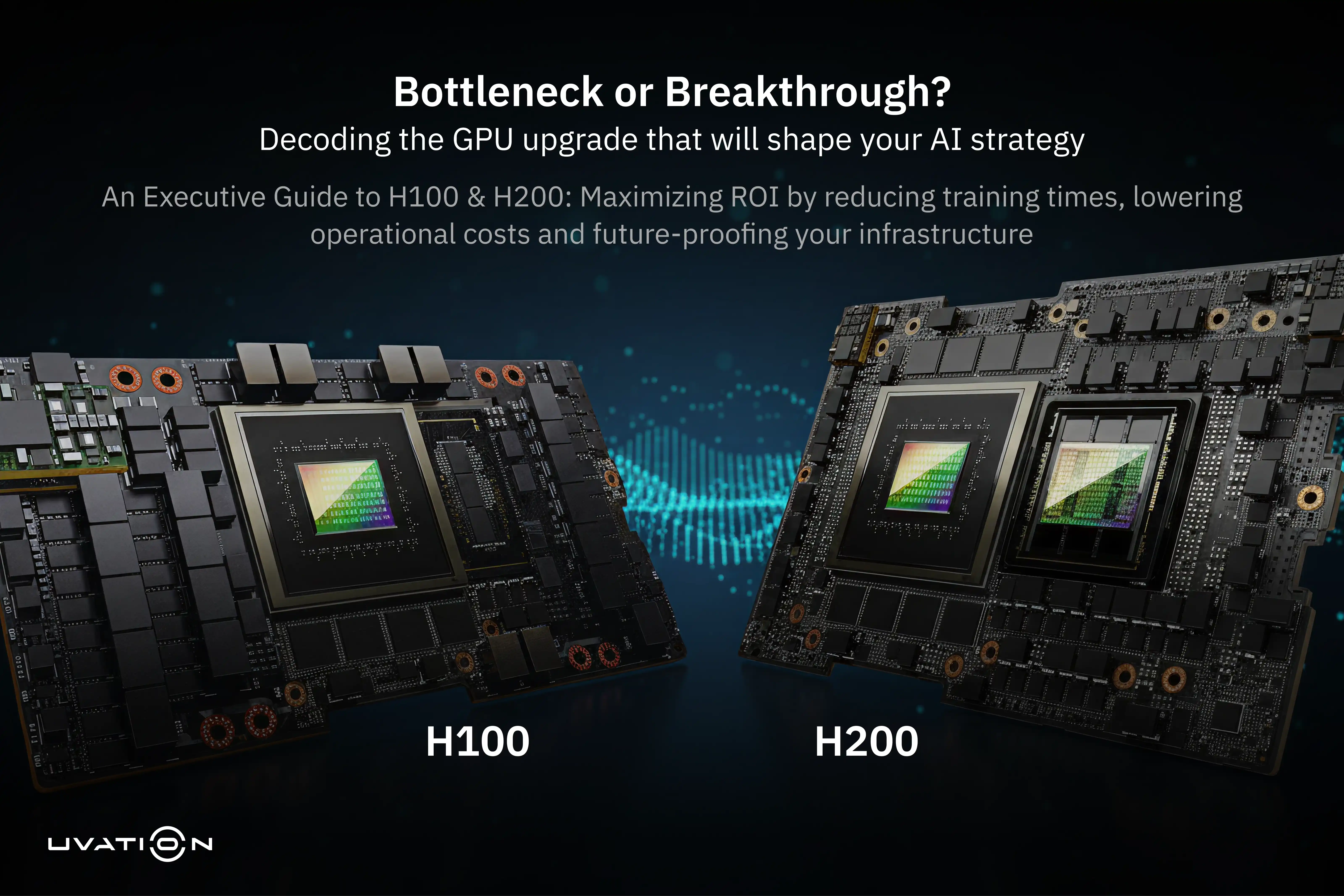
NVIDIA’s Hopper architecture addresses this demand. The NVIDIA H100 has already established itself as a foundation for large-scale AI and HPC workloads. Its successor, the NVIDIA H200, extends this foundation by introducing HBM3e memory with higher capacity and bandwidth, directly addressing performance bottlenecks in training and inference. For decision-makers, the H200 represents not just an upgrade in specifications but a measurable improvement in workload efficiency and AI scalability. This blog examines how the transition from H100 to H200 impacts performance and enterprise AI strategies.
011. H100 vs H200: The Architectural Evolution
The NVIDIA H100 and H200 GPUs share the same Hopper architecture foundation, but their design differences have a direct impact on how enterprises run AI and HPC workloads. The upgrade from H100 to H200 is less about changing the core architecture and more about removing key bottlenecks that limit model training and inference speed.
The H100 introduced the Hopper architecture with Tensor Cores designed to accelerate large-scale AI training. Comparing H100 vs H200 performance highlights improvements in memory and compute efficiency for advanced workloads. The H100 features HBM3 memory with up to 80 GB capacity and a bandwidth of roughly 3.35 TB/s. This made it well-suited for handling large datasets and model parallelism. However, as generative AI and trillion-parameter models grew, memory capacity and throughput became a limiting factor, leading to slower training times and higher compute costs.
The H200 addresses this directly by becoming the first GPU to ship with HBM3e memory. It expands capacity to 141 GB while increasing bandwidth to around 4.8 TB/s. In practice, this means larger models can fit within a single GPU, reducing the need for splitting workloads across multiple devices. The higher bandwidth also improves data throughput, allowing AI models to train and infer faster without being constrained by memory bottlenecks.
For enterprises, the shift from H100 to H200 translates into higher workload efficiency and a clear advantage for generative AI applications. By supporting larger models natively, the H200 reduces both training time and overall infrastructure complexity, making it better aligned with the demands of today’s AI development cycle.
022. Performance Head-to-Head: Memory, Compute, and Efficiency
The performance difference between the NVIDIA H100 and H200 is centered on memory capacity, bandwidth, and efficiency. Both GPUs use the Hopper architecture, but the H200 extends its capability by addressing limitations in how quickly data can be stored and retrieved during large-scale AI workloads. For enterprises working with large language models, this change directly impacts training speed, inference reliability, and overall infrastructure cost.
The H100 delivers 80 GB of HBM3 memory with a peak bandwidth of about 3.35 TB/s. This was sufficient for most AI and HPC workloads when it launched, but the size and complexity of today’s models have pushed against those limits. The H200 addresses this challenge by increasing memory to 141 GB and introducing HBM3e technology, which significantly improves H100 vs H200 performance in training large AI models. With a bandwidth of roughly 4.8 TB/s, the H200 can handle larger datasets and keep GPUs fed with data at higher speeds, reducing idle time during training. This helps enterprises run GPT-3 and GPT-4 scale models with fewer memory-related slowdowns.
Compute efficiency also improves with the H200’s higher memory-to-bandwidth ratio. Models that previously required multi-GPU partitioning may now fit on fewer devices, reducing both communication overhead and training duration. This directly affects the total cost of ownership, as faster throughput lowers energy use per training cycle. For organizations where energy and infrastructure costs are significant, the H200 delivers measurable efficiency gains over the H100.
033. Enterprise AI Use Cases: Where the H200 Outpaces H100
The NVIDIA H200 is designed to extend what enterprises can achieve with AI. By expanding memory and bandwidth, it supports larger models, faster inference, and more complex simulations. These improvements directly impact areas such as natural language processing, generative AI, and scientific computing, where data volume and model size are growing rapidly.
For large language models, understanding H100 vs H200 performance shows that the H200 allows organizations to train and fine-tune models beyond the trillion-parameter scale more efficiently. With its expanded HBM3e memory, more of the model can remain in GPU memory at once, reducing the overhead of splitting workloads across multiple GPUs. This not only shortens training cycles but also lowers infrastructure costs by improving efficiency. Enterprises working with models similar to GPT-3 or GPT-4 can benefit from this capacity for higher throughput and reduced time to insight.
Generative AI applications also see significant improvements. Whether it is conversational chatbots, AI copilots, or advanced media generation tools, inference speed is often a limiting factor. The H200’s increased bandwidth supports faster response times and higher concurrency, making it better suited for production-grade deployments where latency directly affects user experience.
In scientific high-performance computing and simulation, bandwidth has long been a bottleneck for workloads like drug discovery, molecular modeling, and climate simulations. These tasks require rapid movement of very large datasets, and the H200’s expanded memory pipeline provides the throughput needed to accelerate results. For industries such as pharmaceuticals and energy, this can translate to faster experimentation and reduced time to discovery.
044. Deployment and Infrastructure Considerations
The transition from the H100 to the H200 is not only about hardware specifications. Enterprises also need to assess how these GPUs fit into existing infrastructure, cloud strategies, and long-term ROI. Availability, deployment models, and energy efficiency are central to planning adoption.
The H200 will ship in purpose-built systems such as the NVIDIA DGX H200, which is designed to support AI factories and large-scale training environments. These systems are tailored for organizations building advanced AI platforms and require high memory bandwidth for large models. In contrast, the H100 is already widely deployed in DGX systems and across cloud platforms, making it the current standard for production-grade AI workloads.
Cloud adoption will also define availability. Hyperscalers such as AWS, Microsoft Azure, and Google Cloud are expected to introduce H200-based instances in the future. For enterprises running large AI workloads in the cloud, this means access to higher performance without significant capital investment in on-premises infrastructure. Early adopters may gain competitive efficiency advantages by accessing the H200 sooner than peers.
Cost and ROI remain key considerations. While the H200 introduces a higher upfront expense, the reduced training hours and lower energy use per workload can offset capital outlays over time. For decision-makers, the trade-off lies in aligning current demand with future scalability—deciding when the gains from faster training and lower operating costs justify the investment.
055. Strategic Takeaways for Enterprises
The NVIDIA H200 represents more than a specification increase. It is designed to support larger workloads, greater efficiency, and long-term AI expansion. For enterprises, the decision to adopt the H200 must be viewed not just in terms of performance but also in terms of timing, cost, and overall infrastructure strategy.
In the near term, the H100 continues to deliver strong results for most enterprise workloads. It remains a reliable choice for training and inference across large language models, computer vision, and HPC applications. For organizations with stable AI requirements today, the H100 can still meet operational goals without immediate disruption.
Looking ahead, the H200 enables enterprises to prepare for larger AI deployments. Its ability to support trillion-parameter models and advanced generative AI workloads makes it better suited for organizations planning expansion into large-scale model training and inference. This positions the H200 as an asset for enterprises expecting rapid growth in AI-driven services.
Return on investment is another central factor. While capital expenditure for H200-based infrastructure is higher, operational savings come through reduced training times, lower energy usage, and greater efficiency in multi-GPU environments. AI infrastructure decisions should balance current performance with long-term adaptability, ensuring that hardware investments align with evolving AI strategies.
For enterprise leaders, the key takeaway is clear: H100 remains a strong platform today, but the H200 provides a path to support the scale and efficiency demands of the coming AI era. The decision depends on whether an organization’s needs are immediate or forward-looking.
06Conclusion: Decoding the Upgrade
The NVIDIA H200 represents a decisive advance in GPU design, especially for enterprises planning larger and more complex AI workloads. By addressing long-standing memory constraints and delivering higher bandwidth, it enables faster training and inference at scales that were previously limited. This matters not just for performance benchmarks, but for how quickly enterprises can move from experimentation to production-grade AI systems.
Enterprises now face a strategic decision. The H100 remains a capable GPU for today’s generative AI, HPC, and enterprise AI tasks. It offers proven reliability and is widely available across on-premises deployments and cloud providers. For organizations whose AI adoption curve is steady, extending investment in the H100 can still provide strong returns.
Evaluating H100 vs H200 performance makes it clear that the H200 opens the door to workloads requiring higher efficiency and support for trillion-parameter models. Enterprises looking to expand into generative AI at scale, or those building AI platforms as a core part of their long-term strategy, will find the H200’s architectural improvements more aligned with these ambitions.
The decision between H100 and H200 is not simply about raw compute power. It is about how bandwidth, memory availability, and efficiency gains shape the cost of ownership and the pace of innovation. As Gartner and McKinsey note, AI infrastructure is now a key differentiator in enterprise competitiveness. Enterprises that align their infrastructure strategy with these realities will be best positioned to scale effectively.
In summary, the H200 is not just a performance upgrade. It represents a shift toward GPUs designed for the scale of tomorrow’s AI, where efficiency and capacity define long-term advantage. For technology leaders, the decision comes down to timing: continue with the proven strength of the H100 or move early to the H200 to prepare for larger models and more demanding AI applications.
← Back to Insights