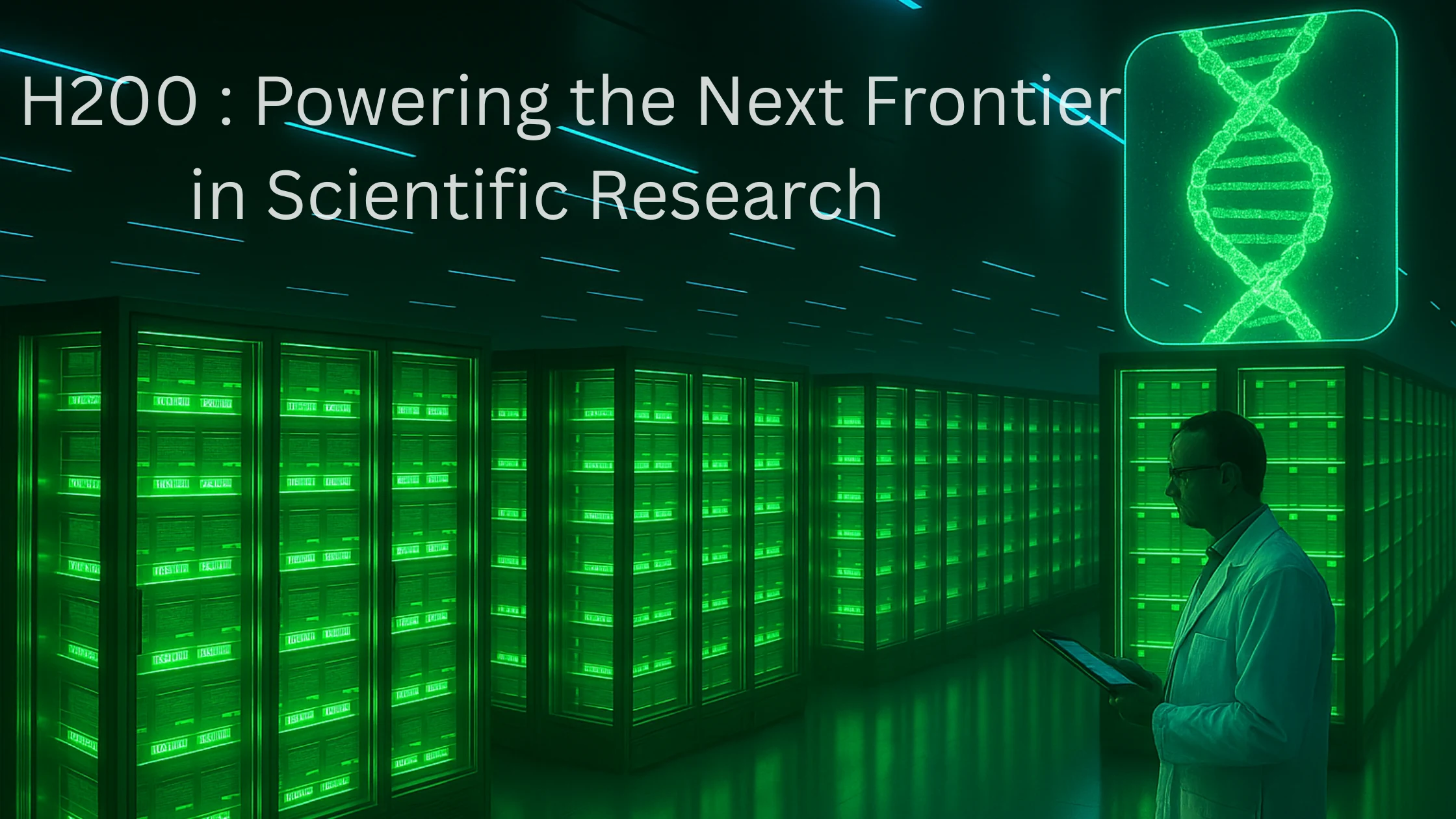
Beyond chatbots and copilots, a quieter revolution is underway in laboratories and research institutions. GPU computing — and the NVIDIA H200 in particular — is compressing timelines for discovery in fields from molecular biology to climate science.
Key Takeaways
- Life sciences — protein folding, drug candidate screening, genomics.
- Climate & weather — higher-resolution models, faster ensembles.
- Materials — simulating novel compounds before synthesis.
- Physics — large-scale numerical experiments and data analysis.
01Simulation at new scale
Scientific computing has always been bounded by how much you can simulate and how quickly. The H200's memory capacity and bandwidth let researchers model larger systems — more atoms, finer grids, longer time steps — without partitioning problems across dozens of nodes. Fewer partitions mean less communication overhead and faster results.
02AI-accelerated discovery
Increasingly, research blends traditional simulation with machine learning: surrogate models that approximate expensive calculations, or AI that proposes candidates for a simulator to verify. These hybrid workflows are exactly what high-memory GPUs excel at, running both the learned model and the numerical solver close together.
03Infrastructure for research
Research workloads are bursty and varied, which makes flexible, well-architected GPU infrastructure especially valuable. Semifly helps institutions build environments that serve many investigators and workload types without idle capacity or contention — turning compute into a shared accelerator for discovery.
← Back to Insights