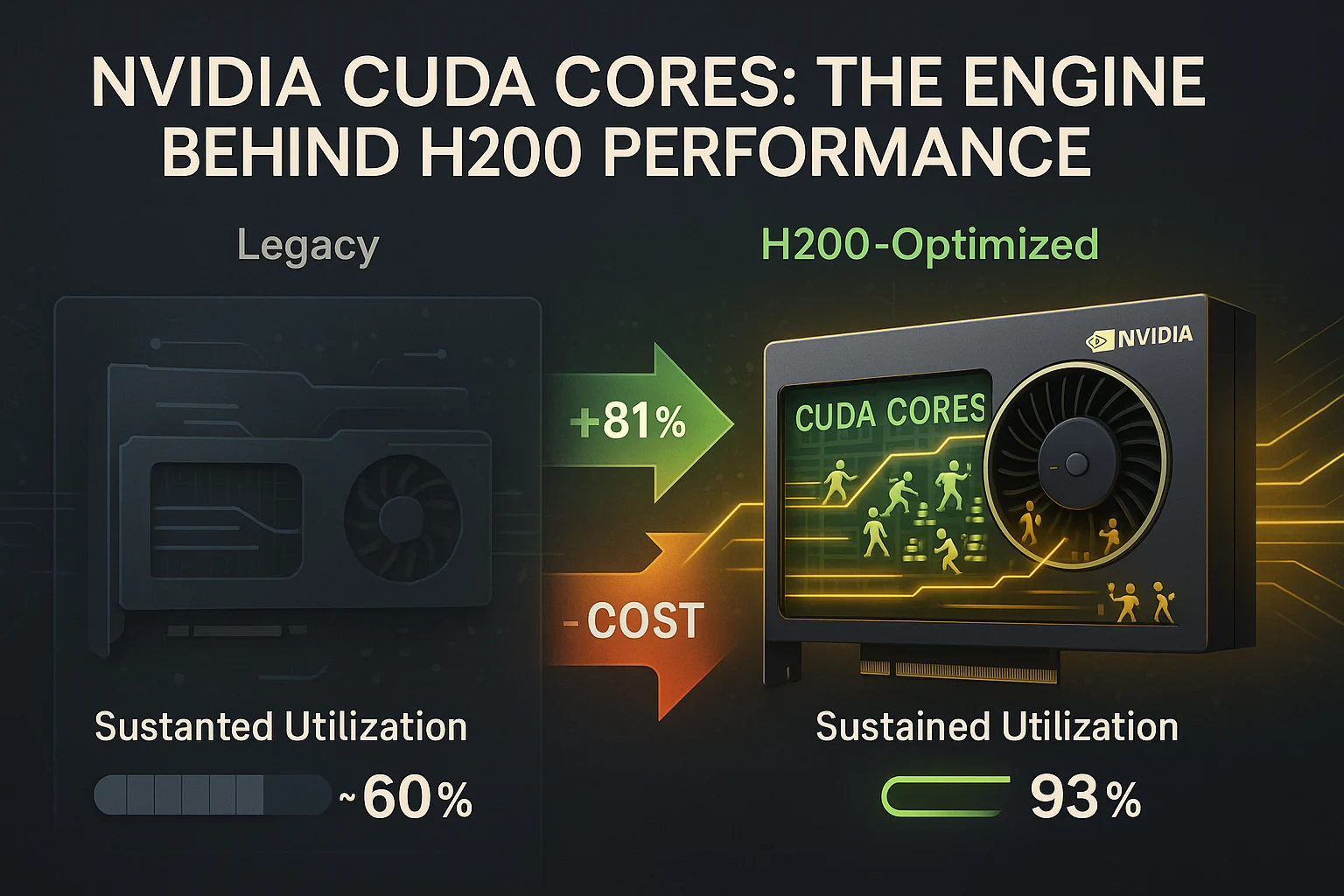
For years, GPU performance has been measured in CUDA Core counts. Marketing slides often tout numbers in the thousands, leaving enterprises to assume “more cores = more performance.” But in reality, the story is far more nuanced. CUDA Cores are not just a stat — they are the execution units where AI, HPC, and simulation workloads come to life.
01Introduction: Beyond Specs, Toward Outcomes
With the NVIDIA H200, CUDA Cores reach their fullest expression yet. Backed by 4.8 TB/s memory bandwidth, 141 GB of HBM3e, and the Hopper Transformer Engine with FP8 precision, the Cores are no longer constrained by memory starvation or fragmented access. For enterprises and managed service providers (MSPs), understanding Nvidia CUDA Cores — and how they integrate into modern cluster architecture — is the difference between idle silicon and production-grade throughput.
At Semifly, we help organizations turn this technical foundation into operational success. Let’s explore what CUDA Cores really do, how they’ve evolved in the H200, and how to architect around them for maximum ROI.
02What Are Nvidia CUDA Cores?
CUDA Cores are the parallel compute units inside NVIDIA GPUs. Think of them as the “workers” that handle the instructions of matrix multiplications, floating-point operations, and tensor workloads.
- Core Functionality: They process data in parallel, enabling GPUs to handle workloads like large language model (LLM) inference, image generation, and simulation at massive scale.
- Precision Support: With Hopper (H100 and H200), CUDA Cores gained FP8 support alongside FP16/BF16, dramatically improving performance-per-watt for inference and fine-tuning.
- Scale: The H200 integrates tens of thousands of CUDA Cores, orchestrated by NVLink and NVSwitch for cluster-wide scaling.
In short: CUDA Cores are the atomic units of AI computation — but their true impact depends on how well they are fed with data and scheduled in workloads.
03Why CUDA Cores in the H200 Are Different
Previous GPUs often left CUDA Cores underutilized because memory bandwidth couldn’t keep up. The H200 changes this equation:
- 4.8 TB/s Bandwidth: Ensures CUDA Cores are continuously fed, reducing idle cycles.
- 141 GB HBM3e: Larger batches and longer sequence lengths fit in-memory, eliminating CPU-to-GPU shuffling.
- Transformer Engine with FP8: Lets CUDA Cores execute more operations per clock, cutting inference cost-per-token nearly in half.
- NVLink 4 + NVSwitch Integration: Allows CUDA Cores across multiple GPUs to function like a unified compute pool.
For AI workloads like high-throughput batch inference, this means predictable scaling across GPUs, not the diminishing returns seen on older architectures.
04CUDA Cores and High Throughput in the Enterprise
The real measure of CUDA Core performance is throughput, not theoretical peak FLOPs. In practical deployments:
- Batch Inference: CUDA Cores handle multiple LLM requests per pass, with H200 enabling up to 380K tokens/sec on a 70B FP8 model.
- Multi-Modal Workloads: Text + vision + retrieval inference streams can run concurrently without starving Cores of data.
- HPC Simulations: Memory-bound workloads like genomics and CFD see 30–40% faster runtimes when CUDA Cores are properly utilized with HBM3e.
05Provisioning Clusters Around CUDA Cores
Simply buying H200s doesn’t guarantee results. The infrastructure must be architected to keep CUDA Cores saturated:
- Memory Placement
- Pin memory-heavy tasks to GPUs with local HBM pools.
- Use NUMA-aware scheduling to avoid cross-switch delays.
- NVLink/NVSwitch for intra-node communication.
- InfiniBand NDR or 400GbE with GPUDirect RDMA for cross-node scaling.
- Kubernetes + NVIDIA GPU Operator for multi-tenant scheduling.
- NVIDIA Triton Inference Server for efficient multi-model batch serving.
- Simulate thermal loads, checkpoint I/O flooding, and mixed-precision kernels to ensure CUDA Cores sustain utilization above 90%.
06Avoiding Pitfalls That Starve CUDA Cores
We’ve seen enterprises waste millions by leaving CUDA Cores underutilized. Common traps include:
- PCIe Staging: Routing data through CPU RAM instead of direct-to-GPU tiers.
- Outdated CUDA/NCCL Builds: Disabling FP8 acceleration and tensor optimizations.
- Memory Fragmentation: Mixing small inference jobs with large LLM training batches on the same GPUs.
- Cooling Misconfigurations: Thermal throttling silently cuts CUDA Core throughput in half.
07The ROI of Fully Utilized CUDA Cores
When CUDA Cores are provisioned and orchestrated correctly, the performance-to-cost ratio of H200 clusters is unmatched:
For MSPs, this translates into higher client density per rack. For enterprises, it means faster time-to-market and predictable costs.
08Semifly’s Role: Turning CUDA Cores into Outcomes
At Semifly, we don’t just ship GPUs. We design CUDA Core–aware architectures that maximize throughput and minimize cost:
- Pre-validated DGX/MGX/H200 reference designs.
- MOFED-optimized networking for zero-copy transfers.
- Benchmark-to-baseline reporting for sustained performance.
- Managed services that keep CUDA, NCCL, and orchestration stacks tuned.
This ensures CUDA Cores aren’t just a number on a spec sheet — they become the foundation of profitable, future-proof AI infrastructure.
09Conclusion: CUDA Cores Are the Battleground
The Nvidia CUDA Cores inside the H200 represent more than parallel compute units. They are the battleground where enterprises win or lose in the race for AI and HPC dominance.
With 141 GB of HBM3e, 4.8 TB/s of bandwidth, and FP8 acceleration, CUDA Cores H200 set the benchmark for 2025. But the real differentiator is architecture: without a bandwidth-first, utilization-driven design, even the most advanced CUDA Cores can go underused.
With Semifly as your partner, every Core counts — delivering throughput, efficiency, and ROI at scale.
← Back to Insights