• FEATURED STORY OF THE WEEK

      NVIDIA DGX H200 Components: Deep Dive into the Hardware Architecture

      Written by :  
      semifly
      Team Semifly
      5 minute read
      August 28, 2025
      Category : Business Resiliency
      NVIDIA DGX H200 Components: Deep Dive into the Hardware Architecture

      Introduction: Why Components Define Success in AI


      In the AI arms race, everyone talks about FLOPs, model parameters, and benchmark results. But behind every record-breaking training run or lightning-fast inference pipeline lies something more fundamental: components.


      The NVIDIA DGX H200 is not just a server. It’s a carefully engineered convergence of GPUs, networking, memory, CPUs, storage, and power systems — each playing a specific role in turning raw compute into real-world AI throughput. For enterprises and managed services providers (MSPs), understanding the NVIDIA DGX H200 components is critical. It’s not enough to buy the hardware; the value lies in knowing how each part interacts, scales, and delivers business outcomes.


      At Semifly, we help organizations transform this component-level design into bandwidth-first, utilization-maximized AI data centers. Let’s take a deep dive into the DGX H200’s architecture.


      The Engine Room: H200 GPUs


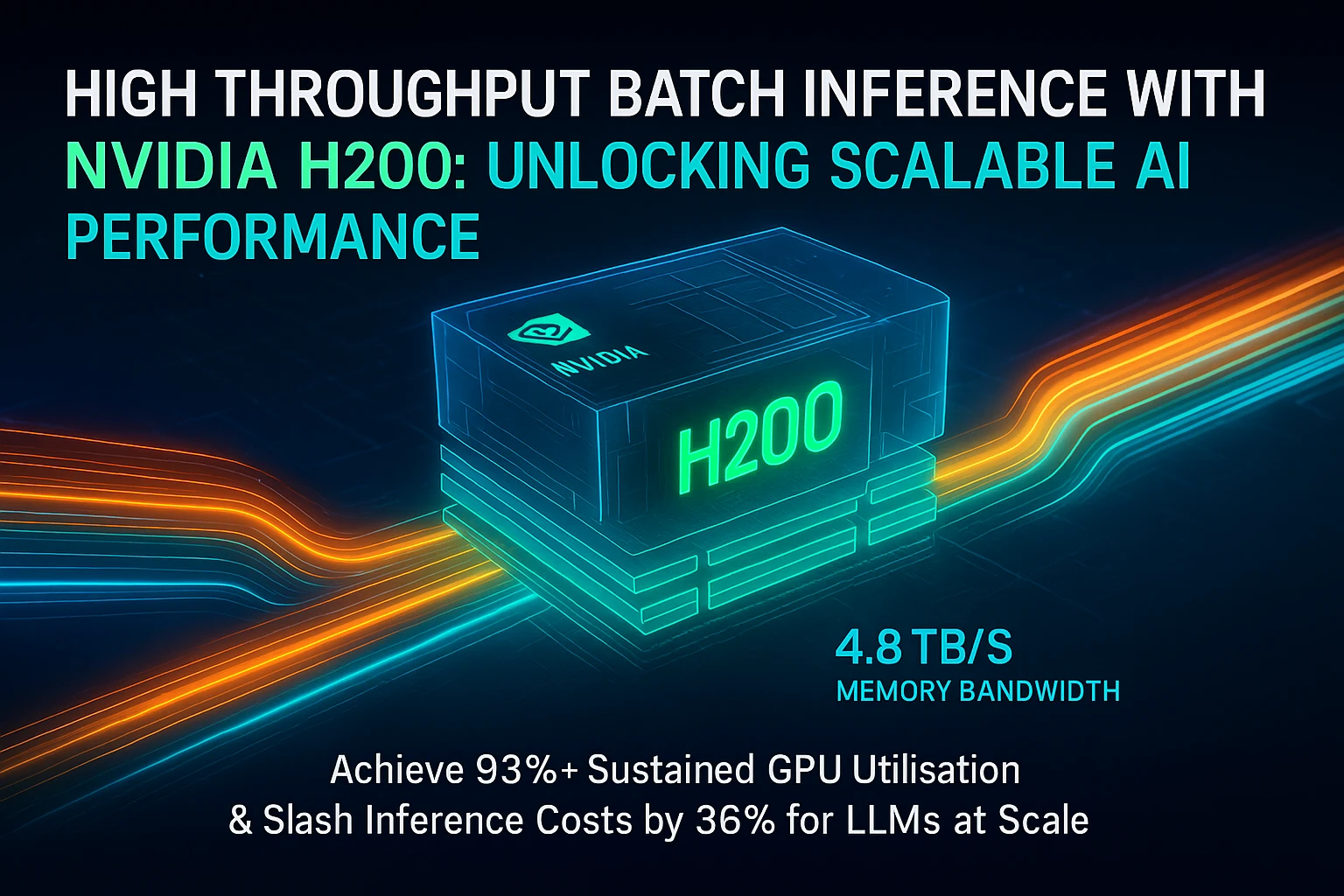
      The NVIDIA H200 GPU is the cornerstone of the DGX H200. Each GPU comes with:


      • 141 GB of HBM3e memory to hold large context windows and support multi-batch inference.
      • 4.8 TB/s of memory bandwidth, ensuring Tensor Cores are never starved for data.
      • Hopper architecture with FP8 Transformer Engine, lowering precision overhead while sustaining accuracy.
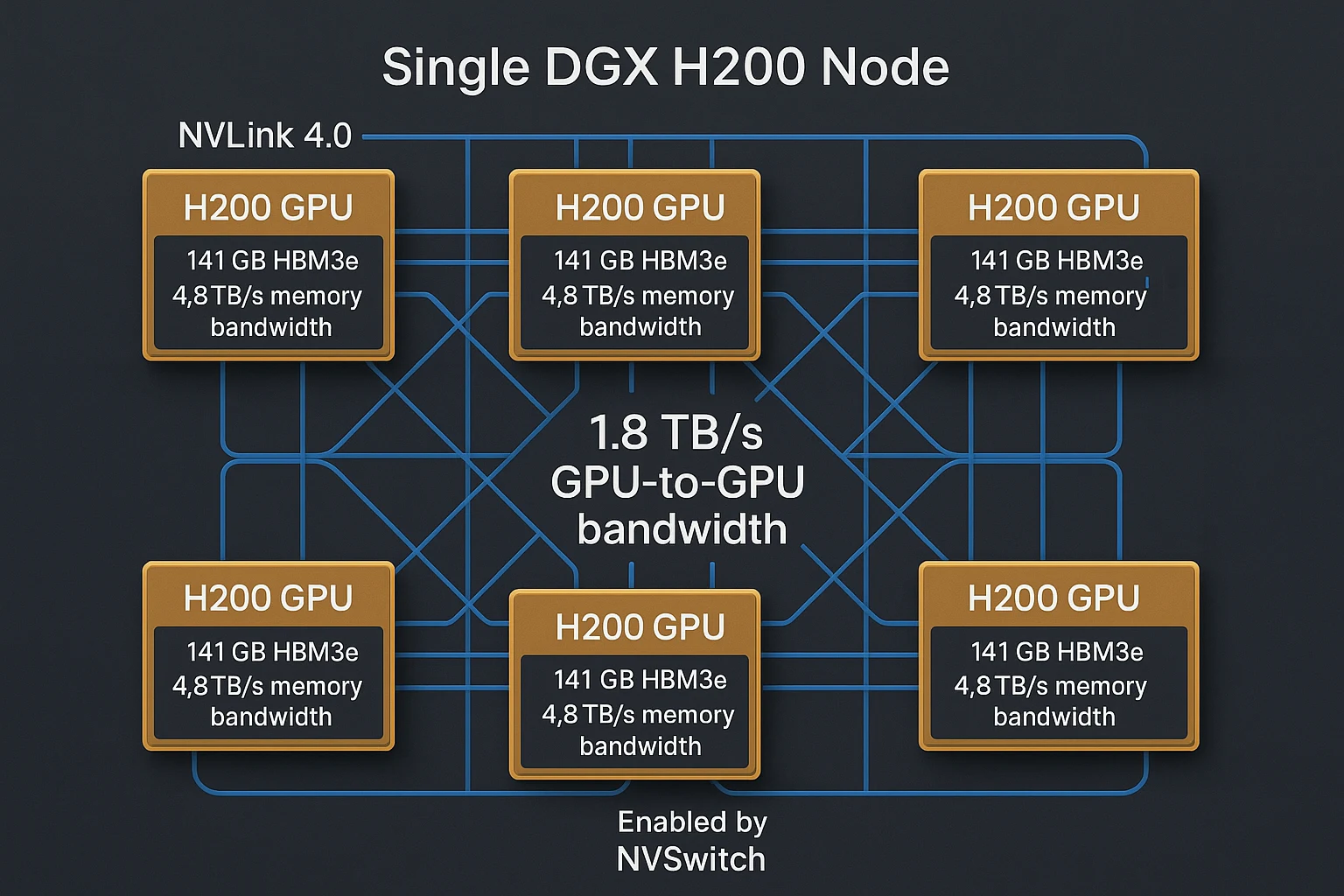
       

      DGX H200 internal node diagram: 8 H200 GPUs, NVLink 4.0, NVSwitch for all-to-all connectivity


      In the DGX H200 system, 8x H200 GPUs are interconnected with NVLink and NVSwitch, creating a single, high-bandwidth pool of compute. This configuration enables both large-model parallelism and multi-tenant inference serving with minimal latency.


      GPUs are only as fast as the links between them. DGX H200 incorporates:


      • NVLink 4.0, delivering up to 1.8 TB/s GPU-to-GPU bandwidth.
      • NVSwitch, enabling all-to-all connectivity across all eight GPUs.


      This interconnect ensures that when enterprises train 70B+ parameter LLMs or run multi-modal AI workloads, they don’t hit bottlenecks inside the node. For HPC or AI inference, this means seamless scaling across GPUs, rather than wasting cycles waiting for data transfers.


      The Orchestrator: CPUs and System Memory


      Though GPUs drive throughput, CPU infrastructure remains essential for orchestration:


      • High-core-count CPUs with PCIe Gen5 lanes handle I/O and control-plane tasks.
      • NUMA-aware memory layouts minimize latency between system RAM and GPU workloads.
      • Optimized schedulers keep memory-hungry jobs pinned close to the right GPU.


      This balance allows the DGX H200 to run diverse workloads — from HPC simulations to multi-tenant inference — without choking at the CPU level.


      Feeding the GPUs: Storage Subsystem


      AI workloads are data-hungry, and storage must keep pace:
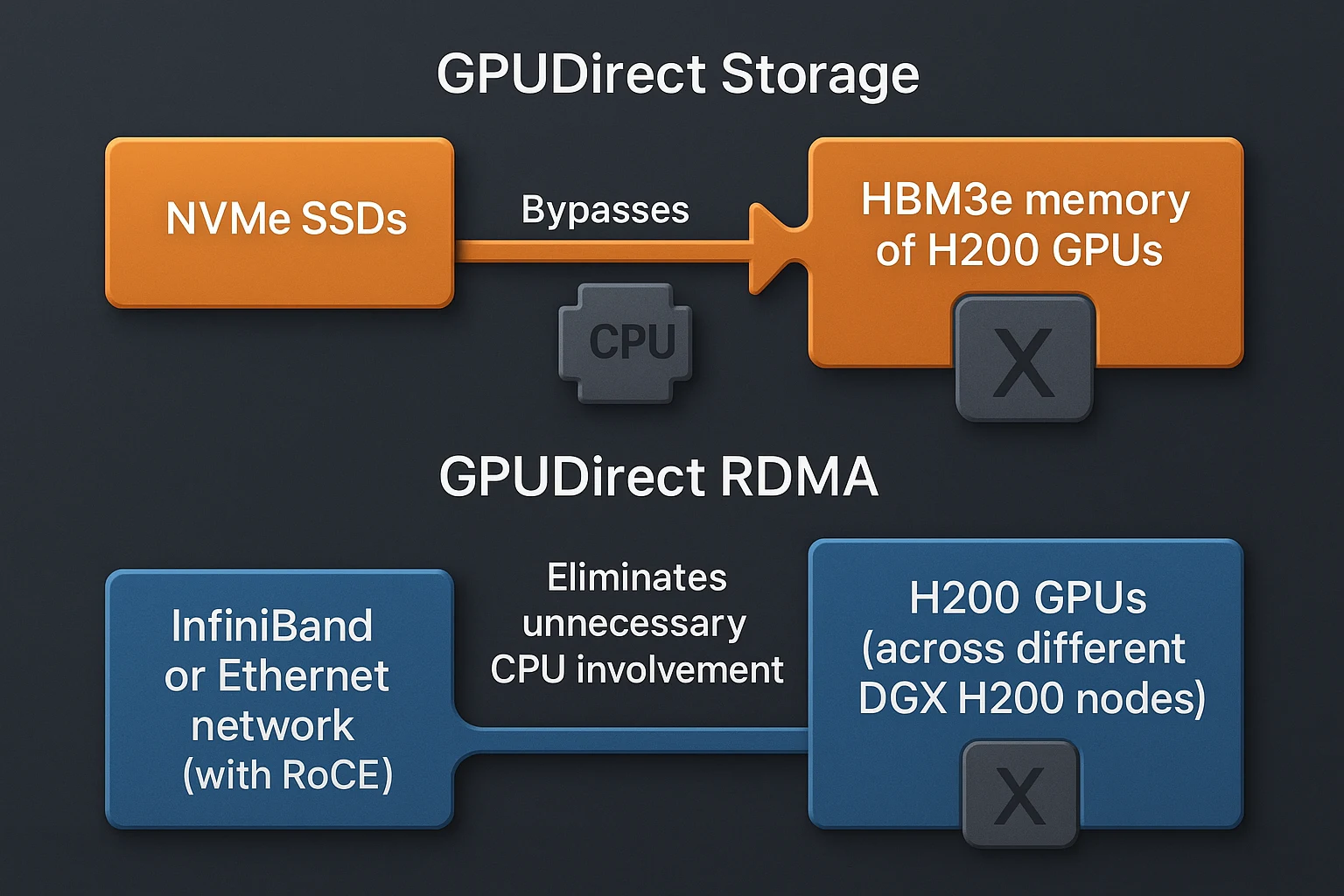
       

      Data flow diagram showing GPUDirect Storage and RDMA, bypassing CPU for optimised AI data transfer.


      • NVMe SSDs with parallel file systems (BeeGFS, WekaIO, Lustre) sustain massive throughput.
      • Burst buffers absorb spikes from checkpoints or logs during training.
      • GPUDirect Storage bypasses CPU overhead and moves data directly into GPU HBM.


      For enterprises running inference pipelines, this ensures embeddings, context windows, and retrieval queries are always fed at GPU speed.


      Scaling Beyond One Box: InfiniBand and Ethernet


      The DGX H200 is designed for data center-scale AI. To extend performance across racks:


      • HDR/NDR InfiniBand and 400 GbE with RoCE enable low-latency GPU-to-GPU transfers.
      • GPUDirect RDMA eliminates unnecessary CPU involvement in multi-node communication.
      • Topologies such as fat-tree or Dragonfly+ ensure predictable performance at scale.


      This networking layer is what enables DGX H200 clusters to power distributed LLM training or multi-tenant inference workloads across hundreds of nodes.


      Sustaining Peak Loads: Cooling & Power Systems


      The performance of eight H200 GPUs can’t be sustained without robust power and cooling:


      • Redundant PSUs keep systems stable during workload spikes.
      • Advanced cooling designs prevent thermal throttling under 24/7 AI workloads.
      • Monitoring tools help IT teams proactively manage energy efficiency and uptime.


      For enterprises, this translates into predictable operating costs — a key part of ROI.
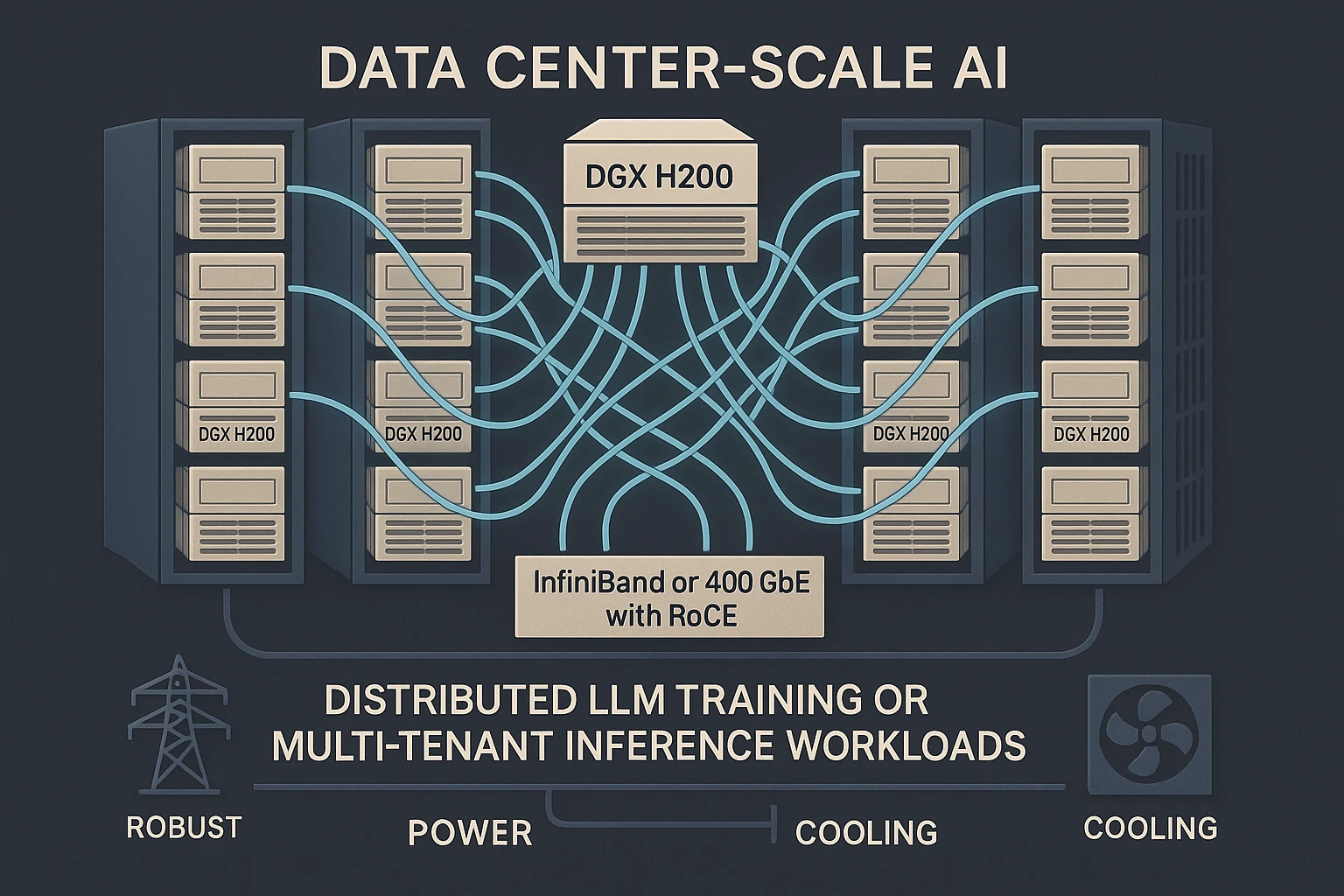
       

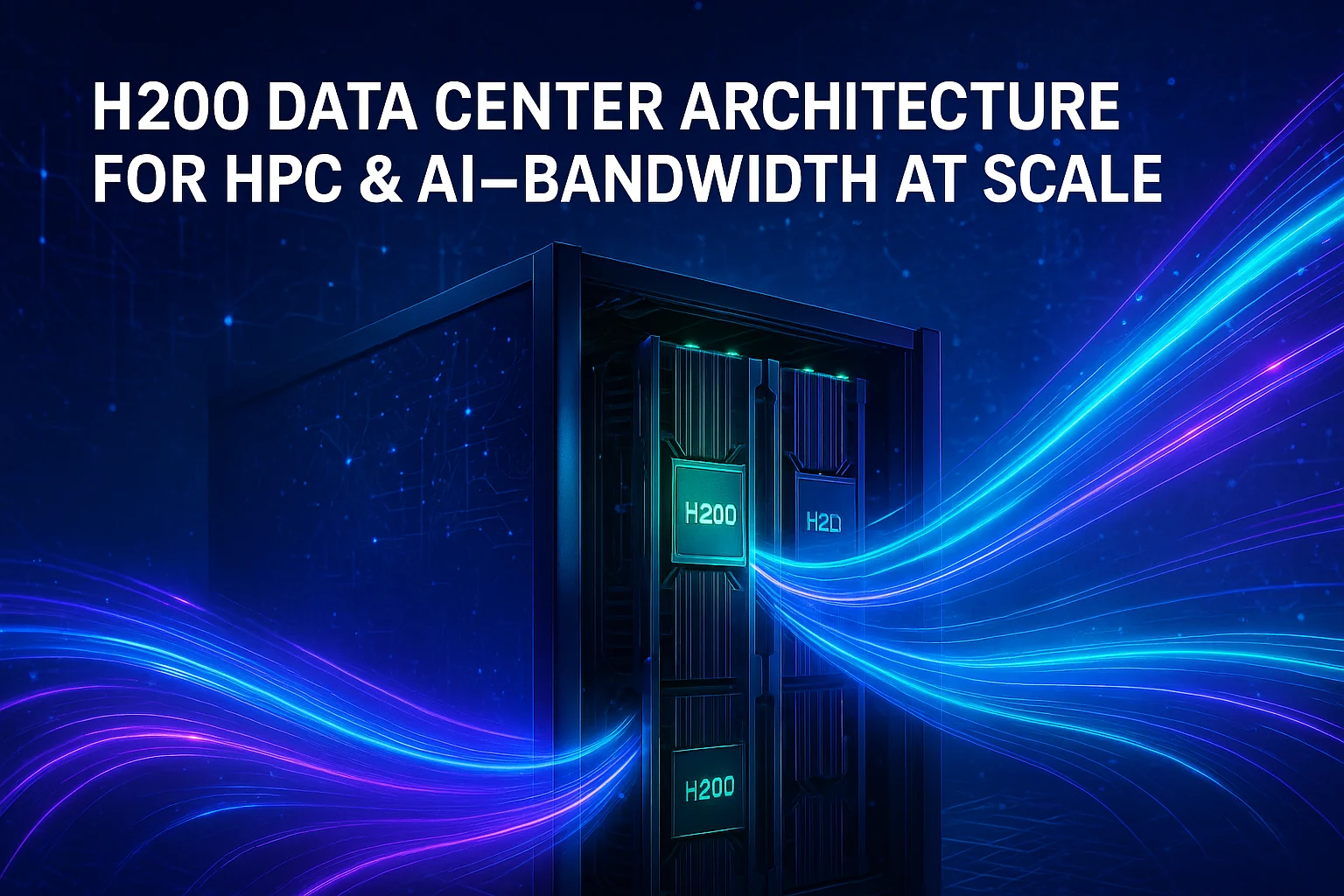
      DGX H200 cluster visual: Multiple nodes interconnected by high-speed networks for data center-scale AI.


      Why Components Matter: From Specs to Outcomes


      Each DGX H200 component directly contributes to measurable outcomes:


      • GPUs + NVSwitch → Faster training convergence for LLMs.
      • HBM3e + 4.8 TB/s bandwidth → Lower inference cost per token.
      • Storage + GPUDirect → Reduced I/O stalls in high-throughput environments.
      • Networking + RDMA → Seamless distributed scaling.
      • Cooling + Power Systems → Reduced downtime and operational costs.


      The takeaway? DGX H200 isn’t just hardware. It’s a carefully engineered balance of components designed for sustained AI throughput.


      Semifly’s Approach: Beyond Components


      At Semifly, we help clients bridge the gap between technical specs and operational success by:


      • Delivering component-validated architectures for AI-first data centers.
      • Running pre-flight stress tests across I/O, networking, and workloads.
      • Offering managed services that handle lifecycle management, tuning, and orchestration.
      • Providing continuous optimization with updated CUDA, NCCL, and MOFED stacks.


      This ensures that every DGX H200 deployment pays for itself in higher utilization, faster training cycles, and lower cost-per-inference.


      Conclusion: Building with the Right Components


      The NVIDIA DGX H200 components are more than just parts in a server — they are the building blocks of next-generation AI infrastructure. With HBM3e memory, NVSwitch networking, parallel storage, and optimized cooling, the DGX H200 defines how enterprises can scale AI in 2025 and beyond.


      And with Semifly as your partner, those components transform into business outcomes — not just speed, but efficiency, resilience, and profitability.

       

      Bookmark me
      Share on
      Comments
      Add your Comment

      Writing About AI

      Semifly

      is an engineer and a technologist with a diverse background spanning software, hardware, aerospace, defense, and cybersecurity. As CTO at Semifly, he leverages his extensive experience to lead the company’s technological innovation and development.

      Explore Nvidia’s GPUs

      Find a perfect GPU for your company etc etc
      Go to Shop

      FAQs

      • The NVIDIA DGX H200 is not merely a server, but a meticulously engineered system of interconnected components — including GPUs, networking, memory, CPUs, storage, and power systems — all designed to convert raw computing power into real-world AI throughput. Understanding these individual components is crucial for enterprises and managed service providers (MSPs) because their specific interactions, scalability, and ability to deliver business outcomes determine the ultimate value of the hardware in an AI data centre. In the highly competitive field of AI, knowing how each part contributes to a “bandwidth-first” and “utilization-maximized” architecture is key to success.

      • The NVIDIA H200 GPUs are the foundational element of the DGX H200. Each GPU is equipped with 141 GB of HBM3e memory, enabling it to handle extensive context windows and support multi-batch inference. Furthermore, a remarkable 4.8 TB/s of memory bandwidth ensures that the Tensor Cores are continuously supplied with data. Utilising the Hopper architecture with an FP8 Transformer Engine, the GPUs achieve high accuracy while minimising precision overhead. Within a DGX H200 system, eight H200 GPUs are linked together by NVLink and NVSwitch, forming a singular, high-bandwidth compute pool that facilitates both large-model parallelism and low-latency multi-tenant inference serving.

      • NVLink and NVSwitch act as the “nervous system” of the DGX H200, ensuring seamless and rapid communication between the GPUs. The system incorporates NVLink 4.0, which provides up to 1.8 TB/s of GPU-to-GPU bandwidth, and NVSwitch, which enables comprehensive all-to-all connectivity across all eight GPUs. This robust interconnect is essential for preventing bottlenecks within the node when enterprises are training large language models (LLMs) with over 70 billion parameters or running complex multi-modal AI workloads. For high-performance computing (HPC) or AI inference tasks, this technology ensures scalable performance across GPUs without delays caused by data transfer waits.

      • While GPUs are the primary drivers of throughput, the CPU infrastructure in the DGX H200 is vital for orchestration and managing the overall system. High-core-count CPUs with PCIe Gen5 lanes efficiently handle I/O and control-plane tasks. The system employs NUMA-aware memory layouts to minimise latency between system RAM and GPU workloads, while optimised schedulers ensure that memory-intensive jobs are allocated close to the appropriate GPU. This balanced design allows the DGX H200 to execute a diverse range of workloads, from HPC simulations to multi-tenant inference, without encountering CPU-level bottlenecks.

      • AI workloads are inherently data-intensive, necessitating a storage subsystem that can keep pace. The DGX H200 utilises NVMe SSDs, often integrated with parallel file systems like BeeGFS, WekaIO, or Lustre, to maintain massive throughput. Burst buffers are included to absorb peak demands from checkpoints or logs during training processes. Crucially, GPUDirect Storage technology is employed to bypass CPU overhead, allowing data to move directly into the GPU’s HBM (High Bandwidth Memory). This ensures that for enterprises running inference pipelines, essential data such as embeddings, context windows, and retrieval queries are consistently fed at the speed required by the GPUs.

      • The DGX H200 is engineered for data centre-scale AI deployments. To extend performance across multiple racks, it leverages HDR/NDR InfiniBand and 400 GbE with RoCE (RDMA over Converged Ethernet), facilitating low-latency GPU-to-GPU transfers. GPUDirect RDMA further enhances efficiency by eliminating unnecessary CPU involvement in multi-node communication. The system supports various network topologies, such as fat-tree or Dragonfly+, to ensure predictable performance at scale. This sophisticated networking layer is what enables DGX H200 clusters to power distributed LLM training or multi-tenant inference workloads across hundreds of nodes.

      • Sustaining the immense performance of eight H200 GPUs requires robust cooling and power infrastructure. The DGX H200 is equipped with redundant Power Supply Units (PSUs) to maintain system stability during intense workload spikes. Advanced cooling designs are implemented to prevent thermal throttling, ensuring continuous peak performance even under 24/7 AI workloads. Additionally, comprehensive monitoring tools assist IT teams in proactively managing energy efficiency and system uptime. For enterprises, these features translate into predictable operating costs and reduced downtime, which are vital for achieving a positive return on investment.

      • Each component of the DGX H200 is designed to deliver measurable business outcomes. The combination of GPUs and NVSwitch leads to faster training convergence for LLMs. The high HBM3e memory and 4.8 TB/s bandwidth result in a lower inference cost per token. The integrated storage and GPUDirect technology significantly reduce I/O stalls in high-throughput environments. Enhanced networking with RDMA ensures seamless distributed scaling, while the robust cooling and power systems minimise downtime and operational costs. Ultimately, the DGX H200’s carefully engineered balance of components is not just about raw hardware specifications, but about achieving sustained AI throughput, greater efficiency, resilience, and profitability for businesses.

      More Similar Insights and Thought leadership

      Zero-Trust Security Implementation: How Managed Services Turn Strategy into Continuous Protection

      Zero-Trust Security Implementation: How Managed Services Turn Strategy into Continuous Protection

      Zero-trust security replaces obsolete perimeter defenses with a model that assumes breach and mandates explicit verification for every access request, regardless of location,. Unlike static…
      14 minute read
      Energy and Utilities
      H100 vs H200 Performance Comparison: Decoding the GPU Upgrade That Will Shape Enterprise AI

      H100 vs H200 Performance Comparison: Decoding the GPU Upgrade That Will Shape Enterprise AI

      The NVIDIA H200 GPU enhances the H100, sharing the same Hopper architecture but targeting performance bottlenecks in large-scale AI. The key upgrade is its memory…
      10 minute read
      Energy and Utilities
      Accelerating Workflows with NVIDIA HPC Compilers: Unlocking Performance on NVIDIA H200 GPUs

      Accelerating Workflows with NVIDIA HPC Compilers: Unlocking Performance on NVIDIA H200 GPUs

      The NVIDIA HPC Compiler stack is essential for bridging the gap between the raw power of hardware like the NVIDIA H200 GPU and real-world application…
      18 minute read
      Energy and Utilities
      NVIDIA H200 Regulatory Approvals: Ensuring Safe and Compliant AI and HPC Deployments 

      NVIDIA H200 Regulatory Approvals: Ensuring Safe and Compliant AI and HPC Deployments 

      The NVIDIA H200 GPU has numerous regulatory approvals, which are essential for safe, legal, and reliable deployment of AI and high-performance computing (HPC) workloads globally.…
      8 minute read
      Energy and Utilities
      GPUs in University Research: Powering the Next Era of Discovery

      GPUs in University Research: Powering the Next Era of Discovery

      Universities are increasingly adopting Graphics Processing Units (GPUs) to accelerate research in fields like medicine, climate science, and artificial intelligence, which depend on processing massive…
      14 minute read
      Energy and Utilities
      NVIDIA DGX H200 Power Consumption: What You Absolutely Must Know

      NVIDIA DGX H200 Power Consumption: What You Absolutely Must Know

      The NVIDIA DGX H200 is a powerful, factory-built AI supercomputer designed for complex AI and research tasks. Its high performance, driven primarily by eight H200…
      14 minute read
      Energy and Utilities
      semifly